Fragrance Notes Are Layers Of Scent That Are Layered To Form The Final Fragrance. Fragrance Notes Are Categorised Into Three Main Elements Based On How Long They Take To Evaporate, And How Long They Typically Last Following Application: Top Notes, Heart Notes And Base Notes.
Kangaroo Paw
Kangaroo Paw offers a green, velvety, and slightly metallic floral aroma, distinctively Australian. It blends waxy, honeyed nuances with a subtle, dry herbaceousness and a fresh, dewy petal quality. It's used to convey an exotic, textural freshness and a sophisticated, unusual floral heart in modern compositions.

Origin & Extraction Of Kangaroo Paw
Kangaroo Paw is an exotic and modern note in perfumery, valued for its unique green, velvety, and slightly metallic floral profile, which adds a distinctively Australian texture to compositions. Unlike foundational citrus or classic floral notes, Kangaroo Paw is not found in historical classics. Its emergence in fine fragrance is tied to contemporary perfumers seeking sophisticated, textural freshness and unusual floral hearts, often used to convey an Australian landscape character.
The increasing utilization of Kangaroo Paw reflects a trend in modern perfumery towards incorporating unique botanical extracts, highlighting sustainability and regionality. It is primarily featured in niche and artisanal brands, such as Goldfield & Banks, where it provides an unexpected, dewy green opening and an airy lift. The note's slightly metallic quality prevents the scent from becoming overly sweet, making it suitable for abstract floral and modern unisex compositions.
Extraction Methods of Kangaroo Paw
Historically, kangaroo paw was processed using traditional indigenous methods, where the whole plant was prepared into natural remedies for topical application to wounds and burns. Early scientific and commercial extraction often relied on simple maceration and solvent extraction using polar solvents like water or lower alcohols such as ethanol and glycerol, often under thermal conditions, to capture the plant's healing and anti-aging properties.
Modern commercial production has advanced to more sophisticated techniques to maximize the retention of active phyto-compounds. A prominent latest method is cellular extraction, which captures the botanical's natural molecules in a water-soluble format while maintaining their synergy. Additionally, innovative micro-jet extraction processes are utilized, involving mixing kangaroo paw powder with a solvent and applying high-pressure micro-jets, followed by high-speed centrifugation, ultrafiltration, and membrane concentration to produce high-purity extracts rich in polyphenols and antioxidants.
Kangaroo Paw is an exotic and modern note in perfumery, valued for its unique green, velvety, and slightly metallic floral profile, which adds a distinctively Australian texture to compositions. Due to its niche and contemporary nature, it is not found in historical classics but is increasingly utilized by modern perfumers seeking to convey sophisticated, textural freshness and unusual floral hearts. This note acts as a subtle bridge between fresh herbaceousness and waxy sweetness.
- A key example showcasing the note is **Goldfield & Banks Desert Rosewood**, an Australian niche brand that often highlights native ingredients. Although the main focus is on rosewood and oud, Kangaroo Paw is used to provide an unexpected, dewy green opening and an airy lift, complementing the dry, woody intensity of the heart.
In other contemporary works, Kangaroo Paw lends itself well to abstract floral and fresh green compositions, offering complexity beyond traditional floral notes like rose or jasmine. Its slightly metallic quality prevents the scent from becoming overly sweet, making it suitable for modern unisex fragrances. It is often paired with notes such as eucalyptus, coastal herbs, or marine accords to enhance its unique Australian landscape character.
- Another notable appearance is in selections by **The Rake** or similar independent houses, where it might be listed alongside other unconventional green notes like Tomato Leaf or Ivy to create a vibrant, hyper-realistic garden scent, appealing to collectors looking for unusual olfactory textures.
The use of Kangaroo Paw signifies a move towards incorporating unique botanical extracts into fine fragrance, highlighting sustainability and regionality. Its inclusion often signals a fragrance designed to be evocative of open spaces and unique flora, providing an earthy, almost architectural structure to the composition while remaining refreshingly bright.
Sustainability Of Kangaroo Paw
Sustainability of Kangaroo Paw
- Utilizing drought-tolerant native species to reduce water consumption in landscaping and gardens, particularly in arid climates
- Promoting biodiversity by providing high-quality nectar sources that attract and support native bird populations, such as honeyeaters and wattlebirds
- Adopting low-maintenance gardening practices through the cultivation of hardy varieties that require minimal fertilization and chemical intervention
- Implementing natural resilience strategies by utilizing the plant’s underground rhizomes, which allow it to survive and resprout after harsh conditions like drought or fire
- Supporting the circular economy by repurposing plant biomass as mulch or compost to recycle nutrients back into the soil after seasonal pruning
Trivia
The red and green kangaroo paw is the floral emblem of Western Australia and its tubular flowers are uniquely evolved to deposit pollen on specific parts of a honeyeater bird's head to ensure precise cross-pollination.
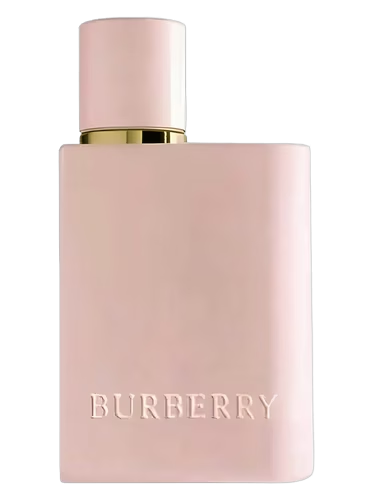
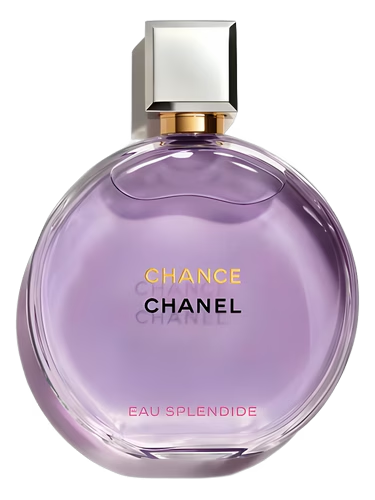
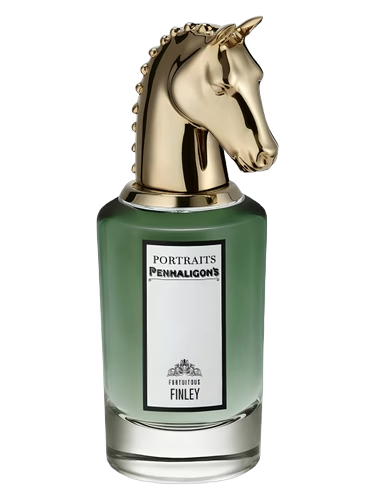
Most Popular Scents Using Kangaroo Paw
What is Kangaroo Paw?
Kangaroo Paw is an exotic floral note derived from the Anigozanthos plant native to Western Australia, named for its unique tubular flowers that resemble a kangaroo's paw.What does Kangaroo Paw smell like?
It offers a green, velvety, and slightly metallic floral aroma with waxy, honeyed nuances and a fresh, dewy petal quality.How is Kangaroo Paw essence extracted?
Modern commercial production utilizes advanced methods such as cellular extraction and micro-jet extraction to capture the plant's natural molecules and active phyto-compounds.What are some top perfumes featuring Kangaroo Paw?
This unique note is featured in fragrances like Goldfield & Banks Desert Rosewood, as well as several compositions by Christopher Hanlon including Black Cockatoo and Royal Banksia.When is Kangaroo Paw in season?
In its native Australia, peak blooming typically occurs from late winter through summer, specifically between August and December.