Fragrance Notes Are Layers Of Scent That Are Layered To Form The Final Fragrance. Fragrance Notes Are Categorised Into Three Main Elements Based On How Long They Take To Evaporate, And How Long They Typically Last Following Application: Top Notes, Heart Notes And Base Notes.
Jobs Tears (Yi Yi Ren)
Job's Tears (Yi Yi Ren) in perfumery presents a subtle, nutty, and slightly starchy/earthy profile, reminiscent of grains. It features a bland sweetness and a delicate, creamy texture, often with a hint of cool, rooty freshness. It is used to add a quiet, grounding, and natural grain texture to compositions.

Origin & Extraction Of Jobs Tears (Yi Yi Ren)
Job's Tears (Coix lacryma-jobi), also known as Yi Yi Ren, is an ancient grain cultivated throughout Asia, prized for millennia in traditional Chinese medicine and as a food source. Historically, its primary use was not in fine perfumery, but its presence as a subtle, natural, and slightly sweet-starchy element in Asian traditions provided a background for its later interpretation in fragrance. The grain itself is known for its hard, bead-like seeds, which are sometimes used for making jewelry or rosaries, further establishing its cultural significance.
The use of Job's Tears as a specific, isolated note in Western perfumery is relatively modern. It is typically employed in contemporary niche and naturalistic compositions to impart a quiet, grounding, and textured effect, often associated with cereal, rice, or soft grain accords. Perfumers utilize its creamy, subtle sweetness and cool, earthy undertone to suggest themes of purity, naturalness, or a delicate powdery finish, providing complexity without the volatility of traditional floral or citrus notes.
Extraction Methods of Job's Tears
Historically, Job's Tears (Yi Yi Ren) has been processed through traditional decoction and simple water extraction methods, primarily for medicinal teas and soups. In these practices, the dried seeds are soaked—often overnight—and then boiled in water to capture their therapeutic compounds. For artisanal and beverage production, traditional methods also involve a sequence of immersion, mechanical defibrination (grinding into slurry), and filtration through coarse cloth to create liquid extracts.
Modern commercial and scientific extraction utilizes more advanced techniques to isolate specific bioactive constituents. The latest methods include standardized solvent extraction using alcohol or methanol to produce high-potency liquid tinctures, and water extraction at high yields to create concentrated granule powders. Specialized pharmaceutical processes have also led to the development of injectable lipid extracts, such as Kanglaite, which involves sophisticated isolation of the seed's neutral oils for clinical use. Current quality control often incorporates high-performance thin-layer chromatography (HPTLC) and infrared spectroscopy to ensure the purity and identity of the resulting extracts.
In the context of perfumery, Job's Tears is considered a fantasy note. Because the grain does not yield a commercially viable essential oil through standard mechanical or steam processes, perfumers reconstruct its subtle, nutty, and earthy aroma using a blend of other synthetic or natural aromatic compounds.
The Job's Tears (Yi Yi Ren) note is predominantly utilized in contemporary niche and naturalistic perfumery to introduce a subtle, textured, and grounding cereal-like quality. It is a sophisticated, non-volatile ingredient favored by houses seeking unique, quiet accords, often associated with rice or soft grain notes. This subtle creaminess and hint of earthy freshness contrast beautifully with traditional bright openings, such as those found in many Lattafa Perfumes, where it adds a layer of depth and longevity.
- * * *
In high-end perfumery, prominent houses like Guerlain, Tom Ford, and Giorgio Armani leverage Job's Tears (Yi Yi Ren) to refine delicate compositions. It is frequently employed to bolster powdery or musky dry-downs, providing a clean, starchy sweetness that is less overtly gourmand than vanilla, but still imparts a comforting, creamy texture. This usage helps bridge complex floral or amber hearts with more natural, skin-like base notes.
- * * *
Furthermore, niche and luxury brands such as Xerjoff, Amouage, and Yves Saint Laurent may feature Job's Tears (Yi Yi Ren) in fragrances inspired by Asian cultures or natural themes. Here, the note’s inherent nutty and earthy characteristics are amplified to evoke a sense of purity and ancient tradition, providing an unusual, sophisticated twist that distinguishes these modern creations from mass-market offerings.
Sustainability Of Jobs Tears (Yi Yi Ren)
Sustainability of Job's Tears
- Promoting zero-waste initiatives by repurposing the entire plant, including using seeds for jewelry and crafts, and utilizing leaves and stems as nutritious livestock fodder
- Supporting food security and agricultural resilience by cultivating Job's Tears as a versatile, low-maintenance alternative to traditional staple grains like rice
- Enhancing soil health and biodiversity through its ability to thrive in marginal, uncultivated lands and wet areas, often serving as a natural stabilizer for waterways
- Adoption of sustainable cultivation practices such as organic mulching and reliance on natural rainfall, which reduces the need for synthetic fertilizers and intensive irrigation
- Preservation of traditional knowledge and local economies by supporting smallholder farmers in Asian and tropical regions who cultivate this ancient, multi-purpose crop
Trivia
Job's Tears are unique because their hard, pearly seeds feature a natural, built-in hole through the center, allowing them to be strung into jewelry or rosaries without any drilling.
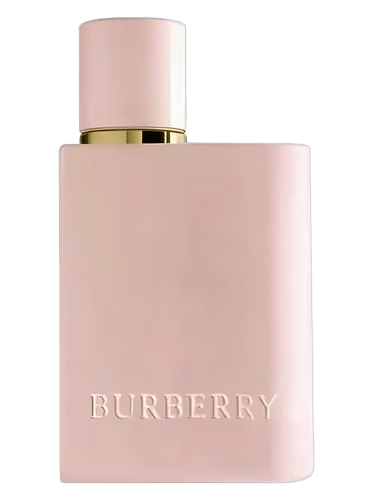
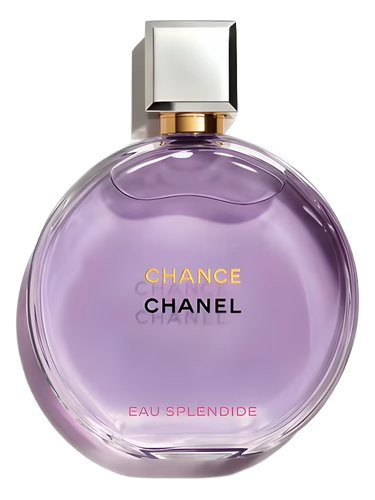
Most Popular Scents Using Jobs Tears (Yi Yi Ren)

What is Job's Tears (Yi Yi Ren)?
Job's Tears is an ancient grain native to Southeast Asia, traditionally used in medicine and cuisine, and used in modern niche perfumery as a "fantasy note" to provide a cereal-like texture.What does Job's Tears smell like?
It offers a subtle, nutty, and slightly starchy aroma with a creamy texture and cool, earthy undertones reminiscent of soft grains or rice.How is the Job's Tears note used in perfumery?
As a non-volatile note, it is used to add grounding depth to compositions and to bolster powdery or musky dry-downs with a clean, natural sweetness.Is Job's Tears a natural fragrance extract?
In perfumery, it is considered a fantasy note reconstructed by perfumers using synthetic or other natural compounds, as the grain does not produce a commercially viable essential oil.What are the cultural associations of Job's Tears?
The grain is highly valued in Traditional Chinese Medicine for its "dampness-clearing" properties and is famously used to make jewelry and rosaries due to the natural holes in its seeds.