Fragrance Notes Are Layers Of Scent That Are Layered To Form The Final Fragrance. Fragrance Notes Are Categorised Into Three Main Elements Based On How Long They Take To Evaporate, And How Long They Typically Last Following Application: Top Notes, Heart Notes And Base Notes.
Japanese Loquat
Japanese Loquat offers a delicate, slightly tart, and luminous fruity scent, blending notes of ripe apricot, subtle peach, and a crisp, clean floral freshness. It possesses a dewy, watery texture with hints of greenness and a touch of honeyed sweetness, providing an uplifting and airy tropical note.

Origin & Extraction Of Japanese Loquat
The Japanese Loquat, or Eriobotrya japonica, has ancient origins in south-central China, where it was cultivated for over a millennium before being introduced and naturalized in Japan. The fruit's presence in the West was documented by botanists in the late 17th and early 18th centuries, subsequently leading to its cultivation across the Mediterranean and other subtropical climates. Despite its long history as a decorative tree and a prized fruit, the Loquat note did not enter the repertoire of classical European perfumery, remaining a largely regional aroma.
The note's use in fine fragrance is relatively modern, valued for its complex olfactory profile that marries a sweet, juicy fruit aroma—often described as a blend of plum, apricot, and hints of tropical fruit with citrus and floral undertones—with the delicate scent of its unusual winter-blooming flowers. The Japanese Loquat note is utilized by contemporary perfumers to inject a creamy, sweet, or subtly green-tropical nuance, adding an exotic and sophisticated touch to modern compositions.
Extraction Methods of Japanese Loquat
Historically, extraction methods for Japanese loquat focused on traditional folk medicine and artisanal techniques. For the leaves, this typically involved simple water decoctions or "biwa-cha" infusions, where leaves were cleaned of their fuzzy hairs and boiled to extract tannins and medicinal compounds. Another traditional method, still used today, involves long-term maceration where leaves or fruits are soaked in high-proof spirits (such as white liquor) for up to ten months to create medicinal tinctures and extracts for topical compresses or moxibustion.
Modern extraction utilizes more efficient and standardized technologies to isolate bioactive compounds like triterpenoids, flavonoids, and phenolic acids. The primary industrial method is solvent extraction, frequently using water or ethanol-water mixtures (often a 70% ethanol ratio) to maximize the yield of active constituents such as ursolic and oleanolic acids. Advanced contemporary approaches have introduced modern purification and separation technologies to isolate specific volatile oils—including nerolidol and farnesol—and to reduce naturally occurring cyanogenic glycosides like amygdalin to safe levels for cosmetic and health applications. These modern processes often incorporate sun-drying, pulverization, and vacuum treatments to produce concentrated powders or liquids with verified purity and potency.
The Japanese Loquat note is prized in contemporary perfumery for introducing a delicate, airy, and slightly exotic fruit accord. It is frequently employed to offer a refined, watery freshness that avoids the heaviness of typical fruit notes. An example of its use in a playful, youthful scent is **Hello Kitty** by Sephora (2011), where it contributes a light, sweet fruitiness to a whimsical composition.
- * * *
In modern designer and niche fragrances, Japanese Loquat serves to enhance luminous floral and aquatic compositions. In the main collection, the note appears in fragrances like **Sunflowers Sunlight Kiss** by Elizabeth Arden (2017), lending a bright, fresh vitality to a sunny, floral bouquet. Similarly, **Emelia** by Tocca (2016) utilizes the loquat's subtle apricot-peach nuances to provide a sophisticated, dewy sweetness that complements its romantic, feminine profile.
- * * *
As perfumers continue to explore unique and less common fruit notes, Japanese Loquat is featured in more exclusive and emerging brands. For instance, **Nobiyaka** by Parfum Satori explicitly features loquat and loquat flowers, highlighting the note's complex, green-floral freshness. More recently, scents like **Deity** by Ataraxia Perfumery (2025) and **Cat Sith** by Scent Hunters (2024) continue the trend of integrating this delicate note into modern compositions to achieve a distinct, uplifting transparency.
Sustainability Of Japanese Loquat
Sustainability of Japanese Loquat
- Promoting a circular economy by repurposing processing waste, such as using loquat seeds as a solid biofuel for thermal energy generation to reduce CO2 emissions
- Enhancing local biodiversity by providing an essential nectar source for bees, butterflies, and other pollinators during seasons when other food sources are scarce
- Implementation of climate-resilient agricultural practices, including the cultivation of drought-tolerant trees that provide erosion control and soil improvement through deep root systems
- Adoption of eco-friendly pest management techniques, such as manual bagging of fruit clusters and the use of organic insecticidal soaps to reduce reliance on chemical pesticides
- Supporting sustainable landscaping and carbon sequestration by integrating hardy, low-maintenance evergreen trees into urban and rural reforestation efforts
Trivia
Japanese folklore suggests a significant wait for the fruit of the loquat tree, immortalized in the saying "three years for peaches and chestnuts, eight for persimmons, and thirteen for loquats."
Most Popular Scents Using Japanese Loquat
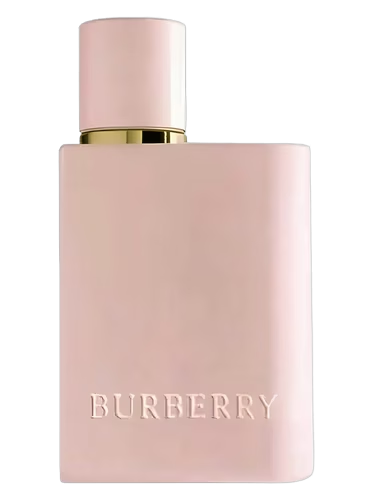
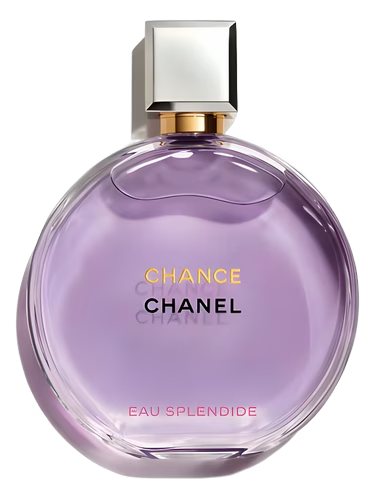
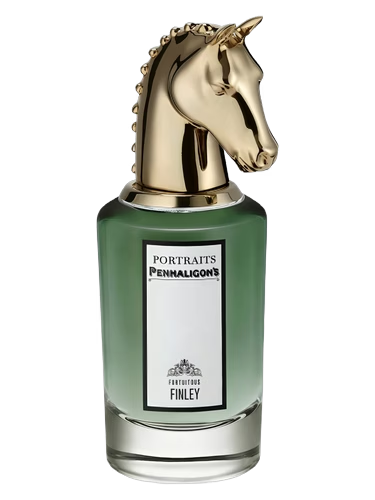
What is Japanese Loquat?
Japanese Loquat, or Eriobotrya japonica, is a fruit tree native to south-central China and Japan, used in modern perfumery for its delicate and exotic fruity profile.What does Japanese Loquat smell like?
It offers a luminous and slightly tart scent that blends notes of ripe apricot and peach with a dewy, watery texture and crisp floral freshness.How is Japanese Loquat essence extracted?
In modern fragrance production, the essence is typically obtained through solvent extraction or distillation to isolate specific volatile oils while ensuring purity.What are some top perfumes featuring Japanese Loquat?
Notable fragrances include Elizabeth Arden Sunflowers Sunlight Kiss, Sephora Hello Kitty, Tocca Emelia, and Parfum Satori Nobiyaka.When is Japanese Loquat in season?
The tree typically blooms in fall and early winter, with the fruit ripening and being harvested during the spring and early summer months.