Fragrance Notes Are Layers Of Scent That Are Layered To Form The Final Fragrance. Fragrance Notes Are Categorised Into Three Main Elements Based On How Long They Take To Evaporate, And How Long They Typically Last Following Application: Top Notes, Heart Notes And Base Notes.
Jackfruit
Jackfruit offers an intensely sweet, sticky-tropical profile, blending notes of juicy pineapple, banana, and bubblegum with subtle lactonic (milky) and earthy undertones. Its aroma is complex, highly diffusive, and often presents a ripe, fermented sweetness, lending a lush, exotic gourmand richness and a vibrant lift to fruity compositions.

Origin & Extraction Of Jackfruit
Jackfruit (Artocarpus heterophyllus) is the national fruit of Bangladesh and Sri Lanka and is native to South Asia and Southeast Asia. Historically, its use was primarily culinary, prized for its massive size and complex, intensely sweet flavor which is often likened to a combination of pineapple, banana, and mango. The fruit's unique and potent aroma is derived from volatile compounds, including esters like ethyl isovalerate, which provide its characteristic sweet, diffusive, and sometimes lactonic scent. Its historical relevance in perfumery is limited, as traditional fragrance was dominated by classical notes like woods, resins, and European flowers and citruses.
The Jackfruit note has emerged in modern perfumery, primarily since the late 20th and early 21st centuries, driven by the rise of the gourmand and exotic fruity categories. As perfumers sought novel, diffusive, and mouth-watering tropical aromas, Jackfruit offered a distinct profile that provided lush sweetness and a vibrant, tropical lift. The note is often recreated synthetically as a sophisticated accord to ensure stability and to highlight its juicy, bubblegum-like facets while controlling its naturally dense, sometimes overripe, or earthy undertones, making it a desirable ingredient in contemporary niche and designer compositions.
Extraction Methods of Jackfruit
Historically, jackfruit oil and aromatic compounds were obtained through traditional manual methods such as milling and simple maceration. The traditional milling process involves drying the seeds and grinding them between rotating stones to release the oil, which is then filtered. For the peel, historical techniques focused on mechanical crushing, squeezing, and simple filtration to separate the liquid essence.
Modern extraction utilizes more sophisticated chemical and mechanical processes to improve yield and quality. These include Soxhlet extraction using organic solvents like hexane or methanol, microwave-assisted extraction, and subcritical water extraction (SWE) for recovering phenolic compounds. Advanced methods for essential oil extraction from the peel now involve complex steps including the use of beta-cyclodextrin and sodium sulfate as extraction agents, followed by centrifugation and concentration under reduced pressure to achieve higher purity and stability.
The Jackfruit note, with its intensely sweet, sticky-tropical profile—blending pineapple, banana, and bubblegum facets—is a feature primarily of modern, exotic, and gourmand compositions, distinguishing itself from classical perfumery. One of the earlier appearances of this tropical sweetness can be found in Vanille Abricot by Comptoir Sud Pacifique (1993), where the fruity richness contributes to a luscious, vanilla-drenched gourmand warmth, highlighting the note’s potential to blend tropicality with dessert-like indulgence.
- * * *
In contemporary perfumery, Jackfruit is increasingly used to lend a vibrant, high-impact tropical lift, often in niche or conceptual fragrances. Zoologist Perfumes' Dodo Jackfruit Edition (2023) showcases the note, utilizing its complex sweetness and diffusive qualities to create an immersive, exotic jungle ambiance. This approach emphasizes the unique, almost fermented sweetness and potent diffusion of the fruit, moving the note beyond a simple fruit accord into a central theme of an olfactory narrative.
- * * *
Other modern interpretations utilize Jackfruit to inject energetic freshness and exotic complexity into specific genre blends. For instance, Calvin Klein's CK Free (2009) incorporates the note to provide a unique, juicy opening in a contemporary masculine fresh fragrance, proving the versatility of Jackfruit beyond purely sweet compositions. Similarly, offerings like New Orleans Jazz & Booze by City Rhythm (2022) demonstrate how this tropical note can add a playful, vibrant edge to more complex, atmospheric, and boozy creations.
Sustainability Of Jackfruit
Sustainability of Jackfruit
- Promoting a circular economy by upcycling processing waste, which accounts for 70% of the fruit's weight, into bio-oil, animal feed, and value-added biochemicals like pectin and citric acid
- Adopting regenerative agriculture practices with perennial trees that are naturally drought-resistant, sequester significant carbon dioxide, and have extensive root systems that prevent soil erosion
- Reducing environmental impact through the development of plant-based leather alternatives from jackfruit stems and husks, providing a sustainable substitute for traditional leather
- Establishing structured supply chains to minimize food waste, ensuring that fruit previously left to rot becomes a valuable source of income for small-scale farmers
- Supporting smallholder economic resilience by educating farmers on the monetary value of jackfruit, helping them integrate it as a reliable cash crop
Trivia
The jackfruit is the world's largest tree-borne fruit, capable of reaching a massive weight of up to 120 pounds, and its complex scent is often compared to a blend of pineapple, banana, and mango, or even the specific aroma of Juicy Fruit gum.
Most Popular Scents Using Jackfruit
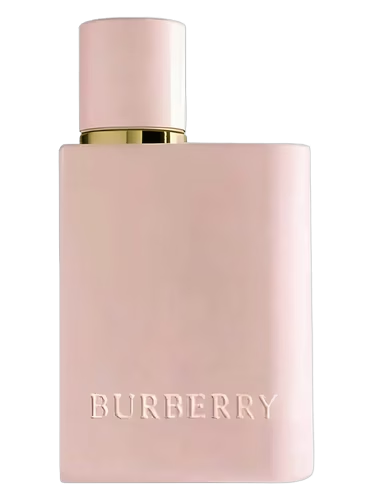
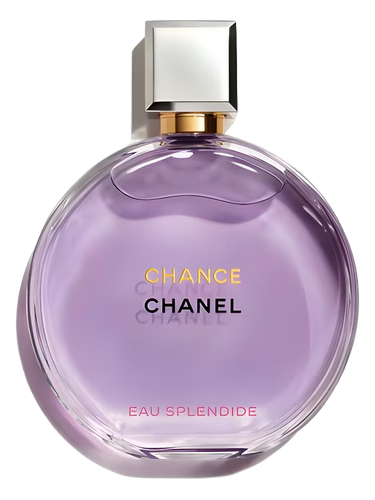
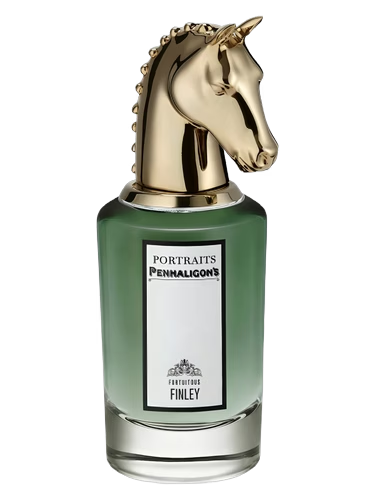
What is Jackfruit?
Jackfruit is the world's largest tree-borne fruit, native to South and Southeast Asia, known in perfumery for its intensely sweet and sticky-tropical aromatic profile.What does Jackfruit smell like?
It features a complex, diffusive aroma blending notes of juicy pineapple, banana, and bubblegum with subtle milky and earthy undertones.How is Jackfruit essence extracted?
Modern extraction uses chemical and mechanical processes like solvent extraction or subcritical water extraction, though the note is often recreated as a synthetic accord for stability.What are some top perfumes featuring Jackfruit?
Notable fragrances include Zoologist Dodo Jackfruit Edition, Calvin Klein CK Free, and Comptoir Sud Pacifique Vanille Abricot.When is Jackfruit in season?
While available year-round in many tropical regions, its primary fruiting season typically peaks from June to October.