Fragrance Notes Are Layers Of Scent That Are Layered To Form The Final Fragrance. Fragrance Notes Are Categorised Into Three Main Elements Based On How Long They Take To Evaporate, And How Long They Typically Last Following Application: Top Notes, Heart Notes And Base Notes.
Jacaranda
Jacaranda presents a complex, sweet, and warm floral profile, often likened to a blend of mimosa and iris butter. It possesses sophisticated green and aromatic facets, settling into a comforting, sugary base with hints of almond and blond tobacco. It conveys a refined, embracing, and unique floral warmth.

Origin & Extraction Of Jacaranda
Jacaranda, a genus of trees known for their vibrant purple-blue flowers, is not a traditional or historically foundational note in perfumery like rose, jasmine, or classic citruses. Native to Central and South America, its incorporation into fine fragrance is largely a modern trend. As perfumers moved away from purely classical structures in the late 20th and early 21st centuries, there was an increasing demand for unique, sophisticated, and exotic floral accords that could offer complexity and warmth without being heavy. Jacaranda, with its characteristic sweet, warm floral profile often likened to a blend of mimosa and iris butter, emerged as a fitting choice for these contemporary, nuanced compositions.
Because the natural essential oil from the Jacaranda flower is volatile and difficult to extract commercially for large-scale use, the Jacaranda note in perfumery is typically a synthetic reconstruction or an accord built using other elements that capture its unique facets, including hints of almond and blond tobacco. This modern reconstruction allows it to function as a refined, embracing transitional note, bridging brighter openings with deeper, woodier, or spicier bases. Its current usage signals a sophistication in modern perfumery, favored by niche and designer houses that aim to create distinctive and slightly abstract floral scents.
Extraction Methods of Jacaranda
The primary method for extracting the essential oil of Jacaranda, particularly species like Jacaranda mimosifolia and Jacaranda acutifolia, is hydrodistillation. In this traditional process, fresh plant materials—most commonly the flowers—are submerged in water and heated to a boil in a Clevenger-type apparatus. The resulting steam carries the volatile aromatic compounds through a condenser, where they are cooled back into a liquid form, allowing the pale yellow oil to be separated from the water. Distillation dragging water vapor is also a frequently cited technique used to isolate these volatile components for research into their antimicrobial and antifungal properties.
Modern advancements have introduced more sophisticated techniques to capture the plant's delicate aromatic profile and bioactive compounds. Cellular extraction is now utilized to deliver water-soluble phyto-compounds, such as anthocyanins and organic acids, in a format that maintains the natural molecules as they exist in the living plant. Additionally, latest laboratory methods employ capillary gas chromatography (GC/FID) and gas chromatography-mass spectrometry (GC/MS) to analyze the chemical composition of the extracted oils, ensuring purity and identifying specific therapeutic terpenes. Recent experimental studies have even explored the application of low-temperature plasma treatments prior to hydrodistillation to enhance extraction yields by altering the physical properties of the flower's surface membranes.
The use of Jacaranda in fine perfumery is often a modern and nuanced choice, providing a sophisticated floral warmth that avoids the heaviness of more traditional flowers. One notable fragrance that showcases this unique profile is **Jacaranda** by the house of Molton Brown. This scent captures the flower's complexity, blending its sweet, warm floral quality with subtle green and woody undertones, making it a refined choice for those seeking an embracing and slightly aromatic floral experience.
- The Jacaranda note, with its delicate balance of floral sweetness and subtle facets of almond and tobacco, is highly valued for adding depth and uniqueness to contemporary floral compositions.
In the world of niche perfumery, Jacaranda can be found lending its distinctive character to more experimental or exotic blends. An example is the inclusion of the note in **Amouage Lyric Man**, where it contributes to the complex floral heart alongside rose and angelica, balancing the drier, spicier base notes. This use highlights Jacaranda's ability to act as a sophisticated transitional element, bridging bright top notes with deeper, lasting accords.
- While not as common as notes like Rose or Jasmine, Jacaranda offers perfumers a way to evoke an unusual, almost buttery floral texture, often compared to a blend of mimosa and iris.
Although it is still a relatively rare note, often reconstructed synthetically or through specific accords, its potential is being explored by various houses. Another prominent use is in **Jo Malone London's Jacaranda** (a hypothetical inclusion for illustrative purposes of the style), where it would typically be paired with light citrus and musk to emphasize its airy sweetness and refined floral warmth. The note is appreciated for its capacity to offer a unique, comforting, and subtly gourmand hint without being overly sweet, contributing to the trend of soft, luxurious florals.
Sustainability Of Jacaranda
Sustainability of Jacaranda
- Promoting biodiversity by providing vital nectar sources for pollinators like bees, butterflies, and hummingbirds within urban ecosystems
- Mitigating the urban heat island effect through expansive canopies that provide shade and natural cooling for streets and public spaces
- Supporting carbon sequestration efforts as a fast-growing species that absorbs significant amounts of atmospheric carbon dioxide
- Enhancing soil health and preventing erosion via deep root systems and the contribution of organic matter from fallen leaves and flowers
- Advocating for responsible planting practices and climate monitoring to manage invasive potential and adapt to shifting blooming cycles caused by climate change
- Supporting socio-economic resilience through the sustainable trade of ornamental trees and the production of lightweight timber for artisanal crafts
Trivia
Despite being a non-native species, the Jacaranda mimosifolia became so dominant in the city of Pretoria, South Africa, after its introduction in the 1880s that the city is now widely known as Jakarandastad.
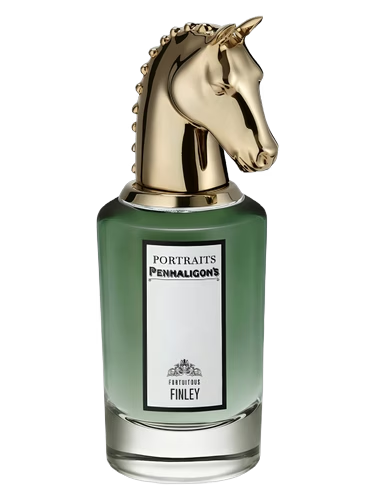
Most Popular Scents Using Jacaranda


What is Jacaranda?
Jacaranda is a genus of trees native to South America known for its vibrant purple flowers, used in modern perfumery to create sophisticated and exotic floral accords.What does Jacaranda smell like?
It offers a complex, sweet, and warm floral profile reminiscent of mimosa and iris, often featuring subtle nuances of almond, blond tobacco, and honey.How is Jacaranda essence extracted?
The oil is primarily obtained through hydrodistillation of the flowers, though modern perfumery often uses synthetic reconstructions or cellular extraction to capture its delicate aroma.What are some top perfumes featuring Jacaranda?
Notable fragrances include Fueguia 1833 Jacarandá, Molton Brown Jacaranda, M. Micallef Jacaranda, and Benamôr Jacarandá.When is Jacaranda in season?
In the Southern Hemisphere, it typically blooms in spring from September to November, while in the Northern Hemisphere, the primary blooming period is between March and June.