Fragrance Notes Are Layers Of Scent That Are Layered To Form The Final Fragrance. Fragrance Notes Are Categorised Into Three Main Elements Based On How Long They Take To Evaporate, And How Long They Typically Last Following Application: Top Notes, Heart Notes And Base Notes.
Jabuticaba
Jabuticaba offers a complex, multi-faceted aroma: a blend of fresh, flowery sweetness (honey, linalool, 2-phenylethanol) with pronounced woody-green notes (beta-pinene). It has a unique, slightly medicinal or tannic undertone (delta-cadinene), creating a sophisticated, subtly fruity and aromatic profile.

Origin & Extraction Of Jabuticaba
Jabuticaba, the fruit of the *Myrciaria cauliflora* tree native to Brazil, has a long cultural and culinary history in South America, where it is valued for its unique taste and appearance (the fruit grows directly on the trunk). Historically, it was not a traditional or classical ingredient in Western perfumery, which relied primarily on established European and Asian sources. Its emergence as a specific, named note reflects a modern trend in fine fragrance towards exploring exotic and regionally unique materials, particularly those offering complex, multi-faceted olfactive profiles.
In contemporary perfumery, the Jabuticaba note is valued precisely for its complexity, which blends fruity sweetness (reminiscent of grapes and berries) with green, woody, and slightly tannic undertones. This profile allows it to bridge the gap between sparkling top notes and deeper, more aromatic heart notes. Its application is predominantly seen in modern niche and high-end designer fragrances that aim to evoke tropical or Amazonian freshness, offering a sophisticated and unique twist on traditional fruit accords.
The extraction of aromatic and bioactive compounds from jabuticaba, particularly from its thick, tannin-rich peel, has traditionally relied on simple manual and thermal processes. Historically, the fruit was processed through domestic maceration, crushing by hand or with basic tools to release juices and pigments for jams, jellies, and liqueurs. Steam extraction remains a traditional small-scale method for producing juice, where heat and water vapor are used to rupture the fruit's cells and isolate its phenolic-rich liquid. In medicinal and culinary contexts, the peels have long been sun-dried or boiled in water to create concentrated infusions.
Modern commercial and scientific extraction has evolved significantly, focusing on sustainable "green" technologies to maximize the recovery of sensitive compounds like anthocyanins. Advanced techniques include ultrasound-assisted extraction (UAE), which uses cavitation to disrupt cell membranes without excessive heat, and microwave-assisted extraction (MAE), which utilizes internal heating for rapid release of compounds. Other high-efficiency methods include pressurized liquid extraction (PLE), supercritical fluid extraction (SFE) using carbon dioxide, and high hydrostatic pressure (HHP) processing. Recent innovations also feature enzyme-assisted extraction using cellulases and the development of biosorbents derived from jabuticaba waste to simultaneously extract and purify high-value antioxidants.
The Jabuticaba note, a sophisticated blend of fruity sweetness, green, and woody undertones, is primarily celebrated in modern perfumery for introducing exotic South American complexity. One of the most notable brands to embrace this Brazilian native fruit is Natura. They feature it prominently in fragrances like **Jabuticaba** (2008) and **Amora Vermelha e Jabuticaba** (2020), which showcase the note’s unique sweet-tart profile.
- * * *
While often used by Brazilian houses like Natura and Avon, Jabuticaba has also been adopted in global designer and niche markets to add a distinctive, sparkling fruit accord. A key example is **Fantasia Pop Surprise** by Anna Sui (2023), where the note contributes a vibrant, juicy opening, differentiating the fragrance from more traditional fruity florals. This usage demonstrates the note's versatility in bridging cheerful top notes with deeper, more complex scent structures.
- * * *
In addition to contemporary releases, the Jabuticaba note, or a synthetic accord mimicking its complex profile, is sometimes cited in earlier compositions known for their rich, exotic fruit layers. While not explicitly listed in original formulas, its complex profile (reminiscent of grapes and berries) aligns with the lush, tropical feel of fragrances like Estée Lauder's **Beyond Paradise** (2015), where a medley of unique fruit notes creates an intoxicating, hyper-real floral-fruity landscape.
Sustainability Of Jabuticaba
Sustainability of Jabuticaba
- Promoting a circular economy by repurposing agro-industrial waste, such as using nutrient-rich peels and seeds for nutraceuticals, natural food colorants, and dermocosmetic products
- Utilizing sustainable extraction technologies like ultrasound-assisted extraction and pressurized hot water extraction to capture bioactive compounds without harsh chemical solvents
- Recovering bioenergy through small-scale anaerobic digestion of fruit by-products to produce biomethane, electricity, and organic fertilizers
- Supporting environmental restoration and climate mitigation through high carbon sequestration rates in the woody biomass of mature trees
- Enhancing local biodiversity in agroforestry systems by providing habitats and food sources for bees, birds, and other native pollinators
- Advancing socio-economic resilience for rural communities by diversifying farmer income through value-added products and sustainable harvesting practices
Trivia
The jabuticaba tree is unique because both its flowers and fruits sprout directly from the main trunk and stems rather than on the branches, a botanical phenomenon known as cauliflory.
Most Popular Scents Using Jabuticaba
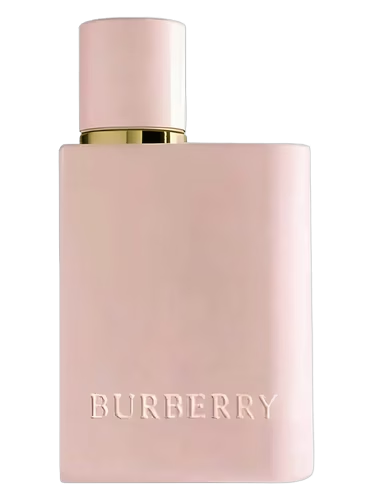
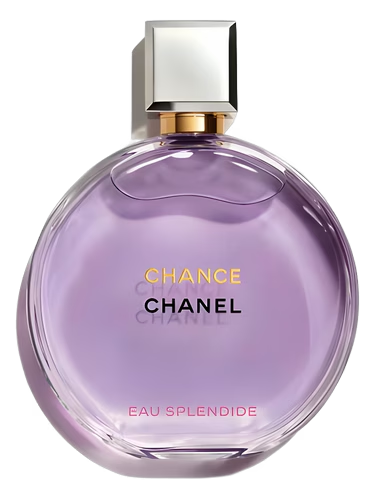
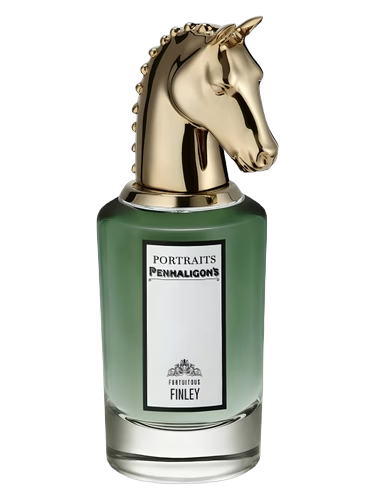
What is Jabuticaba?
Jabuticaba is the fruit of the Myrciaria cauliflora tree native to Brazil, notable for its unique botanical trait of cauliflory, where the fruit grows directly on the main trunk and stems.What does Jabuticaba smell like?
It offers a complex, multi-faceted aroma that blends fresh, flowery sweetness and honey-like facets with pronounced woody-green notes and a unique, slightly medicinal or tannic undertone.How is Jabuticaba essence extracted?
While traditionally processed through maceration or steam extraction, modern commercial methods utilize distillation and advanced green technologies like ultrasound-assisted extraction (UAE) to recover its sensitive aromatic compounds.What are some top perfumes featuring Jabuticaba?
Popular fragrances featuring this note include Natura Aguas Jabuticaba, Avon Aquavibe Jabuticaba, L'Occitane Au Bresil Flor de Jabuticaba, and Estee Lauder Beyond Paradise.When is Jabuticaba in season?
The tree primarily blooms in late winter and spring, with the fruit developing remarkably fast and reaching maturity just 20 to 45 days after flowering.