Fragrance Notes Are Layers Of Scent That Are Layered To Form The Final Fragrance. Fragrance Notes Are Categorised Into Three Main Elements Based On How Long They Take To Evaporate, And How Long They Typically Last Following Application: Top Notes, Heart Notes And Base Notes.
Iris
Iris is characterized by a complex, sophisticated aroma. The natural note (from the root) is earthy, woody, and subtly powdery, sometimes suggesting boiled carrot. The fantasy note is a delicate, powdery floral scent, often likened to violet, imparting an elegant, soft, and slightly melancholy quality to fine perfumery.

Origin & Extraction Of Iris
The history of Iris in perfumery stretches back centuries, with the root (Orris) being highly prized for its fixative properties and complex scent profile. The use of Iris oil, derived from the rhizomes, was historically significant, particularly in luxury preparations. Early classic perfumery embraced Iris for its ability to impart a distinctive, cool, and melancholic powderiness, defining the famous "makeup" or "lipstick" scent profile. Iconic fragrances like Guerlain's L'Heure Bleue and Chanel's No. 19 famously utilized this note to add a sense of timeless elegance and depth, positioning Iris as an essential bridge between a fragrance's floral heart and its woody base.
In contemporary perfumery, Iris remains one of the most precious and expensive raw materials, valued for its earthy, woody, and sophisticated facets. Modern perfumers have dramatically expanded its application. For example, the luxurious, high-quality Iris Pallida (Orris) absolute is a cornerstone of the best-selling Lancôme La Vie Est Belle line, where its powdery character is blended with gourmand and patchouli notes. Furthermore, avant-garde use, such as in fragrances like Dior Homme, has proven its versatility by integrating its velvety, refined quality into masculine structures, ensuring Iris continues to be reinterpreted across all fragrance genres.
Extraction Methods of Iris
The extraction of iris essence is one of the most time-consuming processes in perfumery, focusing on the plant's underground rhizomes rather than its flowers. Historically, dating back to ancient Egypt and the Renaissance, rhizomes were hand-peeled with a traditional "roncolino" knife, sun-dried, and aged for three to six years to allow starches to transform into aromatic irones. These aged roots were then crushed and steam-distilled to produce a thick, waxy substance known as iris concrete or orris butter, or macerated in alcohol to create tinctures for use in powders and ointments.
Modern commercial production continues to rely on steam distillation to produce iris butter and solvent extraction using petroleum or benzene to create iris absolute. Recent technological advancements have introduced supercritical CO2 extraction, which utilizes pressurized carbon dioxide to capture more realistic and delicate aromatic molecules without the use of heat or harsh chemical solvents. Furthermore, innovative ripening processes now allow fresh rhizomes to develop irones in just a few hours through controlled enzymatic treatments, significantly reducing the traditional multi-year drying period while maintaining consistent quality.
Iris is considered one of the most precious and expensive raw materials in fine perfumery. Its complex, powdery, and earthy facets define many classic and contemporary masterpieces. A prime example of Iris's modern prominence is the Lancôme franchise, particularly the La Vie Est Belle line. The original La Vie Est Belle Eau de Parfum features Iris Pallida as a cornerstone note, blending its fresh, powdery character with patchouli and warm vanilla to create a beloved, best-selling gourmand-floral signature.
- The sophistication of Iris is perhaps most famously captured in the designer realm by compositions that highlight its root-like, "buttery" quality, contrasting its delicacy.
- Many high-end fragrances, such as those from the Dior La Collection Privée, elevate Iris by centering the fragrance around the note, showcasing its full spectrum from earthy roots to soft powder.
Beyond modern best-sellers, Iris has a deep history in classic perfumery. The note is essential to the "makeup" or "lipstick" scent profile. Iconic fragrances like Guerlain's L'Heure Bleue or Chanel's No. 19 utilize Iris to impart a distinctive, cool, and melancholic powderiness. This classic use demonstrates Iris's ability to act as a bridge between the floral heart and the woody/oriental base, lending a sense of timeless elegance and depth.
- In the niche segment, Iris is often paired with woody notes like vetiver or cedar to emphasize its rooty, slightly aggressive facets, moving away from pure femininity.
- The use of high-quality Iris Pallida (Orris) is a hallmark of luxury, due to the lengthy and costly extraction process required for the absolute.
Contemporary perfumers frequently explore Iris in more avant-garde ways, sometimes pairing it with contrasting notes like leather or incense to create textural and unexpected results. For instance, in the luxury segment, fragrances like Dior Homme (in its classic iterations) famously used Iris as a key component in a masculine structure, demonstrating its versatility and capacity to add a refined, velvety quality to otherwise rugged compositions. This exploration proves that the Iris note remains a vital ingredient, continuously reinterpreted across all fragrance genres.
- The iris is a versatile perennial note that transitions across all seasons, shifting from clean and calm in the heat to plush and cozy in the cold
- While the flowers are typically associated with a short-lived bloom in the spring, the aromatic rhizomes require three to five years of maturation and aging before extraction
- It is most commonly recommended for spring and autumn, mirroring the subtle environmental transitions of those seasons with its earthy and green nuances
- In winter, the buttery and suede-like facets of orris provide a refined, comforting warmth that pairs well with heavy fabrics and scarves
- In summer, its rooty, mineral, and "fresh shirt" qualities offer a sophisticated, dry chill that remains breathable in close quarters
Sustainability Of Iris
Sustainability of Iris
- Adopting long-term cultivation cycles as the extraction of high-quality orris butter requires iris rhizomes to be aged for three to five years before processing
- Implementing traditional drying and curing methods that rely on natural aeration rather than energy-intensive industrial heating
- Supporting agricultural biodiversity by preserving heritage varieties of Iris pallida and Iris germanica in specialized regions like Tuscany and Grasse
- Promoting circularity by exploring the use of spent iris root biomass for natural fertilizers or botanical extracts after the primary essential oil has been distilled
- Engaging in fair trade partnerships with local growers to ensure the socio-economic preservation of specialized iris farming communities
Trivia
The name Iris is derived from the Greek goddess of the rainbow, but in perfumery, the scent is famously extracted from the plant's underground roots, which must be dried and aged for up to five years to develop their signature aroma.
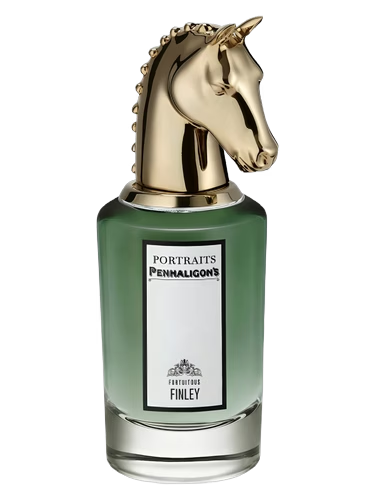
Most Popular Scents Using Iris


What is Iris in perfumery?
In perfumery, the Iris note is derived from the plant's underground rhizomes (roots) rather than its flowers, making it one of the most unique and precious ingredients in a perfumer's palette.What does Iris smell like?
It is characterized by a complex, sophisticated aroma that is earthy, woody, and subtly powdery, often creating the iconic "makeup" or "lipstick" scent profile found in fine fragrances.How is Iris essence extracted?
The extraction process is time-consuming; rhizomes are hand-peeled and aged for three to five years before being steam-distilled to produce iris butter or solvent-extracted to create iris absolute.Why is Iris one of the most expensive raw materials?
The high cost is due to the lengthy cultivation and aging cycles required for the roots to develop their signature aromatic molecules, combined with labor-intensive harvesting and processing.What are some top perfumes featuring Iris?
Popular fragrances highlighting this note include Dior Homme Intense, Prada L'Homme, Lancôme La Vie Est Belle, and Chanel No. 19.