Fragrance Notes Are Layers Of Scent That Are Layered To Form The Final Fragrance. Fragrance Notes Are Categorised Into Three Main Elements Based On How Long They Take To Evaporate, And How Long They Typically Last Following Application: Top Notes, Heart Notes And Base Notes.
Inula
Inula offers a sharp, herbaceous, and earthy profile, often described as floral-herbal with minty nuances. Its characteristic aroma is potent and frequently utilized to blend with notes like Chamomile and Lavender, providing a distinctive natural and slightly bitter green character to compositions.

Origin & Extraction Of Inula
The note of Inula, with its sharp, herbaceous, and earthy profile, is a relatively specialized ingredient in perfumery, meaning it is not as commonly featured as notes like Rose or Jasmine in mainstream fragrances. However, it is highly valued in niche and artisanal compositions where its distinctive floral-herbal character provides unexpected depth and a natural, slightly bitter green nuance. Its use often indicates a fragrance designed to evoke wild, untamed landscapes or traditional herbal remedies, setting these scents apart from conventional floral bouquets.
The rise of hyper-realistic and botanical-focused niche brands has given Inula more prominence. In these modern creations, it functions not just as an aromatic filler, but as a key note that defines the scent's texture and narrative. Perfumers often pair Inula's potency with classical herbs like Chamomile and Lavender to enhance their aromatic qualities, but with a more complex, earthy foundation, seen in fragrances striving for an ancient, botanical atmosphere. Its complex profile appeals to connoisseurs who appreciate challenging and layered green aromas.
The primary and traditional method for extracting inula essential oil is steam distillation of the flowering plant or herb, typically using the flowers and leaves. This process involves passing pressurized steam through the plant material to evaporate the volatile aromatic compounds, which are then condensed and collected. Historically, small-batch distillation was used to manage the rarity of the plant, which is often only available in years with abundant harvests. The choice of equipment significantly impacts the final product; distillation in a traditional copper still results in a distinctive emerald green oil due to chemical reactions between the plant's constituents and the metal, while modern stainless steel stills produce a pale to medium yellow oil.
Recent developments have introduced innovative techniques to improve yield and preserve the integrity of the oil's complex chemical profile. Microwave-assisted steam distillation (MASD) has emerged as a more efficient alternative to conventional steam distillation, offering better preservation of volatile compounds and reduced extraction times. Additionally, analytical advancements such as gas chromatography-mass spectrometry (GC-MS) are now standard for verifying the purity and chemical composition (chemotype) of the oil, ensuring it meets medicinal and aromatherapeutic standards.
The note of Inula, with its sharp, herbaceous, and earthy profile, is a relatively specialized ingredient in perfumery, meaning it is not as commonly featured as notes like Rose or Jasmine in mainstream fragrances. However, it is highly valued in niche and artisanal compositions where its distinctive floral-herbal character provides unexpected depth and a natural, slightly bitter green nuance. Its use often indicates a fragrance designed to evoke wild, untamed landscapes or traditional herbal remedies, setting these scents apart from conventional floral bouquets.
- While specific large-scale commercial successes heavily centered on Inula are rare, the note often appears as a sophisticated accent in fragrances that lean into green, aromatic, and chypre territories. A notable example where Inula is reportedly utilized for its unique green and subtle medicinal edge is in certain compositions by niche houses, such as those that seek to capture the rugged Mediterranean flora.
- Perfumers often pair Inula's potency with classical herbs like Chamomile and Lavender to enhance their aromatic qualities, but with a more complex, earthy foundation. This can be seen in fragrances striving for an ancient, almost forgotten botanical atmosphere.
The rise of hyper-realistic and botanical-focused niche brands has given Inula more prominence. In these modern creations, it functions not just as an aromatic filler, but as a key note that defines the scent's texture and narrative. For instance, some interpret its use to emulate the scent of dry, sun-baked earth mixed with wild flowers, giving an authentic, unpolished feel. Look for Inula in the ingredient list of high-concept aromatic scents, particularly those from European and Japanese niche producers.
One acclaimed niche fragrance that has been recognized for its innovative use of less-common herbal notes, potentially including Inula to deliver a sharp, green opening and heart, is **Timbuktu** by L’Artisan Parfumeur, or similarly-styled artisanal works like **L'Eau Trois** by Diptyque, which uses a potent herbal blend to evoke ancient landscapes. These fragrances demonstrate how the complex, natural profile of Inula contributes to perfumes known for their conceptual brilliance and olfactory sophistication, appealing to connoisseurs who appreciate challenging and layered green aromas.
Sustainability Of Inula
Sustainability of Inula
- Promoting the cultivation of medicinal species like Inula racemosa to reduce pressure on wild populations and prevent extinction due to unsustainable wild harvesting
- Adopting green extraction technologies, such as microwave-assisted extraction (MAE), to significantly reduce energy consumption and the carbon footprint of industrial production
- Supporting socio-economic resilience by linking local farmers and self-help groups with reliable markets, providing additional income and enhancing rural livelihoods
- Implementing organic farming practices and maintaining proprietary organic cultures to ensure the quality and safety of raw materials while respecting the environment
- Adopting circular economy principles by redesigning packaging and sales materials to favor recyclable materials and minimize waste at the source
- Engaging in conservation efforts through the establishment of nurseries and the distribution of quality planting materials to encourage ex-situ cultivation and habitat preservation
Trivia
Historically used since ancient times for its medicinal properties, inula was once candied and sold as a sweet treat.
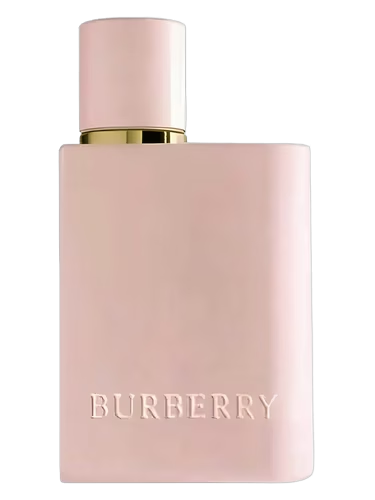
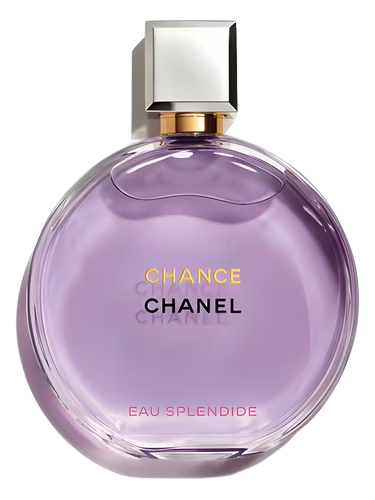
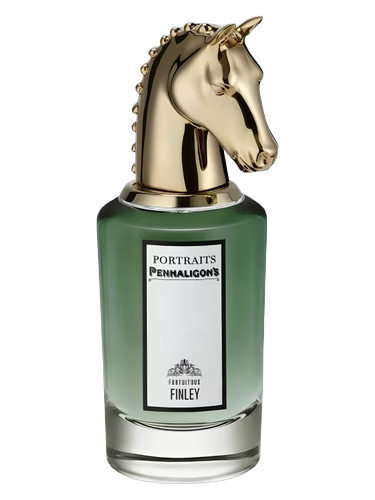
Most Popular Scents Using Inula
What is Inula?
Inula is a specialized fragrance note derived from Inula graveolens, an aromatic herb native to the Mediterranean region and parts of Eurasia, highly valued in niche and artisanal perfumery.What does Inula smell like?
It features a sharp, herbaceous, and earthy profile with minty nuances, often described as floral-herbal with a slightly bitter green character and subtle honey or chamomile undertones.How is Inula essence extracted?
The essential oil is primarily obtained through steam distillation of the flowering plant, with the color ranging from pale yellow to emerald green depending on whether stainless steel or copper stills are used.What are some perfumes featuring Inula?
While rare in mainstream scents, Inula is used in high-concept aromatic fragrances like Timbuktu by L’Artisan Parfumeur and L'Eau Trois by Diptyque to evoke ancient or rugged landscapes.When is Inula in season?
Inula is a hardy perennial that typically blooms from mid-to-late summer, specifically July through September, producing vibrant yellow daisy-like blossoms.