Fragrance Notes Are Layers Of Scent That Are Layered To Form The Final Fragrance. Fragrance Notes Are Categorised Into Three Main Elements Based On How Long They Take To Evaporate, And How Long They Typically Last Following Application: Top Notes, Heart Notes And Base Notes.
Hortensia
Hortensia (Hydrangea hortensis) presents a delicate and remarkably fresh floral profile. Extracted via steam distillation of the leaves and flowers, it carries distinctive, clean, and subtly watery notes. The scent features green, slightly earthy undertones, often described as having ephemeral, dewy facets with hints of light, bright, camphorous tonalities, lending an ethereal touch to fragrances, particularly in niche compositions.

Origin & Extraction Of Hortensia
Hortensia (Hydrangea hortensis) does not possess a long historical lineage in classical perfumery like notes such as Bergamot or Neroli, which formed the foundation of the 18th-century Eau de Cologne structure. Its adoption as a distinct note is a more modern development, reflecting a trend towards utilizing unique, naturalistic, and ethereal floral profiles in contemporary fragrance design. Historically, the plant itself was valued ornamentally, but its delicate, watery, and slightly green essence became attractive to perfumers seeking sophisticated, light, and transparent accords.
The contemporary use of Hortensia is primarily seen in modern mass-market and niche perfumery, where its clean, subtle, and dewy characteristics provide a sophisticated alternative to traditional heavy florals. It is often employed in mainstream lines, such as Victoria's Secret's "Very Sexy" fragrances, to introduce a bright, light opening. In niche perfumery and modern designer scents like Issey Miyake’s lighter compositions, Hortensia contributes to an airy, luminous structure, bridging delicate floral freshness with clean, sometimes camphorous, undertones.
Extraction Methods of Hortensia
Historically, hortensia (hydrangea) extracts were obtained through traditional methods such as manual hand-rolling, fermentation, and sun-drying of the leaves and branches, particularly for varieties like Hydrangea macrophylla var. Thunbergii. These processes were essential to trigger the bioconversion of precursors into sweet-tasting compounds like phyllodulcin. Ancient techniques also included simple maceration and infusion in water or alcohol to capture the plant's medicinal and aromatic properties, although these often resulted in low yields or unstable extracts.
Modern extraction methods have evolved to include more efficient and precise technologies. Accelerated solvent extraction (ASE) and ultrasonication are now commonly used with solvents like ethanol or methanol to maximize the yield of active ingredients. Recent developments also include the use of supercritical carbon dioxide (CO2) extraction to capture delicate molecules without high heat, and specialized dehydration processes in the presence of plant powder to prevent the formation of highly viscous precipitates. For specific components like anthocyanins, researchers now optimize conditions using UPLC-Q-TOF-MS to ensure purity and stability.
The Hortensia note, valued for its delicate, fresh, and subtly watery floral profile, is often utilized to add an ethereal and clean touch, moving beyond traditional, heavier florals. A prominent house that has repeatedly featured this note is Victoria's Secret, particularly within their "Very Sexy" line. Fragrances like < strong>Very Sexy (2018)</ strong>, < strong>Very Sexy (2007)</ strong>, and < strong>Very Sexy (2012)</ strong> employ Hortensia to introduce a bright, dewy opening that maintains a sense of sophistication and lightness, often balancing richer, more sensual bases typical of the collection.
- The note's unique green and camphorous tonalities, derived from the steam distillation of the plant's leaves and flowers, offer complexity, making it an appealing choice for perfumers seeking an ephemeral quality.
Beyond the mainstream market, Hortensia has been integrated into fragrances that emphasize modernity and unique transparency, such as Issey Miyake’s < strong>Le Feu D'Issey Light</ strong> (2000). This scent uses the Hortensia note to contribute to a luminous, clean structure, complementing the overall airy and aquatic characteristics associated with the Miyake brand. This approach highlights the note's versatility, proving it can anchor both mass-market seductive compositions and more avant-garde, light-focused designs.
- In niche and artisanal perfumery, the delicate profile of Hortensia can be used to evoke specific natural or atmospheric sensations, such as in fragrances like Neil Morris's < strong>Earthtones #2: Desert Wind</ strong>, where it likely contributes a subtle, naturalistic floral freshness against a broader landscape accord.
The contemporary appeal of Hortensia is further demonstrated by its inclusion in fragrances like Jill Stuart's < strong>Crystal Bloom Something Pure Blue 2019</ strong>. Here, the fresh, clean, and slightly watery essence of the note reinforces the fragrance’s themes of clarity and brightness, making it suitable for modern, romantic floral compositions. Overall, Hortensia serves as a refined, specialized floral ingredient chosen when the aim is to create a delicate, fresh, and distinctive opening.
Sustainability Of Hortensia
Sustainability of Hortensia
- Promoting a circular economy by composting green waste to create weed suppressants and enhance soil health
- Reducing carbon emissions by growing flowers locally and sourcing vintage or upcycled items to minimize transport and production footprints
- Conserving water resources through the implementation of rainwater harvesting systems and precision irrigation like drip or soaker hoses
- Enhancing local biodiversity by maintaining meadow strips and planting native hydrangea varieties to support pollinators and beneficial insects
- Adopting energy-efficient practices such as using LED lighting in workshops and reusing plastic trays and vases
- Utilizing organic amendments and natural pest management strategies to reduce reliance on synthetic chemicals and agrochemicals
Trivia
Most hydrangea varieties are actually scentless; in perfumery, the note is typically a "concept accord" created to mimic the flower's visual beauty, as only specific Japanese species possess a natural fragrance.
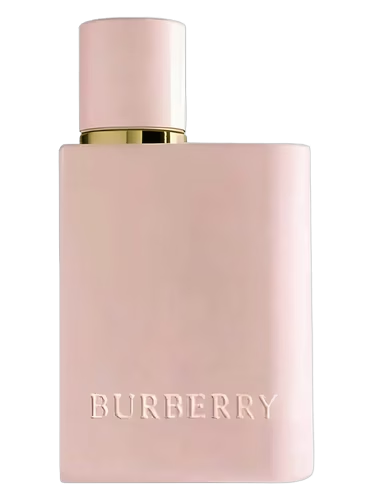
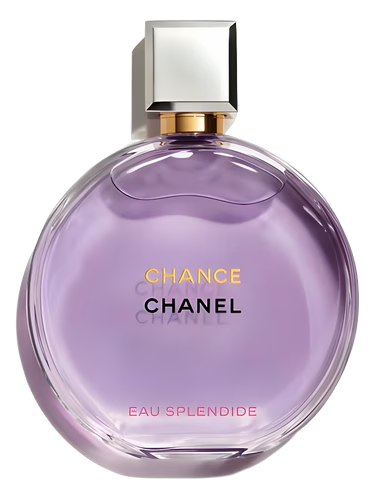
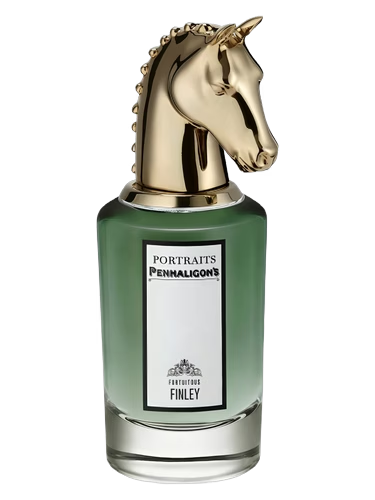
Most Popular Scents Using Hortensia
What is Hortensia?
Hortensia, also known as Hydrangea, is a flowering plant native to Asia and the Americas, valued in modern perfumery for its delicate, fresh, and ethereal floral profile.What does Hortensia smell like?
It features a remarkably fresh and clean floral scent with watery, green, and slightly earthy facets, often characterized by subtle camphorous tonalities.How is Hortensia essence extracted?
The note is traditionally obtained through steam distillation of the leaves and flowers, though modern perfumery also utilizes solvent extraction and supercritical CO2 extraction.Does the hydrangea flower have a natural scent?
Most hydrangea varieties are actually scentless; as a result, the note in perfumery is often a "concept accord" designed to mimic the flower's visual beauty and fresh, dewy aura.When is Hortensia in season?
Hydrangeas follow a seasonal cycle that typically begins in early spring, with peak blooming occurring during the summer months of June and July.What are some top perfumes featuring Hortensia?
Notable fragrances including this note are J-Scent Hydrangea, Victoria's Secret Very Sexy, and Issey Miyake Le Feu D'Issey Light.