Fragrance Notes Are Layers Of Scent That Are Layered To Form The Final Fragrance. Fragrance Notes Are Categorised Into Three Main Elements Based On How Long They Take To Evaporate, And How Long They Typically Last Following Application: Top Notes, Heart Notes And Base Notes.
Honeydew Melon
Honeydew Melon presents a sweet, lush, and highly watery aroma. It is distinctly fresh and slightly green, capturing the scent of the ripe, succulent flesh. In perfumery, it delivers an expansive, dewy, and aquatic-fruity top or heart note, offering a smooth, almost creamy sweetness without being overly sugary, often used to impart a transparent, summery coolness and lift.

Origin & Extraction Of Honeydew Melon
The Honeydew Melon note in perfumery is primarily a modern invention, gaining popularity with the rise of aquatic and ozonic fragrances in the late 20th and early 21st centuries. While melon varieties have been cultivated globally for millennia, their intense, watery, and lush sweetness was difficult to capture and stabilize using natural extraction methods. The actual use of Honeydew in fine fragrance relies heavily on synthetic molecules (like Calone or similar compounds) which are engineered to convey a dewy, expansive, and transparent fruity freshness that suggests water and sweetness without being heavy.
Honeydew Melon is valued for providing a specific kind of light, summery, and slightly tropical sweetness that differs from traditional fruit notes. It became prominent after the success of the first aquatic scents, helping to define the "fresh-fruity" category. Perfumers use this note to inject a transparent coolness and lift, often featured in top and heart notes of casual, contemporary, and particularly summer-themed fragrances, signifying optimism and a clean, refreshing vitality.
The extraction of honeydew melon essence is primarily achieved through steam distillation or solvent extraction, as the fruit's high water content and delicate aromatic structure make traditional cold-pressing of the peel ineffective. In steam distillation, the fruit's volatile compounds are vaporized and then condensed into a liquid form. Historically, capture of the honeydew scent was often limited to maceration, where the fruit was soaked in carrier oils or alcohols to slowly absorb its subtle, sweet aroma, though these early methods often struggled to capture the true freshness of the fruit.
Modern advancements have introduced more sophisticated techniques to better preserve the melon's characteristic aquatic and sugary profile. Supercritical CO2 extraction is now utilized to capture a more "true-to-nature" scent without the thermal degradation associated with boiling. Additionally, headspace technology (or "nature print") is frequently employed by perfumers to analyze and reconstruct the aromatic molecules directly from the living fruit, allowing for the creation of high-fidelity synthetic accords that replicate the crisp, refreshing scent of a ripe honeydew melon more accurately than traditional essential oils.
The Honeydew Melon note, valued for its airy, dewy, and aquatic sweetness, is a signature element in modern perfumery, particularly defining the fresh and casual fragrance trends of the late 20th century. Its transparent quality allowed perfumers to add a succulent, non-heavy fruitiness to compositions. One of the most famous early examples featuring this note is **L’Eau d’Issey Pour Homme** by Issey Miyake, which utilizes a watery melon accord alongside yuzu and aquatic elements to create a groundbreakingly fresh scent.
- *
Honeydew Melon continues to be a staple in scents designed for summer or sport wear, where its refreshing nature excels. A prominent feminine example is **D &G Anthology L'Imperatrice 3** by Dolce &Gabbana. In this popular composition, the dewy, expansive quality of the melon note is blended with kiwi and rhubarb, crafting a vibrant and juicy cocktail that embodies carefree vitality and sparkling freshness. This highlights the note's versatility in creating scents that are both youthful and sophisticatedly bright.
- *
Beyond mainstream designers, niche and contemporary perfumery have utilized Honeydew Melon for its unique aquatic texture. It is often employed in modern interpretations of green or floral fragrances to introduce a specific wet, crisp dimension. For instance, in scents like **Acqua di Gioia** by Giorgio Armani, while not explicitly listed as Honeydew, the aquatic-fruity freshness often employs similar molecules to achieve that dewy, lush sensation, solidifying the melon note's crucial role in the enduring popularity of the contemporary aquatic genre.
Sustainability Of Honeydew Melon
Sustainability of Honeydew Melon
- Promoting a circular economy by repurposing waste, such as turning rinds into animal feed, extracting seeds for oil, or creating packaging from melon fibers
- Implementing water-efficient practices including drip irrigation, rainwater collection, and the use of recycled water to conserve resources
- Adopting regenerative agriculture and organic farming techniques, such as using organic mulch and bio-stimulants to improve soil health and microbial activity
- Investing in socio-economic resilience by supporting local communities through education, meal programs, and fair labor practices
- Utilizing energy-efficient technologies like solar cooling and heat recovery units in processing facilities to reduce carbon emissions
- Reducing chemical reliance through integrated pest management and the development of disease-resistant varieties to minimize environmental impact
Trivia
Honeydew melon is a member of the cucumber family, and in perfumery, its scent cannot be naturally extracted, making every honeydew note a "fantasy accord" meticulously reconstructed by perfumers using synthetic molecules.
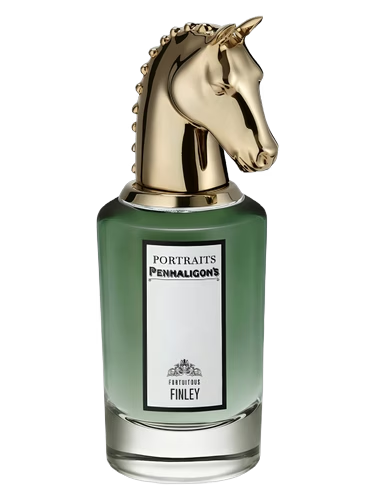
Most Popular Scents Using Honeydew Melon


What is Honeydew Melon?
Honeydew Melon is a sweet, lush, and watery fragrance note primarily used in modern perfumery to create fresh, aquatic-fruity compositions.What does Honeydew Melon smell like?
It features a distinctly fresh, slightly green, and dewy aroma that captures the scent of ripe, succulent fruit flesh with a transparent, summery coolness.How is the Honeydew Melon note extracted?
Because the natural scent is difficult to capture, it is typically a "fantasy accord" reconstructed by perfumers using synthetic molecules or advanced techniques like headspace technology.What are some top perfumes featuring Honeydew Melon?
Notable fragrances include L’Eau d’Issey Pour Homme, D&G Anthology L'Imperatrice 3, Ellis Brooklyn Dear Sky, and Marc Jacobs Honey.When is Honeydew Melon in season?
While often available year-round, its peak season runs from June through October, providing a refreshing profile that is most abundant during the warmest months.