Fragrance Notes Are Layers Of Scent That Are Layered To Form The Final Fragrance. Fragrance Notes Are Categorised Into Three Main Elements Based On How Long They Take To Evaporate, And How Long They Typically Last Following Application: Top Notes, Heart Notes And Base Notes.
Honeybush or Cyclopia
Honeybush offers a rich, warm aroma of floral tea, honeyed berry, and sun-drenched hay. Its complex profile includes a sweet, boozy opening with nuances of violet and a gourmand vanilla-like drydown. It acts as an aromatic enhancer, lending depth and a sophisticated sweetness to compositions.

Origin & Extraction Of Honeybush or Cyclopia
Honeybush, a flowering plant (Cyclopia species) native to South Africa, has a traditional history rooted in herbal tea and medicinal uses by local communities, predating its inclusion in fine fragrance. Unlike classical perfumery materials such as Bergamot or Rose, Honeybush does not have a long historical tradition in the industry. Its introduction is a relatively modern phenomenon, gaining popularity in contemporary perfumery—particularly in niche and natural houses—as perfumers began exploring unique, non-traditional materials to achieve subtle sweetness and complexity.
In perfumery, Honeybush is valued for its distinctive complex aroma, which blends the warmth of sun-drenched hay, sweet tea, and nuances of honeyed fruit and vanilla. Its relevance lies in its ability to offer natural, sophisticated sweetness and depth, often used to enrich tea accords or provide a comforting, slightly gourmand foundation that is less heavy than traditional honey. This allows the note to bridge the gap between fresh, floral compositions and deeper, aromatic bases, making it a versatile ingredient in modern scent creation.
Extraction Methods of Honeybush
The extraction of honeybush essence and tea traditionally involves a labor-intensive four-step process: harvesting, cutting, fermentation (oxidation), and drying. Historically, honeybush was processed through "heap fermentation," a manual method where harvested branches and leaves were finely chopped, piled into large mounds, packed firmly, and covered with canvas for three to five days. This spontaneous heat generation allowed the material to ferment and oxidize, transforming it from green to dark brown and developing its signature honey-like aroma. Once the desired scent and color were achieved, the tea was spread out to dry in the sun.
Modern commercial extraction and production have evolved to use more controlled and efficient methods, such as "oven fermentation" in temperature and moisture-controlled stainless steel tanks. In these tanks, the chopped plant material is heated to approximately 70°C and monitored for 60 to 72 hours, with regular rotation to ensure even oxygen contact. Recent advancements also include "green honeybush" production, which skips the fermentation stage entirely by immediately steaming or drying the cut leaves to preserve high levels of antioxidants and xanthones like mangiferin. For specialized food, cosmetic, and nutraceutical applications, advanced techniques such as aqueous (hot water) extraction, ethanol-water solvent extraction, and freeze-drying are utilized to produce standardized, high-purity extracts.
Honeybush, or Cyclopia, is a distinct note cherished in contemporary perfumery for its unique aroma, blending floral tea, honeyed sweetness, and hay-like warmth. While it does not boast the historical ubiquity of notes like Neroli or Bergamot, it has become a signature ingredient for modern houses seeking depth and natural sweetness without relying on traditional honey or sugar accords. It provides a sophisticated, slightly gourmand foundation, making compositions both comforting and exotic. For instance, the tea-like and warm character of Honeybush is prominently featured in certain niche and artisanal releases.
- * * *
One notable use of the Honeybush note is found in fragrances like Guerlain Aqua Allegoria Teazzurra. Although this perfume focuses on a refreshing, luminous tea theme, the inclusion of Honeybush helps enrich the central tea accord, providing a sun-drenched, slightly fruity sweetness that prevents the scent from becoming overly sharp or purely green. This fragrance exemplifies how Honeybush can serve as a complex aromatic enhancer, bridging the freshness of citrus top notes with the depth of a refined tea heart. Its presence ensures the final composition maintains an airy quality while delivering significant longevity.
- * * *
Another popular fragrance incorporating this warm, floral-tea note is Aftelier Honeybush, which places the note front and center. Being an all-natural perfume house, Aftelier often highlights the authentic nuances of unique ingredients, allowing the honeyed, violet-tinged facets of Cyclopia to truly shine. This perfume illustrates the note's potential to carry a scent's central theme, providing a rich, boozy sweetness paired with subtle dry-hay undertones. It appeals particularly to those seeking unique floral gourmands that feel natural, sophisticated, and deeply comforting.
Sustainability Of Honeybush or Cyclopia
Sustainability of Honeybush
- Transitioning from wild harvesting to managed cultivation to prevent the extinction of indigenous species and reduce pressure on wild populations
- Implementing sustainable wild-harvesting plans that include a mandatory four-year waiting period between harvests to allow plants to set seed and replenish
- Supporting local socio-economic resilience by training smallholder and previously disadvantaged communities in farming skills and business management
- Promoting regenerative agriculture practices such as organic fertilization, no-till cultivation, and using disease-suppressant cover crops like mustard and kale
- Restoring natural biodiversity and water security through the removal of invasive alien vegetation in critical catchment areas
- Developing standardized quality grading systems and sensory tools to ensure consistent product standards and ethical market access
- Establishing industry-wide benefit-sharing agreements to ensure fair and equitable compensation for traditional knowledge holders
Trivia
Honeybush is a sibling to Rooibos and belongs to the Cyclopia genus, a group of plants that grow exclusively in small, specific regions of South Africa's Fynbos biome and have resisted all attempts at large-scale commercial cultivation elsewhere in the world.
Most Popular Scents Using Honeybush or Cyclopia
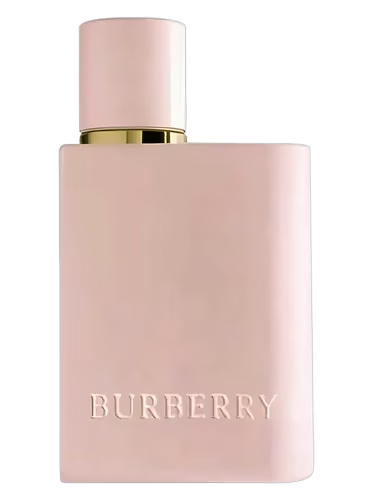
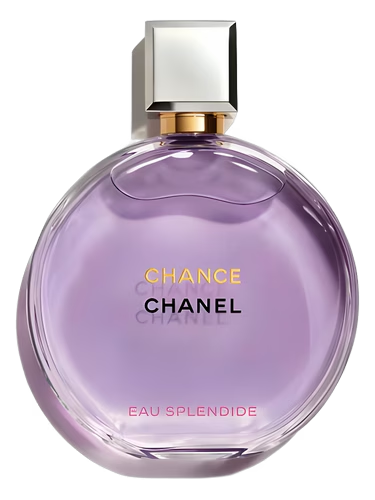
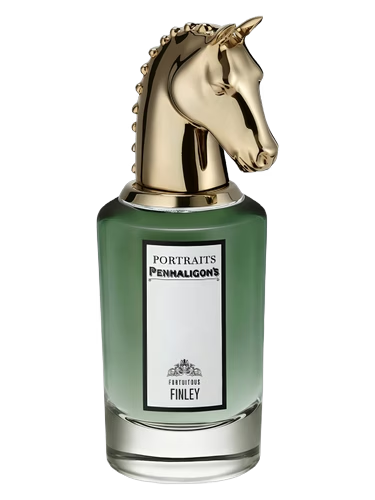
What is Honeybush (Cyclopia)?
Honeybush is a flowering plant native to the fynbos regions of South Africa, traditionally used for herbal tea and now valued in modern perfumery for its unique sweetness and complexity.What does Honeybush smell like?
It offers a rich, warm aroma of floral tea, honeyed berry, and sun-drenched hay with a sweet, boozy opening and a gourmand vanilla-like drydown.How is Honeybush essence extracted?
The essence is obtained through a process of harvesting and cutting, followed by fermentation to develop its signature honey-like aroma, and final drying.What are some top perfumes featuring Honeybush?
Notable fragrances include Aftelier Honeybush, Guerlain Aqua Allegoria Teazzurra, Scent Trunk Honeybush, and Wild Veil Rooibos Tea.When is Honeybush in season?
The plant typically blooms in late winter and spring between August and October, while the harvest for production primarily takes place from January to April.