Fragrance Notes Are Layers Of Scent That Are Layered To Form The Final Fragrance. Fragrance Notes Are Categorised Into Three Main Elements Based On How Long They Take To Evaporate, And How Long They Typically Last Following Application: Top Notes, Heart Notes And Base Notes.
Hellabore Flower
The Hellabore Flower note in perfumery is primarily characterized as a delicate, powdery aroma, reminiscent of the soft, slightly sweet scent of primroses. It provides a subtle, ethereal floral nuance, often used to lend a gentle, sophisticated, and slightly green lift to floral compositions.

Origin & Extraction Of Hellabore Flower
The Hellebore Flower (often referred to as Christmas Rose or Lenten Rose) note does not possess the long-standing, foundational history in perfumery enjoyed by classic floral ingredients like rose, jasmine, or ylang-ylang. Historically, Hellebores were better known in folklore and traditional medicine, but their use in fine fragrance is a relatively contemporary phenomenon. This shift occurred as perfumers began seeking unique, often subtle, and less common floral notes to differentiate modern compositions from traditional floral bouquets. The Hellebore note, characterized by its delicate, powdery, and slightly green/ethereal scent, provides an intriguing complexity that avoids the heavy sweetness of many conventional flowers.
In modern perfumery, the Hellebore Flower note serves a specialized role, primarily appearing in niche and contemporary designer fragrances that aim for sophistication and originality. It is utilized to add a gentle, atmospheric lift to the heart notes, often bridging light openings with deeper, warmer bases (like amber, spice, or dark woods). Its subtle, sophisticated profile helps create a mysterious or seductive undertone, making it successful in more complex oriental or dark floral categories. While it may not be widely documented as a historical component, its modern relevance lies in its ability to lend an ethereal and slightly melancholy quality to a scent.
Extraction Methods of Hellebore Flower
The primary method for obtaining the essence of the hellebore flower in perfumery and floral design is focused on post-harvest conditioning and botanical extraction to preserve its delicate, nodding blooms. Historically, hellebores were challenging to use as cut flowers due to their tendency to wilt rapidly; traditional techniques to manage this involved manual interventions such as searing the stem ends in boiling water for 20 to 60 seconds or slitting the bottom of the stems to increase water-absorbing surface area. These "folk" methods were essential because the showy parts of the flower are actually sepals, which do not take up water as effectively as true petals.
Modern commercial and artisanal approaches emphasize precision in the timing of the harvest and the use of advanced chemical solutions. The latest best practices suggest harvesting only when the flower has reached "ripeness"—indicated by the shedding of stamens and the visible formation of seed pods—which naturally hardens the sepals and extends vase life. Recent developments also include the use of quick-dip hydrating solutions, silver thiosulfate treatments to inhibit ethylene, and micropropagation (tissue culture) in laboratory settings to ensure the consistency and quality of specific cultivars for extraction and high-end floral use.
The Hellabore Flower note, characterized by its delicate, powdery, and slightly green floral aroma, is typically used to introduce a subtle, sophisticated lift to compositions. While not a historical cornerstone like rose or jasmine, it has found modern prominence in fragrances that aim for an ethereal and complex floral heart.
- Black XS Potion for Her
- Black XS Be a Legend Debbie Harry
One notable designer house to utilize the Hellabore Flower is Rabanne. Their fragrance, Black XS Potion for Her, notably features this delicate note, blending its light floral powderiness with warmer, more intense notes to create a mysterious and seductive feminine scent profile. This showcases how the note can be employed not just in light florals, but also in heavier, oriental compositions to provide contrast.
Furthermore, Black XS Be a Legend Debbie Harry is another example where this unique floral element is highlighted. In contemporary perfumery, the Hellabore Flower (sometimes listed as Helleborus odorus or Kukurek) appeals to perfumers seeking specialized, less common floral facets that lend originality and depth, distinguishing the fragrance from more traditional mainstream floral offerings.
- Blooming typically begins in late winter or early spring, with flowers often emerging from November through May depending on the specific variety and climate
- The Christmas rose (Helleborus niger) is known for its early display starting around December, while the Lenten rose (Helleborus orientalis) typically blossoms from February until late spring
- Flowers are exceptionally long-lasting, with colorful sepals remaining of interest for six to eight weeks and often persisting into early summer
- Vegetative growth follows a seasonal cycle where new foliage emerges as flowers finish, while older leaves remain evergreen in most regions until they are pruned back in late winter
- The plant typically enters a period of dormancy or slowed growth during the high heat of summer and resumes active growth in the cooler months of autumn and spring
Sustainability Of Hellabore Flower
Sustainability of Hellebore Flower
- Promoting garden reusability and reduced waste by serving as a sustainable, long-lived perennial alternative to disposable holiday plants like poinsettias
- Supporting early-season biodiversity by providing a vital source of nectar and pollen for pollinators when few other nectar sources are available
- Adopting low-impact landscaping practices through the plant's natural resistance to deer and rabbits, reducing the need for chemical deterrents or protective fencing
- Enhancing soil stability and preventing erosion on slopes through the establishment of hardy, deep-rooted perennial clumps
- Implementing natural pest management by utilizing the plant's toxic alkaloids as a biological deterrent against voles and other tunneling pests
- Encouraging water conservation in shade gardens due to the plant's established drought tolerance and ability to thrive in tough, dry-shade conditions
Trivia
Despite its delicate appearance, the name hellebore is derived from the Ancient Greek word helleboros, meaning "to injure food," a reference to the plant's high toxicity which led it to be used as a chemical weapon by the Greeks during the Siege of Kirrha in 585 BC to poison the city's water supply.
Most Popular Scents Using Hellabore Flower


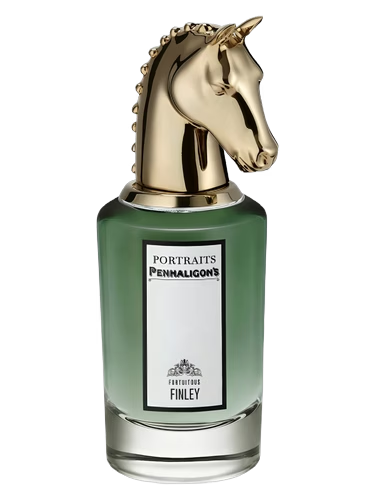
What is Hellebore Flower?
Hellebore, also known as Christmas Rose or Lenten Rose, is a perennial plant whose delicate floral note is used in modern perfumery to provide a sophisticated, ethereal quality.What does Hellebore Flower smell like?
It is characterized by a delicate, powdery, and slightly sweet aroma reminiscent of primroses, often featuring a subtle green and atmospheric lift.How is Hellebore Flower essence obtained?
The essence is primarily obtained through modern botanical extraction and micropropagation (tissue culture) to preserve the delicate scent of its blooms.What are some top perfumes featuring Hellebore Flower?
Notable fragrances include Rabanne Black XS Potion for Her, Etro White Magnolia, and Rabanne Black XS Be a Legend Debbie Harry.When is Hellebore Flower in season?
Hellebores typically bloom from late winter to early spring, with some varieties appearing as early as November and others persisting through May.