Fragrance Notes Are Layers Of Scent That Are Layered To Form The Final Fragrance. Fragrance Notes Are Categorised Into Three Main Elements Based On How Long They Take To Evaporate, And How Long They Typically Last Following Application: Top Notes, Heart Notes And Base Notes.
Heather
Heather offers a sweet, aromatic honey floral note, often complemented by fresh herbal and subtle woody undertones. It provides a rustic yet clean, slightly mossy fragrance, lending a delicate complexity and warmth, distinct from traditional florals.

Origin & Extraction Of Heather
Heather (Calluna vulgaris), a flowering plant native to the wild moors and hills of Europe, particularly Scotland and Ireland, does not have the centuries-old foundational history in classic perfumery that notes like Rose or Bergamot do. Historically, its scent—which is sweet, honeyed, and slightly herbal/mossy—was primarily associated with the local landscapes it inhabited rather than formal fragrance ingredients. The note’s introduction into modern perfumery is often tied to the creation of fragrances that seek to evoke the rustic, pastoral ambiance of the British Isles, appearing frequently in green, chypre, and fougère compositions to lend an earthy, clean texture.
The use of Heather as a distinct note, rather than a generalized "moss" or "green" accord, grew more prominent in the 20th and 21st centuries, especially within niche and artisanal perfumery. This shift reflects a trend toward photorealistic and complex natural elements. Perfumers utilize Heather for its aromatic warmth and subtle bittersweet complexity, which serves to bridge volatile citrus openings with deeper, woodier bases. While it is rarely a dominant component, it is prized for adding sophistication and depth, allowing a fragrance to evoke the rugged elegance of its natural origins.
Extraction Methods of Heather
Historically, the aromatic essence of heather was captured through traditional maceration and infusion techniques. The small, bell-shaped flowers and flowering tops were often steeped in fixed oils or alcohol for extended periods, allowing the solvent to slowly absorb the plant's delicate, honey-like fragrance and medicinal properties. Early herbalists also employed simple water distillation (hydrodistillation) to create heather floral waters, though the low oil yield of the plant made this process labor-intensive and rare.
In modern perfumery and aromatherapy, heather is primarily processed through steam distillation or solvent extraction to produce essential oils and absolutes. Steam distillation involves passing pressurized steam through the dried flowers to vaporize the volatile compounds, which are then condensed and collected. For a more complete aromatic profile that captures the heavier, waxier molecules of the plant, volatile organic solvent extraction is used to create a concrete, which is further refined into an absolute. More recently, supercritical CO2 extraction has emerged as a high-end method, using pressurized carbon dioxide at low temperatures to produce an exceptionally pure extract that closely mimics the scent of fresh heather in the wild.
The Heather note, known for its sweet, aromatic honey floral quality combined with fresh herbal and subtle woody undertones, often lends a delicate complexity and warmth to fragrances, distinguishing them from traditional clean florals. While not as universally common as rose or jasmine, Heather is frequently employed to evoke the rugged, wild landscapes of Scotland and Ireland, particularly in classic green, chypre, or fougère compositions. This focus on a rustic, clean, and slightly mossy profile makes Heather an ideal supporting player for perfumes aiming for a natural, pastoral ambiance.
- One notable historical fragrance that utilized the essence of the British Isles landscape, and likely subtle interpretations of heather’s complex scent profile, is the classic **English Lavender** by Atkinsons, though often the note is synthesized or included within a broader ‘moss’ or ‘green’ accord. In modern niche perfumery, houses often attempt to capture a photorealistic interpretation.
In contemporary perfumery, particularly within artisanal or niche brands focused on natural botanical elements, the Heather note has gained recognition for its ability to add unique texture. It moves beyond a simple floral note to inject an aromatic warmth and subtle bittersweet facet that complements both fresh citrus openings and deep woody bases. This note is challenging to work with due to its complexity but rewards perfumers by bridging diverse families, providing depth without heaviness.
- For example, the delicate, honeyed sweetness of the note can sometimes be found integrated into the compositions of fragrances like **Erolfa** by Creed, where it supports the aquatic and green elements, or within the structure of certain releases by Jo Malone London, such as **Blackberry & Bay**, to enhance the rustic, hedgerow feel.
Ultimately, the inclusion of Heather often signals a fragrance designed for sophistication and subtle natural appeal. Perfumes featuring this note are typically praised for their evocative quality, immediately transporting the wearer to open fields and moors. Its enduring character ensures that even modern formulations that use the note—whether directly or as part of a complex accord—maintain a timeless, earthy elegance that is both comforting and invigorating.
- Among dedicated fragrance collectors, a prominent example showcasing the note's rustic sweetness is **Locherber Milano’s Heather Honey**, which captures the core honeyed facet and combines it with woody notes for a warm, enveloping experience.
Sustainability Of Heather
Sustainability of Heather
- Addressing challenges in natural perfumery by navigating the impact of climate change on plant growth and scent predictability
- Promoting the use of all-natural and botanical ingredients as a transparent alternative to mainstream synthetic perfume making
- Advocating for the preservation of over-harvested natural ingredients to ensure long-term botanical availability
- Supporting the art of small-batch production to manage the high cost and vast resource requirements of distilling natural materials
- Fostering community-based learning and collaboration among natural perfumers to share sustainable practices and creative challenges
Trivia
Heather honey, produced by bees foraging on the plant, has a unique thixotropic property: it is naturally a thick gel that only becomes liquid when stirred or shaken.
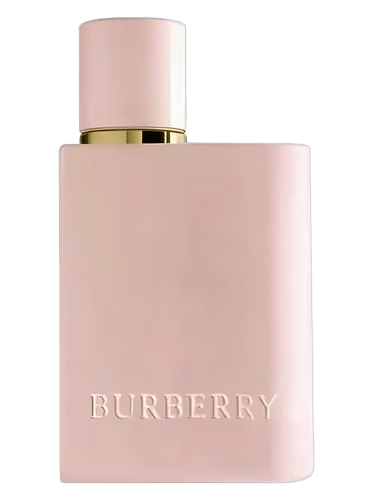
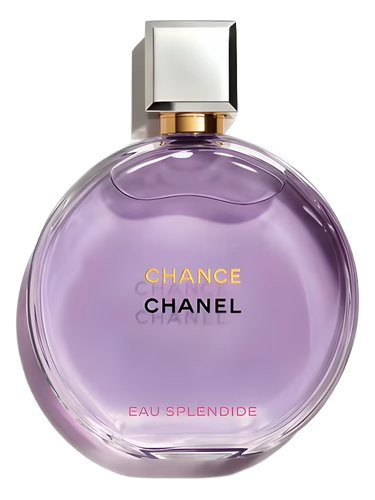
Most Popular Scents Using Heather

What is Heather?
Heather, specifically Calluna vulgaris or "ling," is an evergreen shrub native to the moors and heathlands of Europe and Asia Minor, valued in perfumery for its rustic, honeyed aroma.What does Heather smell like?
It offers a sweet, aromatic honey floral scent with fresh herbal, mossy, and subtle woody undertones, often described as an atmospheric landscape fragrance.How is Heather essence extracted?
The aromatic profile is primarily captured through steam distillation or solvent extraction of the flowering tops, though supercritical CO2 extraction is used for high-end, pure extracts.What are some top perfumes featuring Heather?
Notable fragrances include Jo Malone London Highland Heather, Creed Erolfa, Imaginary Authors Every Storm A Serenade, and Locherber Milano’s Heather Honey.When is Heather in season?
True heather (Calluna) typically blooms from midsummer through autumn, specifically between July and November, while certain heath species (Erica) flower during winter and spring.