Fragrance Notes Are Layers Of Scent That Are Layered To Form The Final Fragrance. Fragrance Notes Are Categorised Into Three Main Elements Based On How Long They Take To Evaporate, And How Long They Typically Last Following Application: Top Notes, Heart Notes And Base Notes.
Hatkora Lemon
Hatkora Lemon offers a distinct citrus profile, brighter and sharper than traditional lemon, with nuances of lime and grapefruit. It possesses a slightly bitter, zesty rind aroma coupled with a dry, intensely aromatic, and moderately sweet pulp scent. It lends an invigorating, sparkling, and sophisticated lift to fragrance compositions.

Origin & Extraction Of Hatkora Lemon
Hatkora Lemon, a distinct citrus variety native to regions like Assam, India, and Bangladesh, has a history in perfumery that reflects a search for unique and sophisticated citrus profiles beyond the traditional lemon and bergamot. While not part of the historical foundational notes like those used in the original Eau de Cologne, its use in modern and niche perfumery has grown due to its complex aroma. Perfumers prize Hatkora Lemon for its ability to deliver an intense, sharp, and aromatic zest that includes nuances of lime and grapefruit, offering a dry, sweet, and slightly bitter complexity to the top notes of a composition.
Its relevance in modern fine fragrance lies in its sophisticated profile, which allows it to bridge the gap between volatile citrus openings and the deeper, more enduring heart notes. Contemporary fragrance houses utilize Hatkora Lemon when seeking a sparkling, invigorating lift that carries an exotic or rare signature, positioning the scent as refined and distinct from mainstream offerings. This specialized citrus note is thus associated with high-end designer and niche releases that require long-lasting clarity and a unique, complex brightness in the opening.
Extraction Methods of Hatkora Lemon
The primary method for extracting essential oil from the Hatkora lemon (Citrus macroptera) is cold expression of the fresh fruit peel. This process involves mechanically rasping or pressing the outer rind to release the volatile oils stored in the secretory glands, a method that effectively preserves the fruit's unique, sharp, and slightly spicy citrus aroma. Historically, this was achieved through labor-intensive manual techniques such as the sponge method, where halved rinds were pressed against sponges, or the "ecuelle a piquer" method, which used a bowl lined with sharp needles to puncture the oil sacs.
In modern commercial production, advanced mechanical systems like the "pelatrice" are utilized to automate the process, using rotating abrasive rollers and water sprays to create an oil-water emulsion that is later separated by centrifugation. Additionally, steam distillation and hydrodistillation are frequently employed to extract oils from the fruit and peels, particularly for medicinal or industrial applications. Recent innovations also include supercritical CO2 extraction and solvent extraction, which allow for the isolation of specific aromatic compounds with high purity while avoiding the heat-induced degradation often associated with traditional distillation.
Hatkora Lemon, a distinct and complex citrus note, has gained traction in niche and designer perfumery for its unique blend of bright lemon, lime, and grapefruit bitterness. While still a relatively modern note compared to staples like Bergamot, it is notably featured in the Guerlain Aqua Allegoria line, specifically in Aqua Allegoria Limon Verde, where its invigorating zest provides a sophisticated, tropical lift to the fragrance's caipirinha accord.
- This note is prized for its ability to offer a long-lasting, sparkling, and slightly exotic freshness that traditional lemon notes often lack, making it ideal for contemporary Eaux Fraîches.
In other contemporary scents, Hatkora Lemon's pronounced rind aroma and moderate sweetness make it a compelling opening for more complex, woody, and spicy compositions, bridging the volatile citrus top with the deeper heart notes. For instance, houses like Acqua di Parma have incorporated sophisticated citrus notes like this to modernize their classic Italian cologne structures, lending a brighter, more aromatic edge to releases such as Fico di Amalfi, ensuring the fragrance maintains an energetic and invigorating start.
- The note’s slightly bitter quality prevents the overall composition from becoming too sweet, maintaining a refined and clean profile crucial for high-end fragrances.
Furthermore, Hatkora Lemon contributes a vibrant and unusual exoticism, often appearing in fragrances seeking a Mediterranean or Southeast Asian flair. It can be found in exclusive lines that prioritize rare ingredients, offering an immediate sensory signature that distinguishes the perfume. Its unique complexity ensures it remains a powerful, uplifting focal point in fresh woody-citrus perfumes, such as Atelier Cologne Sud Magnolia, where the bright citrus balances the deeper floral and woody elements.
Sustainability Of Hatkora Lemon
Sustainability of Hatkora Lemon
- Conservation of endangered genetic diversity through the identification and selection of elite genotypes from wild and semi-wild populations in Northeast India
- Promoting the cultivation of underexploited citrus species to enhance local biodiversity and prevent extinction caused by forest clearing and shifting cultivation
- Supporting climate-resilient agriculture by utilizing hardy, indigenous citrus varieties that are well-adapted to specific agro-climatic conditions
- Encouraging value-addition and commercial interest in neglected crops to provide sustainable livelihoods for local farming communities
- Reducing environmental impact by managing crops in mixed forest systems that maintain soil health and natural ecological balance
Trivia
The Hatkora lemon's name, "macroptera," translates to "large wings" because the stem part of its leaf has wide, wing-like appendages that are often as large as the leaf blade itself.
Most Popular Scents Using Hatkora Lemon
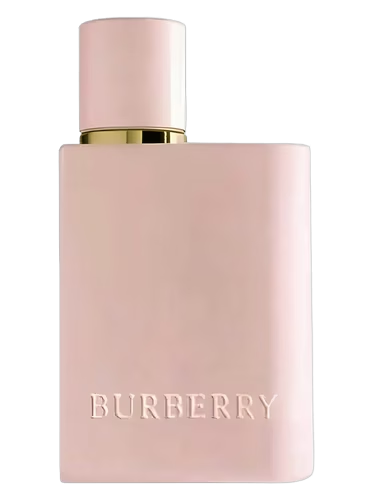
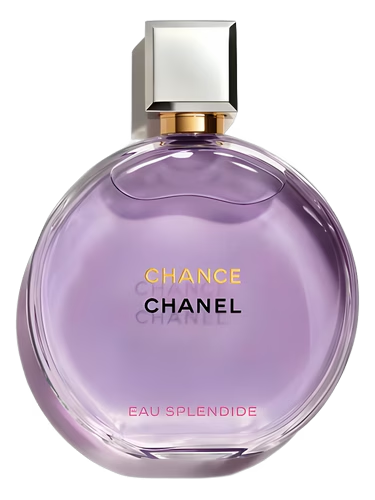
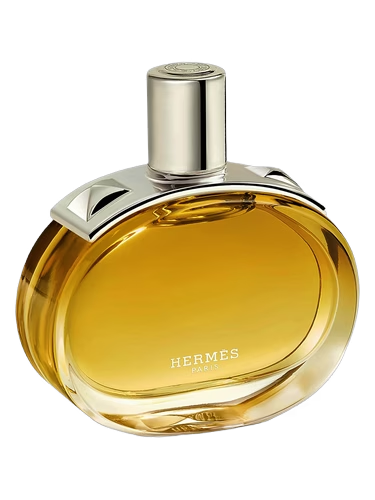
What is Hatkora Lemon?
Hatkora Lemon, also known as Citrus macroptera, is a rare semi-wild citrus fruit native to South Asia, prized for its thick, aromatic rind and sharp, bitter-sweet fragrance profile.What does Hatkora Lemon smell like?
It offers a distinct and complex aroma that is brighter and sharper than traditional lemon, featuring nuances of lime and grapefruit with a dry, slightly bitter, and spicy-citrus finish.How is Hatkora Lemon oil extracted?
The essential oil is primarily obtained through cold expression of the fresh fruit peel, although modern techniques like steam distillation and supercritical CO2 extraction are also used to isolate its aromatic compounds.What are some popular perfumes featuring Hatkora Lemon?
Notable fragrances include Ajmal Hatkora Wood, Dixit & Zak Rising Mysore, and Guerlain Aqua Allegoria Limon Verde.When is Hatkora Lemon in season?
The fruit typically reaches maturity and is harvested during the late fall and winter months, specifically from October through February in its native regions.