Fragrance Notes Are Layers Of Scent That Are Layered To Form The Final Fragrance. Fragrance Notes Are Categorised Into Three Main Elements Based On How Long They Take To Evaporate, And How Long They Typically Last Following Application: Top Notes, Heart Notes And Base Notes.
Guayacan
Guayacan wood, or Palo Santo, delivers a warm, complex, smoky woody note with balsamic depth. It features nuances of leather and a distinct, sweet, earthy resin that evokes cured wood and campfires. It is often used as a long-lasting base note to anchor and add sophisticated richness and mystery to oriental and woody compositions.

Origin & Extraction Of Guayacan
Guayacan wood, often interchangeable with Palo Santo (Bursera graveolens, though historically sometimes referring to Bulnesia sarmientoi), has long been utilized by indigenous communities in South America for ceremonial and spiritual purposes due to its distinctive aromatic smoke. Its application in Western fine perfumery is a more recent phenomenon, gaining significant popularity in the late 20th and early 21st centuries. Prior to this, classical perfumery relied on more traditional smoky and woody notes like cedar and sandalwood. Guayacan offered a unique, cleaner, and more complex woody profile—one that carries both a spiritual, ethereal quality and a deep, grounding smokiness.
In contemporary perfumery, Guayacan is highly valued for its non-volatile nature and its ability to act as a powerful anchor. It functions primarily as a sophisticated base note, lending longevity and a sensual, enveloping quality to fragrances, particularly in the oriental, leather, and deep woody genres. Its inclusion allows perfumers to evoke nuanced impressions of cured leather, earthy resin, and warm campfires, contributing depth and mystery to modern, high-end compositions.
Extraction Methods of Guaiacwood
The primary method for extracting guaiacwood essential oil is steam distillation of the heartwood and sawdust from the Bulnesia sarmientoi tree. Because the wood is extremely dense and the oil contains a high concentration of guaiacol, the distillation process is traditionally long, often running for approximately 17 to 20 hours. Historically, this involved simple hydro-distillation where wood chips were boiled in water, a practice that has been recorded for over a century. The resulting oil is unique for being a semi-solid mass at room temperature, requiring gentle warming to become a mobile liquid.
Modern extraction has evolved to include more efficient and sustainable techniques. Advanced steam distillation units now utilize pressurized dry or wet steam to better penetrate the dense wood fibers, improving yield and aromatic purity. Recent developments also include the use of subcritical water extraction (SCWE), which employs water under high pressure and temperature to significantly reduce processing time while delivering a higher quality oil rich in value-added compounds. Additionally, supercritical CO2 extraction is increasingly used to capture a more complete aromatic profile without the use of high heat or synthetic solvents.
Guayacan wood, or Palo Santo, is highly sought after in modern perfumery for its unique, spiritual, and smoky-woody signature, often acting as a sophisticated base note to grant longevity and a distinctive character. Its application is prominent in complex woody and oriental compositions, moving beyond traditional cedar or sandalwood to offer an evocative aroma reminiscent of sacred wood and sweet resin. This note provides depth, mystery, and an enveloping warmth, making it ideal for high-impact, enduring fragrances.
- One of the most famous and definitive uses of the Guayacan note is in **Byredo's Bal d'Afrique**. While primarily known as a vetiver-centric scent, the inclusion of Guayacan wood in the base anchors the composition with a warm, slightly smoky, and grounding woodiness, contributing significantly to its sophisticated and highly beloved drydown.
- Another notable fragrance that utilizes Guayacan’s unique smoky character is **Le Labo’s Santal 33**. Though sandalwood is central, Guayacan reinforces the leathery, slightly dusty, and intensely woody structure of the scent, providing it with its signature rugged persistence and earthy, cured-wood feeling, which has cemented its status as a contemporary icon.
The versatility of Guayacan allows it to be featured not only in powerful woody orientals but also in more nuanced compositions where a touch of balsamic smoke is required. Fragrances across niche and designer lines—such as **Tom Ford’s Oud Wood** and certain iterations of the **Jo Malone Wood Sage & Sea Salt**—have utilized its complexity to bridge the gap between fresh, airy accords and deep, resinous bases. Guayacan ensures that the woody element is complex, sensual, and long-lasting without becoming overly heavy or traditionally masculine.
Sustainability Of Guayacan
Sustainability of Guayacan
- Implementing sustainable management plans in the Chaco forest to combat deforestation and provide an economic incentive for forest preservation
- Sourcing guaiac wood as a sustainable by-product of the wood industry, utilizing leftover wood shavings, sawdust, and dead branches
- Adopting responsible harvesting practices in Paraguay that ensure the protection of natural surroundings and biodiversity
- Establishing direct partnerships with local communities to promote ethical sourcing and ensure the long-term viability of the resource
- Utilizing synthetic alternatives to reduce pressure on wild populations of endangered true Lignum vitae species
Trivia
Guaiac wood is so exceptionally dense that it does not float in water, a characteristic that led to its historical use in crafting heavy-duty items like bowling balls and propeller shaft bearings for steamships.
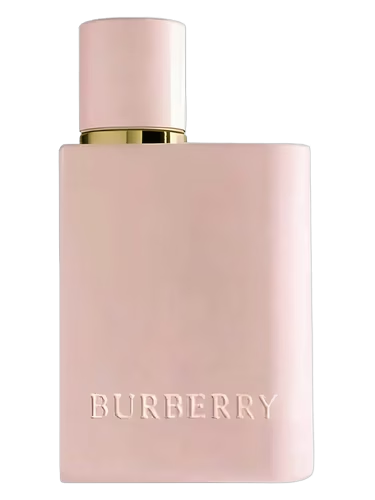
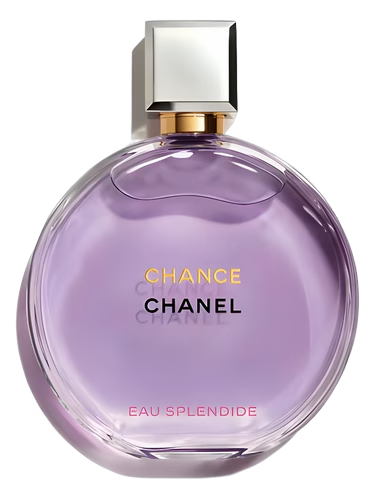
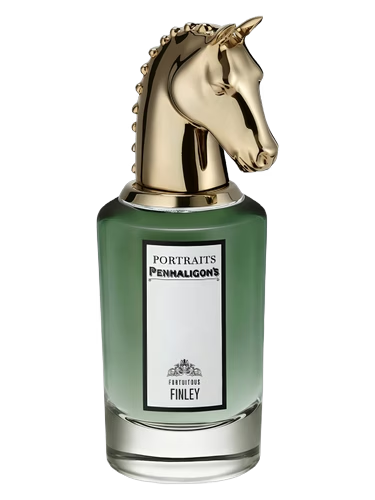
Most Popular Scents Using Guayacan
What is Guayacan?
Guayacan, often referred to as Palo Santo, is a dense wood native to the Caribbean and South America, historically used for spiritual purposes and valued in perfumery as a powerful grounding base note.What does Guayacan smell like?
It delivers a warm, complex, and smoky woody aroma with balsamic depth, featuring nuances of leather and sweet, earthy resin reminiscent of campfires and cured wood.How is Guayacan essence extracted?
The essential oil is primarily obtained through a long steam distillation process of the heartwood and sawdust, producing a unique substance that is semi-solid at room temperature.What are some top perfumes featuring Guayacan?
Notable fragrances include Le Labo Gaiac 10 Tokyo, Byredo Bal d'Afrique, Le Labo Santal 33, and Maison Francis Kurkdjian Oud.When is Guayacan in season?
The tree follows a seasonal cycle tied to rainfall, typically remaining bare during dry periods and bursting into a brief, spectacular bloom for five to eight days following the first rains.