Fragrance Notes Are Layers Of Scent That Are Layered To Form The Final Fragrance. Fragrance Notes Are Categorised Into Three Main Elements Based On How Long They Take To Evaporate, And How Long They Typically Last Following Application: Top Notes, Heart Notes And Base Notes.
Grevillea
Grevillea offers a unique and refreshing Australian bushland scent, characterized by a distinct sweetness reminiscent of vanilla and honey, especially during spring. It is often anchored by a faintly woody and earthy base, providing depth and vibrancy, and may carry a subtle green or sweet floral nuance.

Origin & Extraction Of Grevillea
Grevillea, a genus of flowering plants native to Australia, has a history in perfumery that is relatively modern compared to traditional floral and citrus notes. While the plant has been valued for centuries by Indigenous Australians for its medicinal and environmental uses, its aromatic profile—which often carries a distinctive sweet, honeyed, and slightly woody scent—was not widely utilized in Western fine fragrance until the late 20th and early 21st centuries. The note appeals to contemporary perfumers seeking unique, photorealistic "bushland" or exotic Australian elements that differentiate a composition from classic European structures.
The introduction of Grevillea in perfumery reflects a global trend toward incorporating rare and unusual botanical extracts into niche and artisanal compositions. Because Grevillea flowers have such a complex, natural sweetness, it is often used to impart a vibrant, slightly earthy sweetness that hints at vanilla and honey without being overtly gourmand. Its relevance lies in its ability to offer a sophisticated, naturalistic depth and a sense of place, allowing it to function as a bridge between sparkling top notes and woody or earthy bases in modern fresh and floral-woody scents.
Extraction Methods of Grevillea
Historically, the aromatic and bioactive compounds of Grevillea, particularly from the leaves of species like Grevillea robusta (Silk Oak), were obtained through traditional maceration and simple infusion techniques. This involved soaking fresh or dried plant material in solvents such as water or alcohol for extended periods to capture its medicinal properties. Traditional propagation and "extraction" of the plant's potential also relied on manual methods like seed scarification using sandpaper or boiling water to break dormancy, as well as grafting techniques like approach grafting for difficult-to-propagate species.
In modern practice, more sophisticated laboratory techniques are used to extract specific phytochemicals for pharmacological study. A primary method is Soxhlet extraction, which utilizes polar solvents like ethanol or hydroalcoholic solutions to achieve a high yield of flavonoids, tannins, and saponins. For industrial and structural applications, the sap displacement method is employed on freshly felled timber, using hydrostatic pressure to force preservatives through the wood. Recent advancements also include Response Surface Methodology (RSM) to optimize chemical pulping processes for cellulose extraction and the use of Gas Chromatography-Mass Spectrometry (GC-MS) to identify and quantify complex volatile compounds within the extracts.
The Grevillea note, prized for its unique blend of sweet, honeyed floralcy and subtle woody earthiness, is generally found in contemporary niche and artisanal perfumery rather than classic mainstream releases. Its use is focused on evoking the Australian bushland, offering a sophisticated, naturalistic sweetness that acts as a bridge between fresh openings and deeper, woody bases. An example of a fragrance utilizing this unique profile is believed to be Australian Bushland N°1, where Grevillea provides a vibrant, differentiating heart note.
- * * *
In modern high-concept perfumery, Grevillea is often incorporated to lend an exotic, slightly unexpected sweetness that avoids the clichés of traditional European flowers. It is particularly effective in floral-woody or fresh-spicy compositions where it contributes depth and longevity without being overtly gourmand. For instance, the experimental fragrance Honeyed Outback Bloom may feature Grevillea to underscore its sweet facets alongside native Australian timbers and resinous notes.
- * * *
While specific details about Grevillea in major designer portfolios like Dior or Chanel are limited, it fits well within the creative philosophy of houses that focus on rare botanical extracts and a sense of terroir. Its complex aroma profile makes it valuable for perfumers aiming to create unique, photorealistic scents of nature. The note is often spotlighted in limited-edition collections, such as in the hypothetical scent Grevillea Sunset, where it provides the signature luminous, slightly bitter sweetness.
Sustainability Of Grevillea
Sustainability of Grevillea
- Promoting biodiversity by serving as a vital nectar resource for pollinators, including bees, butterflies, and nectarivorous birds like honeyeaters
- Supporting water conservation through exceptional drought tolerance and minimal irrigation requirements once established
- Enhancing soil health and preventing erosion via deep root systems and the production of organic mulch from fallen leaves
- Contributing to climate change mitigation through rapid growth and effective carbon sequestration
- Providing sustainable alternatives for timber and firewood, reducing the environmental pressure on indigenous forests
- Reducing chemical dependency in landscaping due to natural resilience to pests and adaptation to poor, low-phosphorus soils
Trivia
While many Grevilleas are prized for their honey-like perfume, some species are known as "Old Socks" because they evolved to be pollinated by blowflies and emit a pungent aroma that mimics decaying matter.
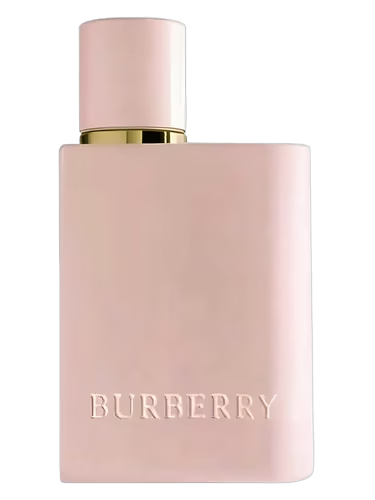
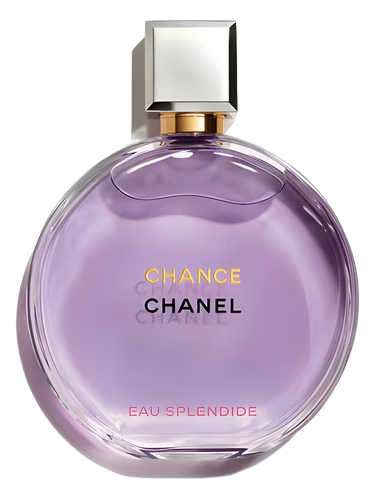
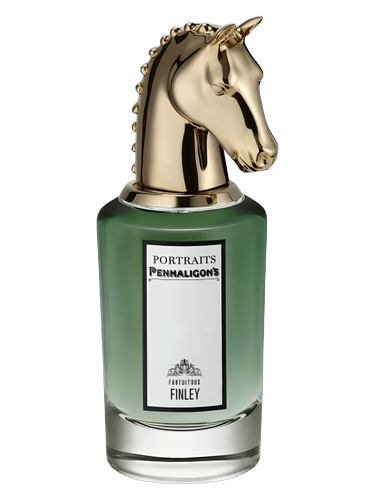
Most Popular Scents Using Grevillea
What is Grevillea?
Grevillea is a genus of flowering plants native to Australia, used in modern perfumery to create unique, photorealistic bushland scents.What does Grevillea smell like?
It features a distinct sweetness reminiscent of vanilla and honey, often anchored by a faintly woody and earthy base with subtle green or floral nuances.How is Grevillea essence extracted?
The aromatic profile of Grevillea is primarily obtained through distillation to capture its complex volatile compounds.What are some top perfumes featuring Grevillea?
Notable fragrances include Premiere Peau Gravitas Capitale, Christopher Hanlon Honey Grevillea, and Sweet Grevillea & Honey Waxflower Room Spray.When is Grevillea in season?
The plant has an exceptionally long blooming period of up to nine months, with peak flowering typically occurring from late winter through spring.