Fragrance Notes Are Layers Of Scent That Are Layered To Form The Final Fragrance. Fragrance Notes Are Categorised Into Three Main Elements Based On How Long They Take To Evaporate, And How Long They Typically Last Following Application: Top Notes, Heart Notes And Base Notes.
Green Tea Flower
Green Tea Flower offers a delicate, fresh, and luminous aroma, softer than the tea leaf. It blends subtle, sweet floral nuances with a transparent, crisp green tea accord, imparting a clean, slightly watery freshness. It provides an elegant, uplifting, and refined top/heart note with a gentle, earthy depth.

Origin & Extraction Of Green Tea Flower
The history of tea in perfumery traditionally centers on the green tea leaf note (often associated with 1990s fragrances like Bvlgari's Eau Parfumée). The Green Tea Flower note, however, is a more refined and contemporary development. The flower itself is subtle and less historically prominent than the leaf in Asian traditions. Perfumers isolated and utilized the "flower" note to capture a softer, more delicate, and luminous aspect of the tea plant, moving away from the crisp, sometimes bitter, herbal profile of the green tea leaf. This note is often synthesized to evoke a clean, transparent, and slightly sweet floral freshness.
The Green Tea Flower note gained relevance in fine perfumery during the late 20th and early 21st centuries, reflecting a trend toward greater nuance and photorealism in floral and fresh categories. It provides an elegant alternative for designers seeking a gentle, uplifting freshness that combines subtle floral sweetness with a clean, watery tea accord. Because it is softer and less sharp than the leaf, it is perfectly suited for sophisticated, airy compositions that require a refined top or heart note with gentle, enduring depth.
Extraction Methods of Green Tea Flower
Historically, the aromatic compounds of green tea flowers were captured through traditional solid-liquid extraction techniques such as maceration and infusion. These age-old methods involved steeping the delicate blossoms in hot or cold water or alcohol for extended periods to leach out their volatile oils and polyphenols. Another traditional approach was hydro-distillation, where water was boiled with the floral material to collect the scented steam, although this often risked thermal degradation of the flower's sensitive aromatic profile.
In modern perfumery and phytochemical recovery, advanced green technologies have replaced conventional solvent-heavy processes to improve yield and preserve olfactory integrity. Ultrasound-assisted extraction (UAE) uses pressure waves to create cavitation bubbles that disrupt cell membranes at lower temperatures, while microwave-assisted extraction (MAE) utilizes electromagnetic radiation to rapidly release target molecules. Furthermore, supercritical fluid extraction (SFE) using CO2 has become a gold standard for creating high-purity absolutes, as it operates at near-room temperatures to capture the true-to-nature scent of the fresh flower without leaving solvent residues.
The Green Tea Flower note, prized for its delicate, luminous, and refined freshness, is often used to impart an elegant, airy quality to compositions that seek to move beyond the herbal crispness of the green tea leaf. A key fragrance that exemplifies this delicate floral facet is **Elizabeth Arden Green Tea Lotus**. In this scent, the Green Tea Flower provides a soft, subtly sweet heart, balancing the zesty opening notes and leading into a clean, watery finish. This usage highlights the note's ability to act as a sophisticated floral bridge rather than just a fleeting fresh accent.
In contemporary niche perfumery, the Green Tea Flower note is utilized for its transparent and slightly watery freshness, making it ideal for minimalist or aquatic-inspired scents. For instance, in fragrances focusing on serene, meditative themes, the note lends a gentle, clean sweetness that suggests a blossoming garden rather than a sharp citrus burst. While not always listed explicitly, scents within the Bvlgari Eau Parfumée line, particularly those that incorporate refined floral elements alongside tea, often leverage the delicate effect reminiscent of the Green Tea Flower to create their signature luminous texture.
The versatility of the Green Tea Flower also allows it to be paired successfully with heavier bases, where it provides necessary lift and clarity. In this context, it prevents sweeter or woodier drydowns from becoming too dense, maintaining an overall sense of elegance and lightness. Another notable example that embraces the full-bodied tea note, including its floral dimension, is the fragrance line **Jo Malone Tea Collection**, where various delicate tea blossoms contribute to the sophisticated, multilayered freshness, showcasing the refined, clean sweetness characteristic of the Green Tea Flower.
Sustainability Of Green Tea Flower
Sustainability of Green Tea Flower
- Promoting a circular economy by upcycling spent tea flowers and leaves as nutrient-rich mulch or compost to enhance soil structure and nitrogen levels
- Supporting biodiversity through organic cultivation and agroforestry practices that avoid synthetic pesticides and preserve habitats for pollinators
- Reducing environmental impact by prioritizing loose-leaf options over plastic-containing tea bags to eliminate microplastic shedding and landfill waste
- Implementing water conservation strategies such as rainwater harvesting and precise irrigation to maintain tea plantations without depleting local resources
- Adopting eco-friendly packaging solutions, including the use of recycled, compostable, or biodegradable materials to minimize the carbon footprint of the supply chain
Trivia
While most green tea scents come from the leaves, green tea flower notes are actually a perfumery reconstruction because no commercial essential oil is naturally extracted from the tiny, jasmine-like blossoms of the Camellia sinensis plant.
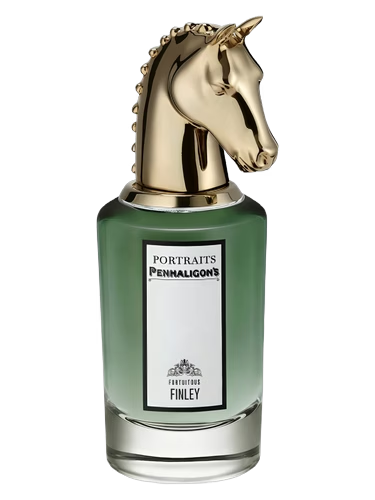
Most Popular Scents Using Green Tea Flower


What is Green Tea Flower?
Green Tea Flower is a delicate fragrance note inspired by the blossoms of the Camellia sinensis plant, offering a softer and more luminous profile than the traditional tea leaf.What does Green Tea Flower smell like?
It features a fresh, clean, and transparent aroma with subtle sweet floral nuances and a watery, crisp green tea accord.Is Green Tea Flower a natural essential oil?
No, it is typically a perfumery reconstruction or fantasy accord, as no commercial essential oil is naturally extracted from the small blossoms of the tea plant.What are some top perfumes featuring Green Tea Flower?
Notable fragrances include Elizabeth Arden Green Tea Lotus, Creed Fleur de Thé Rose Bulgare, and Bvlgari Eau Parfumée au Thé Vert.When is the Green Tea Flower in season?
The small white or pink blossoms of the Camellia sinensis plant typically emerge during the autumn months, marking the transition to cooler weather.