Fragrance Notes Are Layers Of Scent That Are Layered To Form The Final Fragrance. Fragrance Notes Are Categorised Into Three Main Elements Based On How Long They Take To Evaporate, And How Long They Typically Last Following Application: Top Notes, Heart Notes And Base Notes.
Green Nard
Green Nard offers a complex, deep floral-green scent. It combines the warm, earthy, and slightly spicy/medicinal facets of traditional Nard (spikenard) with a sharp, vibrant green freshness, suggesting the unripe tuberose or narcissus stem. It is deeply aromatic, grounding, and mystical, adding an intense, naturalistic complexity.

Origin & Extraction Of Green Nard
The history of Nard (Spikenard, Nardostachys jatamansi), the precursor to the 'Green Nard' note, is ancient and deeply spiritual, originating in the Himalayas, India, and China. Throughout antiquity, Nard was a highly prized and expensive aromatic, frequently associated with luxury, ritual, and the upper classes of society. It is famously mentioned in Biblical texts—most notably when Mary of Bethany used it to anoint Jesus' feet—as well as in works by Dioscorides, who categorized different types of nard (Syrian, Indian, and Celtic). Historically, the scent was warm, earthy, and slightly medicinal, used not just for perfume but also in traditional medicine and religious ceremonies.
In modern perfumery, 'Green Nard' is a sophisticated evolution of the traditional Nard profile. While classic Nard is a deep, grounding base note, 'Green Nard' specifically incorporates a sharp, vibrant green freshness, often likened to the scent of unripe tuberose or narcissus stems, as described in the odor profile. This contemporary interpretation allows perfumers to utilize Nard's characteristic earthy, mystical complexity while introducing an invigorating, naturalistic lift. The use of the "green" facet reflects a 21st-century trend toward utilizing more photorealistic and complex vegetal elements to bridge volatile top notes with deep, aromatic heart notes.
Extraction Methods of Green Nard
The primary and traditional method for extracting green nard (spikenard) essential oil from the roots and rhizomes of Nardostachys jatamansi is steam distillation. Historically, this process involved simple hydro-distillation where the plant material was boiled directly in water, or basic manual maceration in solvents like alcohol or oils to capture its aromatic and medicinal properties. These traditional techniques often required labor-intensive preparation, including hand-cleaning and sun-drying the rugged roots before they were crushed or ground to increase the surface area for extraction.
In modern commercial production, advanced steam distillation technology using high-pressure steam and stainless steel stills is the standard for preserving the oil's complex, earthy aroma and bioactive compounds. Recent developments have introduced microwave-assisted extraction (MAE) as an efficient, green alternative that significantly enhances the yield of secondary metabolites like phenols and flavonoids compared to traditional maceration. Additionally, innovative techniques such as supercritical CO2 extraction and the use of natural deep eutectic solvents (NADES) are being explored to provide highly selective, eco-friendly recovery of the plant's volatile compounds with minimal environmental impact.
The "Green Nard" note, a modern and complex interpretation of traditional Spikenard, is primarily utilized by niche and artisan perfumers seeking to lend an intense, naturalistic, and mystical complexity to their creations. This note, which marries the deep, earthy, and slightly medicinal warmth of Nard with a sharp, vibrant green freshness (akin to unripe tuberose or narcissus stem), appeals to those looking for unique, grounding, and aromatic complexity beyond standard floral or oriental structures.
- Dux Orientis by Pana Dora (2024)
- Norne Oil by Slumberhouse (2021)
- Chéngmén by January Scent Project (2023)
The usage of Green Nard is often seen in high-concept fragrances that explore themes of nature, ancient ritual, and deep earthiness. For example, Norne Oil is famously known for its dense, smoky, and resinous forest profile, where the Nard element provides a dark, grounding, and slightly medicinal depth. Similarly, the note features in works like Nimere' by Nimere' XVI and Earth (Земля) by Acidica Perfumes, often complementing other intense notes such as oudh, patchouli, or dark woods to amplify their aromatic and spiritual intensity.
- Nimere' by Nimere' XVI by Nimere Parfums (2016)
- Earth (Земля) by Acidica Perfumes (2018)
- Oudh by Amberfig (2015)
In contrast to traditional Nard, which functioned largely as a heavy base, Green Nard’s fresh, vibrant facet makes it suitable for more versatile, contemporary compositions. Its inclusion in perfumes like Dux Orientis showcases its ability to integrate into complex compositions that bridge rich oriental elements with sharp, invigorating green top notes, providing a sophisticated link between volatility and longevity.
Sustainability Of Green Nard
Sustainability of Green Nard
- Promoting the cultivation of Jatamansi (Green Nard) through sustainable harvesting practices to prevent the overexploitation of wild populations in the Himalayan region
- Supporting the establishment of community-based conservation initiatives and cooperatives that ensure fair trade and socio-economic benefits for local collectors
- Adoption of organic farming techniques and greenhouse cultivation to reduce pressure on natural habitats and maintain biodiversity
- Implementing responsible sourcing and traceability standards, such as CITES and FairWild certifications, to ensure ethical extraction and trade of the essential oil
- Utilizing energy-efficient steam distillation methods and recycling water used in the extraction process to minimize the environmental footprint
Trivia
Green nard is a fresher, less aged preparation of spikenard that is famously known as the nard of the Bible, which Mary Magdalene used to anoint the feet of Jesus.
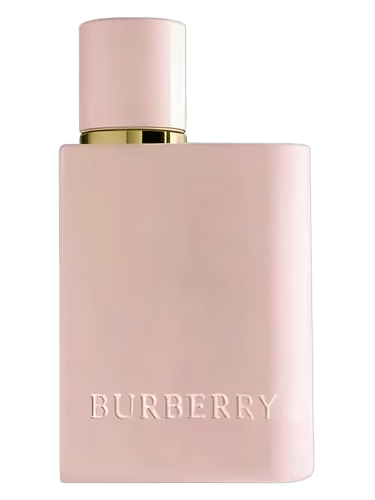
Most Popular Scents Using Green Nard


What is Green Nard?
Green Nard is a modern, sophisticated fragrance note derived from Spikenard (Nardostachys jatamansi), characterized by its combination of traditional earthy, medicinal warmth and a sharp, vibrant green freshness.What does Green Nard smell like?
It offers a complex, deep floral-green aroma that blends warm, spicy, and earthy facets with a crisp, naturalistic lift reminiscent of unripe tuberose or narcissus stems.How is Green Nard extracted?
The essential oil is primarily obtained through steam distillation of the roots and rhizomes of the Nardostachys jatamansi plant, a method that preserves its intricate aromatic profile.What are some top perfumes featuring Green Nard?
Notable fragrances that utilize this note include Pana Dora Dux Orientis, Slumberhouse Norne Oil, January Scent Project Chéngmén, and Alexandre.J Majestic Nard.When is Green Nard harvested?
The ideal collection period for the source plant, Jatamansi, typically occurs between September and November in the high-altitude Himalayan regions to ensure optimum oil yield.