Fragrance Notes Are Layers Of Scent That Are Layered To Form The Final Fragrance. Fragrance Notes Are Categorised Into Three Main Elements Based On How Long They Take To Evaporate, And How Long They Typically Last Following Application: Top Notes, Heart Notes And Base Notes.
Great Burnet
Great Burnet offers a complex, earthy-green profile, blending the scent of damp soil and dried leaves with subtle herbaceous, smoky undertones. It features a unique juxtaposition of savory depth and a surprising lift of sweet, slightly fruity nuances. This note provides rich, natural complexity and longevity to heart and base accords.

Origin & Extraction Of Great Burnet
Great Burnet (Sanguisorba officinalis), though long utilized in traditional herbalism and folk medicine, is a relatively modern and niche addition to the palette of fine perfumery. Its complex profile—which ranges from rooty, earthy soil notes to subtle, savory smokiness—does not align with the classic structures that dominated perfumery until the late 20th century, which favored dominant florals, citruses, and resins. Its introduction to modern fragrance is driven by perfumers' desire to incorporate highly naturalistic, challenging, and unique aromatic facets that evoke specific landscapes and earthy textures, moving beyond conventional synthetic or common botanical extractions.
Today, Great Burnet is valued specifically for its ability to add complex depth and unique longevity, functioning as a sophisticated bridge between volatile top notes and tenacious base notes. It provides an authentic "earthy-green" foundation, often utilized in abstract nature-themed compositions, niche offerings, and fragrances seeking an unusual herbaceous or mineral character. Its use signifies a contemporary trend in perfumery towards hyper-realistic, textural, and less conventional raw materials, appealing to a clientele seeking complex, nuanced scents rather than simple, mass-market freshness.
Historically, the extraction of Great Burnet (Sanguisorba officinalis) has been rooted in traditional herbal medicine, where the roots and aerial parts are harvested in autumn and dried for use in decoctions, infusions, and macerations. Traditional methods involve simmering dried roots in water for approximately 30 minutes to create a potent decoction or soaking them for several hours to extract tannins and other medicinal compounds. In folk practices, simple tinctures are also created by steeping the plant material in alcohol for several weeks.
In modern pharmaceutical and laboratory settings, extraction methods have evolved to include ultrasound-assisted extraction (UAE) to optimize the yield of phenolic acids and antioxidants, often using ethanol-water solvents. Steam distillation is employed to isolate the essential oil from the plant's aerial parts, while advanced analytical techniques like High-Performance Liquid Chromatography (HPLC) and Gas Chromatography-Mass Spectrometry (GC-MS) are used to identify and quantify specific bioactive components. While the herb is cultivated for traditional medicine, it is not currently extracted at a commercial scale for the perfumery industry.
Great Burnet (Sanguisorba officinalis) is a distinctive, complex note prized in modern artisanal and niche perfumery for its deep, earthy, and green profile, often incorporating smoky and mineral nuances. Because it is a relatively unusual and challenging note, it is typically featured in avant-garde compositions designed to evoke hyper-realistic natural landscapes or unique textures. One of the most critically acclaimed uses of Great Burnet is in the conceptual fragrance line by Comme des Garçons, where it contributes to a non-traditional, grounded aesthetic.
- The Great Burnet note often functions as a long-lasting anchor, providing the complexity of damp soil and dried herbs that contrasts sharply with lighter, more volatile top notes. This textural complexity makes it highly valuable in compositions where depth and naturalism are prioritized over traditional floral sweetness.
A notable example of its sophistication is found in **Sanguisorba** by Zoologist Perfumes. This fragrance centers the Great Burnet note, leveraging its dark green, slightly metallic, and savory qualities to craft an intense and evocative portrait of the plant in a damp, shadowy environment. It demonstrates how Great Burnet can move beyond a mere supporting role to become the central, defining character of a scent, appealing to collectors who seek complexity and uniqueness in their fragrance wardrobe.
- While not a mainstream note like Rose or Sandalwood, Great Burnet is increasingly adopted by independent houses specializing in dark, Gothic, or nature-inspired scents. Its inclusion guarantees a fragrance will possess an immediate and memorable earthy signature, moving away from common fresh or sweet profiles.
Another excellent utilization of Great Burnet's multifaceted character is in select niche lines that explore herbal and aromatic complexity. It has been used subtly in experimental releases, adding a touch of smoky earthiness to prevent the composition from becoming overly clean or synthetic. It is a powerful, grounding note that provides remarkable longevity, often pairing expertly with vetiver, patchouli, and deep woody accords to enhance their natural, subterranean facets, solidifying its place as a sophisticated tool for modern perfumers.
Sustainability Of Great Burnet
Sustainability of Great Burnet
- Promoting the restoration of floodplain meadows, a declining and threatened habitat where Great burnet serves as a vital indicator of biodiversity
- Supporting ecosystem resilience through the plant's extensive rhizome system, which stabilizes soil and allows for rapid recovery after flooding
- Implementing mitigation and translocation strategies to protect rare populations from industrial and agricultural expansion
- Enhancing pollinator health by providing abundant nectar and pollen for a wide variety of butterflies, bees, and hoverflies
- Conservation of specialist species, such as the Dusky Large Blue and Scarce Large Blue butterflies, for which the plant is the sole larval food source
- Encouraging sustainable land management practices, including strategic grazing and late-season hay cutting, to maintain flower-rich grasslands
- Utilizing citizen science initiatives to monitor distribution, population size, and habitat health to inform long-term conservation efforts
Trivia
Great burnet's name comes from the Latin words sanguis (blood) and sorbere (to absorb), reflecting its historical use by Roman soldiers who carried it into battle to staunch wounds and stop bleeding.
Most Popular Scents Using Great Burnet


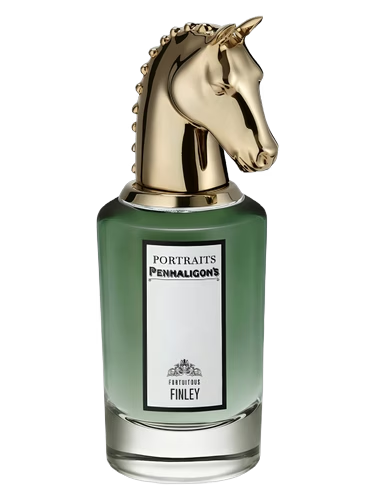
What is Great Burnet?
Great Burnet, or Sanguisorba officinalis, is a hardy perennial plant native to the Northern Hemisphere, used in niche perfumery for its unique earthy and green aromatic profile.What does Great Burnet smell like?
It offers a complex, earthy-green scent with notes of damp soil, dried leaves, and subtle herbaceous or smoky undertones, balanced by a hint of sweetness.How is Great Burnet essence extracted?
In modern settings, the essential oil is isolated through steam distillation of the plant's aerial parts, while traditional methods involve decoctions or alcohol-based tinctures.What are some top perfumes featuring Great Burnet?
Notable fragrances include Zoologist Sanguisorba, Auphorie Shennong, and The Burren Perfumery Wild Rose.When is Great Burnet in season?
The plant begins growing in early spring, producing maroon flowers from midsummer through autumn, with peak blooming occurring between June and September.