Fragrance Notes Are Layers Of Scent That Are Layered To Form The Final Fragrance. Fragrance Notes Are Categorised Into Three Main Elements Based On How Long They Take To Evaporate, And How Long They Typically Last Following Application: Top Notes, Heart Notes And Base Notes.
Goldenrod
Goldenrod Oil offers a unique profile that is Herbal, Terpenic, and Floral. It possesses a complex aroma that blends well with notes like Black Pepper, Cedarwood, Sandalwood, and Vetiver. Used in perfumery for its relaxing qualities, it contributes a distinct, naturalistic, and soothing complexity to compositions.

Origin & Extraction Of Goldenrod
Goldenrod (Solidago) has a history primarily rooted in traditional folk medicine and herbalism across North America and Europe, rather than classical perfumery. While many botanical notes were established in European fragrance during the 17th and 18th centuries, Goldenrod remained largely outside of fine fragrance palettes. Its use historically centered on its medicinal properties and as a source of dye. The essential oil, valued for its complex herbal, terpenic, and sometimes relaxing qualities, began to draw attention in the late 20th and 21st centuries as perfumers explored more naturalistic and unusual floral/herbaceous notes.
In modern perfumery, Goldenrod is a niche note, utilized to impart a distinct, naturalistic, and slightly soothing complexity. It often features in 'botanical' or 'natural' perfumery movements and in compositions aiming for an authentic, untamed meadow or forest scent. It is valued not for its prominence, but for its unique ability to bridge traditional floral or aromatic structures with dry, woody, or slightly spicy base notes, often lending a subtle, relaxing dimension that distinguishes it from more common floral or herbal ingredients.
Extraction Methods of Goldenrod
The primary method for extracting goldenrod essential oil is steam distillation of the plant's flowering tops. In this process, fresh or pre-dried flowering tops are loaded into stainless steel chambers where pressurized steam is passed through the material to vaporize the volatile aromatic compounds. The resulting vapor is then cooled and condensed into a liquid form, allowing the essential oil to be separated from the hydrosol.
Historically, goldenrod has been processed through simple infusion and maceration techniques to capture its medicinal properties. Traditional folk methods involve steeping the aerial parts in solvents like alcohol to create tinctures or in carrier oils to create infused oils. Modern advancements have introduced more efficient techniques such as microwave-assisted hydrodistillation, which shortens extraction time and improves yield, and solvent-free microwave extraction, which eliminates the need for added water or chemicals. High-performance liquid chromatography (HPLC) and GC-MS analysis are now standard for verifying the purity and chemical profile of the extracted oil.
Goldenrod is not a common component in mainstream designer perfumery, but it is highly valued in the niche and artisanal fragrance world for its unique herbal, terpenic, and naturalistic qualities. It is often employed to evoke the scent of an authentic, untamed landscape, lending a dry, slightly spicy, and soothing complexity that sets a composition apart from traditional florals. Its primary use is in modern botanical creations where the goal is to bridge aromatic structures with dry, earthy, or woody notes.
- One notable example where Goldenrod (or a related Solidago accord) plays a role in establishing a natural, meadow-like scent is in certain limited-edition or small-batch releases from houses dedicated to organic and wild-harvested ingredients. For instance, brands like Providence Perfume Co. have utilized botanical extracts that include Goldenrod to achieve an authentic, complex green structure in fragrances such as those with a dry, herbaceous focus like Moss Gown or Heart of Darkness, where the note supports the drydown with its relaxing, terpenic subtlety.
The complexity of Goldenrod, particularly its slight bitterness and woody undertones, makes it an excellent note for unisex and masculine-leaning fresh compositions. It often works in tandem with notes like vetiver, cedarwood, and black pepper (as noted in its odor profile) to provide a distinctive aromatic lift. This characteristic can be found in more experimental or conceptual fragrances, helping to ground brighter elements and add longevity to what would otherwise be a fleeting herbal top note, creating a scent reminiscent of dried fields or late summer air.
While definitive mass-market "famous perfumes" centered solely on Goldenrod are rare, its subtle presence is crucial in sophisticated natural perfumery. The note contributes to the overall texture and narrative of the scent, often appearing in fragrances designed to be evocative of specific North American landscapes or herbal traditions. It elevates simple compositions by injecting a refined, unconventional green note, making the scent more layered and authentically natural. Its use contrasts sharply with the sharp, acidic citruses, offering a more tranquil and grounded freshness.
Sustainability Of Goldenrod
Sustainability of Goldenrod
- Supporting biodiversity by serving as a vital host plant and nectar source for various birds, butterflies, and native pollinators during the late-season bloom
- Promoting the use of wildcrafted and native plant species which require minimal agrochemical inputs and are naturally deer-resistant
- Utilizing hardy, drought-tolerant perennials that thrive in nutrient-poor or sandy soils, reducing the need for intensive soil management and irrigation
- Encouraging the cultivation of well-behaved, clump-forming varieties that do not spread aggressively, helping to maintain ecological balance in garden and meadow settings
- Adopting steam distillation methods for essential oil extraction from flowering tops to capture aromatic compounds efficiently while utilizing renewable botanical resources
Trivia
Thomas Edison used rubber extracted from the goldenrod plant to produce tires for a Model T Ford given to him by Henry Ford.
Most Popular Scents Using Goldenrod
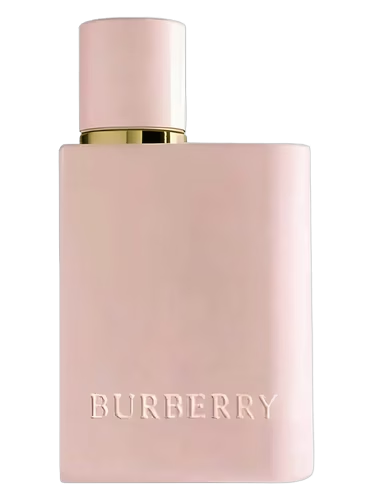
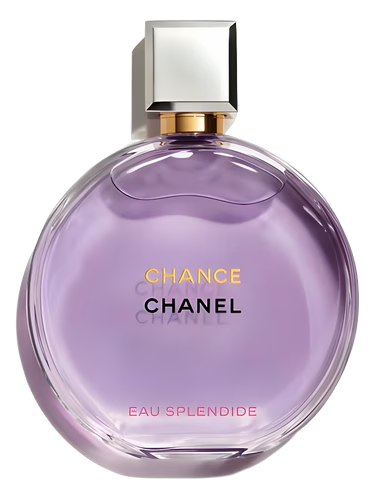
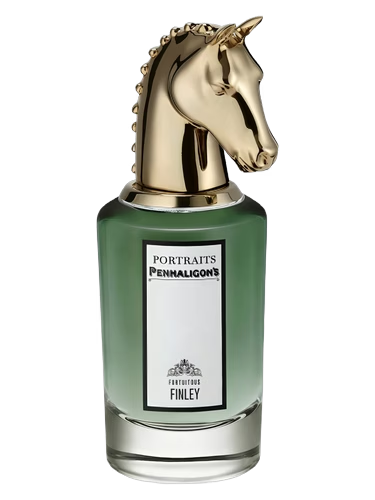
What is Goldenrod?
Goldenrod is a flowering perennial from the Solidago genus, primarily native to North America, whose essential oil is used in niche and botanical perfumery for its unique herbal and naturalistic qualities.What does Goldenrod smell like?
It offers a complex, soothing aroma characterized by herbal, terpenic, and floral facets, often featuring slight bitterness and dry, woody undertones reminiscent of untamed meadows.How is Goldenrod essence extracted?
The essential oil is primarily obtained through the steam distillation of the plant's flowering tops, a process that captures its volatile aromatic compounds.What are some top perfumes featuring Goldenrod?
Notable fragrances that utilize Goldenrod or its accords include Ralph Lauren Polo 67, Jorum Studio Vernus, Pineward Perfumes Acadian, and Providence Perfume Co. Moss Gown.When is Goldenrod in season?
Goldenrod typically blooms from late summer through autumn, with peak activity between August and November, defining the transition from summer to fall.