Fragrance Notes Are Layers Of Scent That Are Layered To Form The Final Fragrance. Fragrance Notes Are Categorised Into Three Main Elements Based On How Long They Take To Evaporate, And How Long They Typically Last Following Application: Top Notes, Heart Notes And Base Notes.
Gerbera
Gerbera offers a light, cheerful floral profile, capturing the scent of a fresh Gerbera daisy. It is characterized by bright, dewy, and slightly green facets, blending youthful optimism with white floral notes. It translates as a clean, wet, and highly realistic floral with a hint of invigorating citrus in the opening, settling into soft, clean, and musky undertones.

Origin & Extraction Of Gerbera
The Gerbera note, derived from the Gerbera daisy, is not an essential oil that can be naturally extracted; therefore, its use in perfumery is entirely a modern development achieved through synthetic reconstruction. Historically, perfumery centered on readily available and extractable materials like rose, jasmine, and citrus. The Gerbera note, with its bright, dewy, and cheerful floral profile, belongs to the realm of "silent flowers"—those that do not yield an oil through traditional methods—and thus its presence in fragrances only became possible with the advancement of headspace technology and synthetic aroma chemistry in the late 20th century.
Gerbera represents a move in modern perfumery towards capturing photorealistic and lighthearted floral bouquets. It is valued for contributing a clean, slightly citrus-tinged freshness and a feeling of youthful optimism to compositions. While it lacks the classical legacy of notes like Neroli or Bergamot, the Gerbera accord is employed by contemporary perfumers to create unique, airy floralcy, often appearing in light, transparent fragrances where clean white floral and green notes are emphasized.
Extraction Methods of Gerbera
Historically, the extraction of aromatic and medicinal compounds from Gerbera species, such as Gerbera anandria, has relied on traditional solvent extraction techniques. This often involved macerating plant material in ethanol (typically 75% concentration) to obtain a total extract. This residue would then be fractionated using solvents of varying polarities, such as light petroleum, chloroform, and ethyl acetate, followed by manual column chromatography on silica gel to isolate specific chemical constituents like coumarins, flavonoids, and sterols.
Modern extraction and separation methods for Gerbera have evolved to include more advanced mechanical and analytical technologies. Recent developments include the use of rotation planar extraction and centrifugal force (using specialized multifunctional separation tools) to isolate delicate glucosides and pyrones. Additionally, current commercial and laboratory practices utilize high-performance liquid chromatography (HPLC), medium pressure liquid chromatography (MPLC), and supercritical fluid extraction to enhance the purity and yield of volatile compounds. For the floral industry, modern post-harvest "extraction" of the flower itself emphasizes a specialized twisting technique at the base to minimize bacterial entry and preserve the plant's health for subsequent production.
The Gerbera note, being a synthetically reconstructed "silent flower" accord, is utilized primarily in modern perfumery to convey a sense of youthful optimism, brightness, and clean freshness. Because it lacks a classic history, it often appears in contemporary, light, and airy floral compositions that seek a photorealistic, dewy effect rather than a heavy, traditional structure. Fragrances from popular contemporary lines, particularly those aimed at lighthearted floral bouquets, often leverage Gerbera for its cheerful, slightly citrus-tinged floral profile.
- * * *
Specific examples demonstrating the use of Gerbera often come from accessible designer and mass-market brands aiming for uplifting simplicity. For instance, Avon utilized the note in both its lighthearted scent, Be... Joyful (2013), and the floral creation Petit Attitude Floret. These fragrances showcase Gerbera's ability to provide a clean, bright, and slightly sweet white floral opening that is immediately cheerful and approachable, reinforcing its reputation as a non-intrusive, happy floral component.
- * * *
In addition to these, other brands have incorporated Gerbera to achieve a similar light, fresh character. Examples include Sommertraum by Dr. Grandel (2011), Lovers Bouquet by Love Passport, and Samouraï Woman Vanity Flora (2014). The note is particularly effective in transparent fragrances, where its dewy, green facets prevent the composition from becoming overly sweet or heavy, allowing it to maintain a sparkling, invigorating presence in the top and heart phases of the scent.
Sustainability Of Gerbera
Sustainability of Gerbera
- Implementing integrated crop protection by using biological control agents and natural enemies to minimize chemical use
- Adopting closed-loop water systems that collect, disinfect with UV radiation, and recycle drain water and fertilizers to prevent environmental emissions
- Utilizing sustainable energy sources such as solar panels and geothermal heat to power greenhouses and processing facilities
- Transitioning to energy-efficient LED lighting and advanced dehumidification systems to reduce power and gas consumption by up to 50%
- Applying Next Generation Growing techniques and thermal screens to optimize climate control and minimize heat loss
- Promoting a circular economy by separating waste streams and repurposing materials into recyclable or FSC-certified products
- Maintaining high industry standards through certifications such as MPS-A, MPS-GAP, GRASP, and Sedex to ensure ethical and environmental compliance
Trivia
What appears to be a single Gerbera bloom is actually a composite flower made up of hundreds of tiny individual flowers, and just like sunflowers, they are phototropic, meaning they actively turn their faces to follow the sun's path throughout the day.
Most Popular Scents Using Gerbera
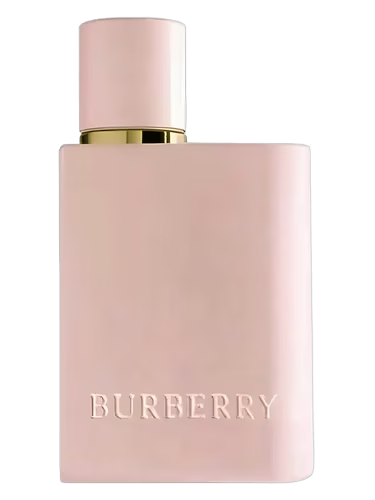
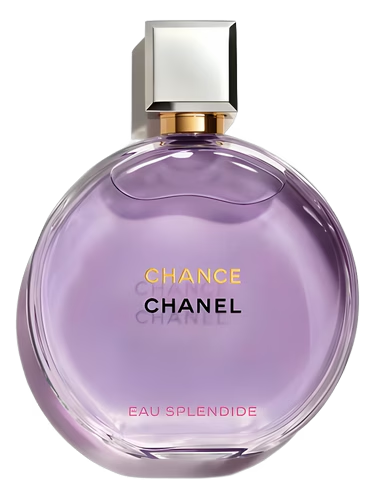
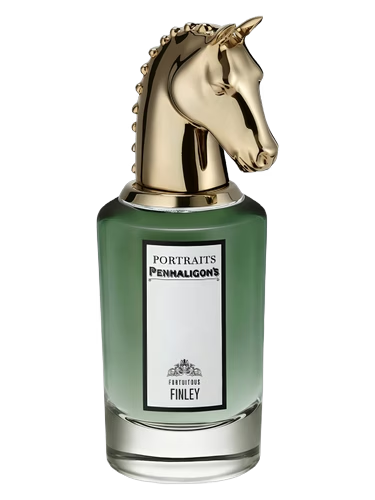
What is Gerbera?
Gerbera is a cheerful, modern floral note inspired by the Gerbera daisy, native to Southern Africa, and valued in perfumery for its bright and youthful character.What does Gerbera smell like?
It offers a light, dewy floral profile with slightly green facets, featuring a clean, wet scent with citrusy top notes and soft, musky undertones.Is Gerbera a natural perfume note?
No, Gerbera is considered a silent flower that does not yield essential oil; its fragrance is synthetically reconstructed using headspace technology and aroma chemistry.What are some top perfumes featuring Gerbera?
Fragrances featuring this note include L.T. Piver Gerbera, Fragrenza Amarena Cherry, Tom Ford Lost Cherry, and Nishane Iris-Musk Skin Scent.When is Gerbera in season?
Gerbera daisies have a long blooming season that typically begins in early spring and continues through the first frost of autumn.