Fragrance Notes Are Layers Of Scent That Are Layered To Form The Final Fragrance. Fragrance Notes Are Categorised Into Three Main Elements Based On How Long They Take To Evaporate, And How Long They Typically Last Following Application: Top Notes, Heart Notes And Base Notes.
Fringed Pink
Fringed Pink offers a delicate, sweet floral aroma with characteristic spicy, warm undertones, closely resembling the scent of clove or carnation (Dianthus). It presents a bright, slightly peppery lift, often used to bridge fresh floral notes with deeper spice accords, lending compositions a vintage, sophisticated complexity and warmth.

Origin & Extraction Of Fringed Pink
The Fringed Pink, or Dianthus superbus, is part of the extensive Carnation (Dianthus) family, which has a long and valued history in perfumery, particularly for its spicy-floral aromatic profile. While the specific Fringed Pink flower may be a niche ingredient, its spicy character aligns with the classic use of the carnation note, which peaked in popularity during the late 19th and early 20th centuries. Due to the high cost and labor involved in extracting the natural carnation absolute, perfumers often recreated this scent profile using the spicy chemical component eugenol, which is prominently found in clove, mimicking the warm, peppery lift characteristic of Fringed Pink.
In modern perfumery, notes like Fringed Pink are utilized to introduce a vintage sensibility and complexity, bridging soft floral hearts with warmer, oriental or spicy bases. Although the broader carnation/clove accord has seen reduced prominence since its golden age, it remains a sophisticated element in niche and traditional compositions, favored for its ability to add a bright, peppery warmth and a subtle, enduring sweetness, offering a contrast to purely sweet or fresh florals.
Extraction Methods of Fringed Pink
Historically, the scent and pigments of fringed pink (Dianthus superbus) were captured through traditional aqueous and alcoholic extraction methods. These conventional techniques involved boiling the fresh flowers in distilled water or soaking them in solvents like ethanol or honey to create medicinal decoctions and aromatic tonics. In traditional perfumery, simpler forms of maceration and infusion were used to harness the delicate, spicy-sweet clove character of the blossoms.
Modern extraction methods have evolved to include more efficient and precise technologies such as steam distillation, which captures the volatile essential oils, and solvent extraction using acidified ethanol or water to isolate specific pigments like anthocyanins. Advanced non-conventional techniques such as ultrasound-assisted extraction (UAE), microwave-assisted extraction (MAE), and supercritical fluid extraction are now employed to increase yield and preserve the integrity of heat-sensitive aromatic compounds and bioactive phytochemicals without molecular degradation.
The Fringed Pink note, due to its characteristic spicy warmth and resemblance to carnation (Dianthus) and clove, often appears in classic and sophisticated compositions, particularly those striving for a vintage aesthetic. Although Fringed Pink itself might be a niche ingredient, its spicy-floral profile is central to the history of perfumery. The broader carnation accord it belongs to was hugely popular in the early to mid-20th century. While difficult to find explicitly listed, the spirit of this note is captured in legendary perfumes that utilize a prominent clove/spice-floral structure, lending them a bright, peppery warmth and lasting complexity.
- The opulent and dramatic style of perfumes from the early 20th century heavily featured the carnation/clove profile. A classic example where a rich, spicy floral is paramount is **L'Air du Temps** by Nina Ricci, which, though primarily known for gardenia and rose, famously uses an underlying spicy-floral accord to give it its distinct, peppery lift and warmth. This technique aligns perfectly with the way Fringed Pink is described as bridging floral and spice accords.
In modern perfumery, Fringed Pink is employed to add a unique, refined twist to contemporary compositions, avoiding the heavy sweetness of purely modern florals. When seeking fragrances with this note's DNA, one might look toward designers or niche houses that appreciate its complex green and peppery undertones. For instance, the spicy heart notes of some Guerlain or Tom Ford fragrances, such as those that utilize a nuanced floral-spice blend, are often attempting to achieve the same vintage warmth and bright, peppery sophistication that Fringed Pink naturally delivers.
Sustainability Of Fringed Pink
Sustainability of Fringed Pink
- Utilizing hardy, low-maintenance perennial varieties that require minimal chemical intervention and are naturally deer resistant
- Promoting biodiversity by providing nectar-rich blooms that support essential pollinators like bees and butterflies
- Encouraging water conservation through the use of well-drained, gritty soils and once-established drought tolerance
- Reducing waste by advocating for self-sowing practices to maintain long-term garden populations without frequent replanting
- Supporting eco-friendly gardening by emphasizing organic fertilization and the use of compost to maintain soil health
Trivia
In traditional Chinese medicine, fringed pink has been used for over 2,000 years as a medicinal diuretic, and its Latin species name, superbus, translates to proud or superb.
Most Popular Scents Using Fringed Pink
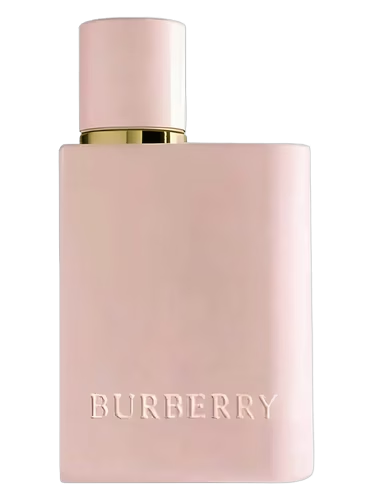
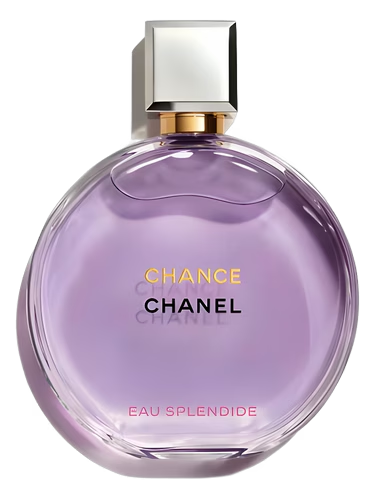
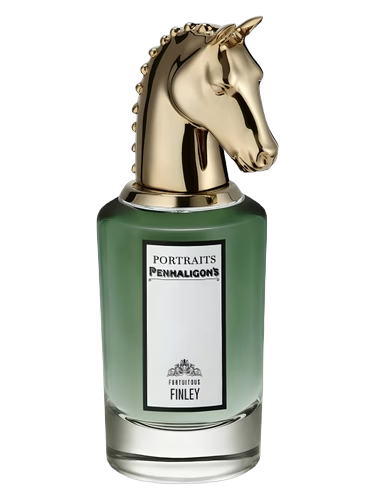
What is Fringed Pink?
Fringed Pink, or Dianthus superbus, is a fragrant perennial flower native to Europe and Northern Asia, known in perfumery for its spicy-floral profile and its historical use in traditional Chinese medicine.What does Fringed Pink smell like?
It offers a delicate, sweet floral aroma with characteristic spicy, warm undertones of clove and a bright, peppery lift, closely resembling the scent of carnations.How is Fringed Pink essence extracted?
The scent is primarily captured through steam distillation of the blossoms to obtain volatile oils, or through solvent extraction to preserve heat-sensitive aromatic compounds.What are some top perfumes featuring Fringed Pink?
While rarely listed as a primary commercial note, its spicy-floral DNA is central to classic perfumes like Nina Ricci L'Air du Temps and various niche fragrances that utilize carnation-clove accords.When is Fringed Pink in season?
The primary blooming period occurs during the summer months, typically from mid-June through August, though it can extend into early autumn in certain climates.