Fragrance Notes Are Layers Of Scent That Are Layered To Form The Final Fragrance. Fragrance Notes Are Categorised Into Three Main Elements Based On How Long They Take To Evaporate, And How Long They Typically Last Following Application: Top Notes, Heart Notes And Base Notes.
French Marigold
French Marigold offers a striking, complex aroma: green, musky, and herbal, with spicy and somewhat resinous undertones. It features challenging nuances reminiscent of crushed leaves or green mango. This bold scent is difficult to use but creates unique, interesting compositions.

Origin & Extraction Of French Marigold
French Marigold (Tagetes minuta, often used as Tagetes oil) has a history in perfumery that is distinct from traditional floral staples. While the plant has ancient uses in traditional medicine and rituals, its essential oil only gained traction in Western fine fragrance during the 20th century. Marigold is rarely used as a central accord due to its complex and sometimes challenging scent profile, which is intensely green, herbal, musky, and can carry slightly bitter, fruity, or even savory undertones. Its initial adoption was primarily as a supporting material to introduce vivid, photorealistic green notes, giving compositions a sharp, slightly earthy edge that traditional leaf notes could not achieve.
In modern perfumery, French Marigold is considered an avant-garde or niche ingredient. Perfumers utilize it strategically to create striking contrasts or to reinforce specific themes, such as green chypre structures or bold aromatic compositions. It is valued not for a classic floral scent, but for its unusual complexity and tenacity. Because of its intensity and propensity to dominate, it is used sparingly, primarily serving to bridge top notes with aromatic hearts, lending a sophisticated, slightly metallic, and often unconventional freshness to contemporary artistic fragrances.
Extraction Methods of French Marigold
The primary method for extracting essential oil from French Marigold (Tagetes patula) is steam distillation or hydro-distillation of its fresh aerial parts, particularly the flowering tops and leaves. This process involves passing pressurized steam through the plant material to release volatile aromatic compounds, which are then condensed and separated from the water to produce a dark amber-green oil with a pungent, herbaceous scent.
Historically, French Marigold was processed using traditional artisanal techniques such as maceration and enfleurage, where flowers were steeped in fixed oils or animal fats over several weeks to capture their delicate scent. In modern perfumery and industrial production, while steam distillation remains the standard for producing "Tagetes oil," advanced solvent extraction is frequently used to create concretes and absolutes. Furthermore, innovative techniques like supercritical CO2 extraction are increasingly employed to capture a more complete and heat-sensitive aromatic profile that closely mimics the scent of the living flower.
French Marigold, or Tagetes, is often utilized in contemporary perfumery to introduce a bold, green, and slightly musky complexity that prevents compositions from becoming conventional. One of the most famous and universally adored examples of this note's subtle integration is in Byredo Parfums Bal D'Afrique. In this scent, the marigold note works beneath the surface of vetiver and African notes, lending an unconventional, slightly earthy freshness and depth that makes the fragrance unique.
The distinctive, herbal nature of French Marigold is also effectively employed in modern designer fragrances to elevate classic structures. For instance, Jo Malone Jasmine Sambac & Marigold Cologne Intense leverages the marigold's striking green-herbaceous profile to contrast and brighten the creamy, rich sweetness of jasmine sambac. This combination highlights the marigold’s ability to inject a sophisticated, contemporary edge into traditional white floral compositions.
Historically, the marigold note has also played a role in rich, complex feminine compositions. While often reformulated, fragrances like Boucheron Boucheron Parfum incorporated marigold facets to support intricate oriental-floral structures, utilizing its spicy and slightly resinous undertones to add complexity and tenacity. More recently, its distinct vegetal sharpness provides a sophisticated green lift in scents like Clinique Calyx 2013, offering a crisp, photorealistic opening that appeals to those seeking bold, non-traditional freshness.
Sustainability Of French Marigold
Sustainability of French Marigold
- Promoting organic gardening and reducing the need for chemical pesticides by acting as a natural repellent for pests like aphids, whiteflies, and cabbage moths
- Enhancing soil health by releasing natural compounds that suppress harmful root-knot nematodes and using deep root systems to improve soil aeration and water infiltration
- Supporting local biodiversity and balanced ecosystems by attracting vital pollinators like bees and beneficial predatory insects such as lady beetles and lacewings
- Contributing to a circular economy and soil fertility by repurposing spent plant material as green manure or nutrient-rich organic matter through decomposition
- Utilizing phytoremediation capabilities to extract and accumulate heavy metals like nickel and cadmium from contaminated soils, helping to decontaminate polluted sites naturally
Trivia
Despite its name, the French marigold is actually native to Mexico and Guatemala; it earned its common name simply because it became immensely popular in French gardens during the 16th century.
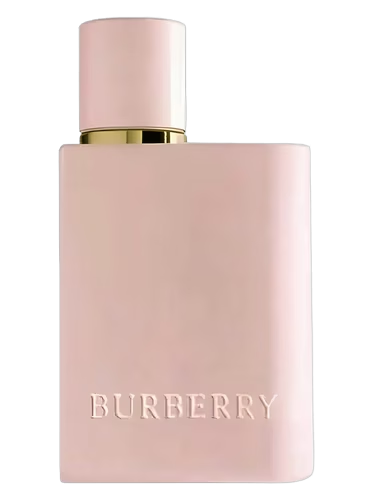
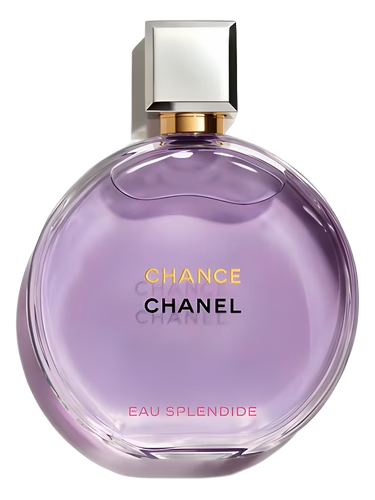
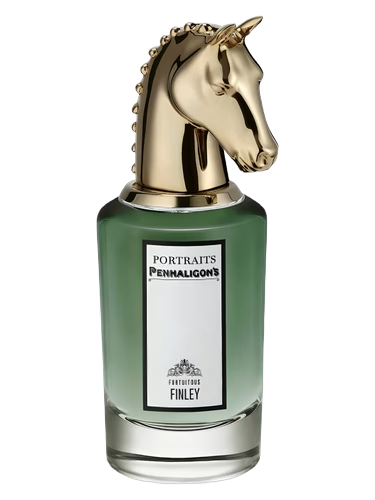
Most Popular Scents Using French Marigold
What is French Marigold?
French Marigold, also known as Tagetes patula, is a flowering plant native to Mexico and Guatemala whose essential oil is used in niche and avant-garde perfumery for its unique, complex character.What does French Marigold smell like?
It offers a bold and striking aroma that is intensely green, herbal, and musky, often featuring spicy, resinous, or slightly bitter undertones reminiscent of crushed leaves or green mango.How is French Marigold essence extracted?
The primary method is steam distillation of the fresh flowering tops and leaves, though advanced solvent extraction and supercritical CO2 extraction are also used to create absolutes and more delicate aromatic profiles.What are some top perfumes featuring French Marigold?
Notable fragrances include Byredo Bal d'Afrique, Jo Malone Jasmine Sambac & Marigold, Clinique Calyx, and Dolce & Gabbana Light Blue Eau Intense.When is French Marigold in season?
As a warm-season annual, it typically blooms from early summer until the first hard frost of autumn, flourishing in high heat and humidity.