Fragrance Notes Are Layers Of Scent That Are Layered To Form The Final Fragrance. Fragrance Notes Are Categorised Into Three Main Elements Based On How Long They Take To Evaporate, And How Long They Typically Last Following Application: Top Notes, Heart Notes And Base Notes.
Freesia
Freesia is a delicate, vibrant, and elegant floral note, typically synthesized to capture its fresh, slightly peppery, green, and often powdery scent. It imparts a clean, joyful, and luminous quality, essential in spring bouquets and contemporary feminine fragrances.

Origin & Extraction Of Freesia
Freesia, scientifically known as *Freesia refracta* (Iridaceae), is native to South Africa. While the flower has a long history, its use in fine perfumery gained significant momentum in the 20th century. The natural essential oil is difficult to extract economically, leading perfumers to rely on synthesis to capture its delicate, vibrant, and elegant fragrance. This synthesized note replicates its characteristic fresh, slightly peppery, green, and often powdery scent, allowing it to become essential in modern floral compositions.
Due to its clean, joyful, and luminous quality, freesia became a staple, particularly in contemporary feminine fragrances and "spring bouquet" accords. Its popularity reflects a trend toward lighter, more transparent floral scents that emerged later than the heavy floral or classic citrus compositions. Freesia is widely appreciated globally today, continuing to provide a distinctive and enduring appeal in the world of perfumery.
Historically, capturing the scent of freesia was a significant challenge due to the flower's delicate nature and low essential oil yield. Traditional methods like enfleurage—where flower petals are placed on layers of fat to absorb their aroma—and simple maceration were used, but these often failed to produce a commercially viable extract that accurately reflected the living flower's sweet, peppery fragrance. While some historical attempts utilized steam distillation and solvent extraction with hexane, the resulting absolutes were often described as having a negligible resemblance to the actual floral scent.
In modern perfumery, freesia is widely regarded as an "imaginary flower" because no commercial botanical extraction of the flower is currently used in fragrances. Instead, the note is almost exclusively a synthetic reconstruction. Modern perfumers use headspace technology to analyze the volatile profile of living blooms, identifying linalool as the primary aromatic component. This data allows for the creation of synthetic accords that mimic the flower's fresh, mineral-green quality. While advanced laboratory methods like microwave extraction and supercritical CO2 extraction have been explored in research to capture water-soluble phyto-compounds, synthetic chemistry remains the standard for delivering freesia's characteristic aroma in the beauty and fragrance industries.
Freesia is celebrated in modern perfumery for its delicate, vibrant, and elegant profile, making it a staple in numerous popular fragrances. Its ability to impart a fresh, clean, and luminous quality secures its place in compositions aiming for uplifting and joyful floral scents. One of the most famous and widely recognized fragrances to feature this note prominently is Jo Malone London English Pear & Freesia Cologne, which pairs the flower's slightly peppery, green character with the mellow sweetness of ripe pear, defining a signature fresh and comforting scent.
- Versace utilizes the luminous quality of Freesia in several of its popular lines, including Versace Dylan Turquoise, where it contributes to a vibrant, fresh, and aquatic opening, and Versace Dylan Purple, adding a bright floral lift.
Freesia is also key to adding a sophisticated, slightly green floral dimension to complex feminine structures. For instance, the note is featured in Chloé Nomade Eau de Parfum, where the freesia flower adds an elegant transparency that complements the deeper notes of cherry plum and oak moss, making the fragrance bright yet grounded. In this context, freesia often functions to modernize traditional floral bouquets, offering a lighter, less heady experience.
- High-end and niche houses also embrace Freesia for its complexity. While Maison Francis Kurkdjian offers a range of creations that include the freesia note, showcasing its adaptability in luxury compositions.
The versatility of the Freesia note allows it to bridge different fragrance families, from crisp Eaux de Toilette to richer Eau de Parfums. Whether it’s paired with juicy fruits for a bright, cheerful opening or integrated into a more complex white floral accord, the synthetic freesia note—used because the natural oil is difficult to extract—ensures a consistent, enduring, and unmistakable clean floral freshness, continuing to drive its popularity across global fragrance markets.
Sustainability Of Freesia
Sustainability of Freesia
- Adopting low-temperature production methods to reduce the energy required for greenhouse heating and improve the overall carbon footprint of cultivation
- Transitioning to closed-loop growing systems and climate chambers that cut cultivation time, reuse drain water, and aim for energy-neutral operations using solar power
- Reducing environmental impact by implementing sustainable cultivation practices in closed systems that make chemical crop protection and pesticides superfluous
- Measuring and monitoring environmental footprints to align growers with global sustainability standards and ensure transparent resource management
- Promoting the use of well-drained, organic-rich growing media and precise water management to prevent root rot and minimize resource waste
- Fostering innovation through dedicated breeding programs focused on developing varieties specifically suited for high-efficiency, sustainable closed-cultivation environments
Trivia
Despite their popularity, perfumers cannot naturally extract the scent of freesia, so the fragrance is always a synthetic reconstruction designed to mimic its radiant, tea-like freshness.
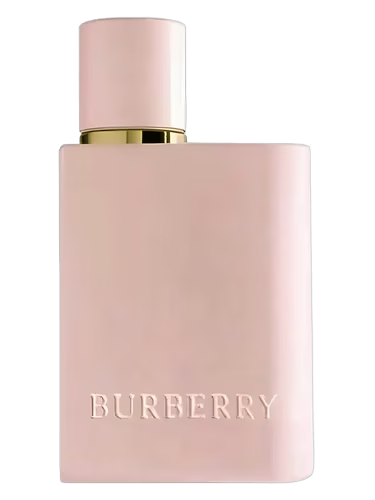
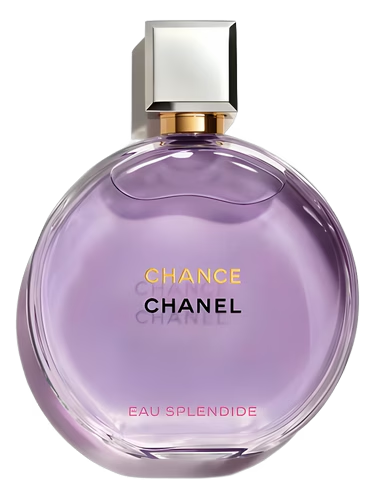
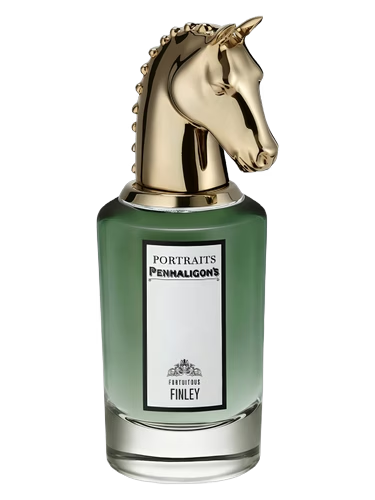
Most Popular Scents Using Freesia
What is Freesia?
Freesia is a delicate and vibrant floral note native to South Africa, valued in perfumery for its clean, joyful, and luminous quality.What does Freesia smell like?
It possesses a fresh, slightly peppery, and green aroma with powdery nuances, often used to create the impression of a spring bouquet.How is the Freesia note produced?
Because natural essential oil is difficult to extract from the flower, the note is almost exclusively a synthetic reconstruction that mimics the scent of the living bloom.What are some top perfumes featuring Freesia?
Popular fragrances include Jo Malone London English Pear & Freesia, Chloé Nomade, Giorgio Armani Sì, and Lancôme Miracle.When is Freesia in season?
Freesias typically bloom for four to five weeks during late winter and early spring, as the plants prefer cool temperatures for flowering.