Fragrance Notes Are Layers Of Scent That Are Layered To Form The Final Fragrance. Fragrance Notes Are Categorised Into Three Main Elements Based On How Long They Take To Evaporate, And How Long They Typically Last Following Application: Top Notes, Heart Notes And Base Notes.
Floral Notes
Floral Notes encompass a vast, versatile spectrum from delicate, green freshness (like Lily of the Valley) to rich, heady sweetness (like Jasmine) and romantic, velvety depth (like Rose or Peony). They are central to classic and modern perfumery, often lending femininity, elegance, and soft complexity to a composition.

Origin & Extraction Of Floral Notes
Floral Notes constitute the oldest and most extensive category in perfumery, with a history dating back to ancient civilizations that used flowers like rose and jasmine in unguents and incense. During the Renaissance, floral waters and pomanders became common. However, the modern floral category was truly established in the 18th and 19th centuries with the refinement of extraction techniques, particularly enfleurage, which allowed perfumers to capture the delicate scents of flowers more effectively. This era saw the rise of soliflores (single flower scents) and sophisticated bouquets, cementing flowers as the central theme of Western perfumery.
The 20th century marked a revolutionary period for florals with the introduction of synthetic molecules (like aldehydes), enabling the creation of abstract and fantasy floral accords that were previously impossible to achieve, such as the famous blends in Chanel N°5 (1921). Today, floral notes remain central to the industry, offering immense versatility—from soft, airy petals in contemporary sheer fragrances to rich, heady white florals in dramatic compositions—making them indispensable across all fragrance types, not just those traditionally marketed as feminine.
Extraction Methods of Floral Notes
Historically, floral notes were captured using traditional and labor-intensive techniques like enfleurage and maceration. Enfleurage, perfected in 18th-century Grasse, involved layering delicate petals on glass chassis coated with odorless animal fat, which absorbed the volatile aroma compounds over several days. This process was repeated with fresh flowers until the fat was saturated, then washed with alcohol to produce a floral absolute. Maceration, another ancient method, involved soaking flowers in warm carrier oils or alcohol to extract their scent.
Modern extraction primarily utilizes steam distillation and volatile solvent extraction. Steam distillation remains the standard for robust flowers like lavender and rose, where steam vaporizes the essential oils before they are condensed and separated. For more fragile or heat-sensitive blossoms like jasmine and tuberose, solvent extraction is preferred; it uses chemicals like hexane to create a waxy concrete, which is then refined with alcohol into a highly concentrated absolute. Recent technological advancements have introduced supercritical CO2 extraction, which uses carbon dioxide in a fluid state as a solvent. This method operates at lower temperatures, preventing thermal degradation and resulting in an aromatic profile that is remarkably true to the scent of the living flower.
The history of floral notes is inextricably linked with some of the most groundbreaking and enduring fragrances ever created. The classic white floral bouquet, often built around jasmine, tuberose, and gardenia, found its dramatic expression in perfumes like **Fracas** by Robert Piguet, which is renowned for its intoxicatingly rich and assertive tuberose heart. Likewise, the romantic tradition is defined by the queen of flowers, the rose, exemplified by timeless scents such as **Joy** by Jean Patou, famously marketed as the most expensive perfume in the world, featuring an opulent blend of roses and jasmine.
- Iconic floral scents often utilize the complexity of a floral accord (many flowers blended together) to create an abstract impression of beauty, rather than recreating the scent of a single bloom.
The 20th century revolutionized floral perfumery by introducing aldehydes, synthetic molecules that enhanced and lifted the natural floral notes. The prime example of this innovation is **Chanel N°5**, which uses a complex blend of florals—including rose and jasmine—brightened by a shimmering veil of aldehydes, creating the world’s most famous abstract floral fragrance. This technique proved that floral compositions could be simultaneously traditional and modern, appealing to a global audience with its sophisticated, hard-to-pin-down scent profile.
- Modern perfumery continues to innovate by emphasizing specific floral facets, such as the green and airy quality of muguet (lily of the valley) in scents like **Diorissimo**, or the rich, velvety quality of iris in **Guerlain Shalimar**, even though Shalimar is primarily classified as an oriental.
In contemporary perfumery, floral notes have expanded their role, often pairing with gourmand or woody bases to give them complexity and longevity. Modern masterpieces like **Dior J’adore** capture a shimmering, liquid floral essence dominated by ylang-ylang and jasmine, setting a standard for sophisticated mass-market fragrances. Meanwhile, the use of orange blossom and tuberose in a rich, modern context, as seen in **Gucci Bloom**, demonstrates the enduring power of white florals when interpreted with freshness and depth.
Sustainability Of Floral Notes
Sustainability of Floral Notes
- Adopting sustainable floristry practices by utilizing reusable or biodegradable mechanics, such as chicken wire, curly willow, and pebbles, to replace toxic plastic floral foam
- Promoting a circular economy by composting botanical scraps and repurposing floral byproducts into high-value items like essential oils, natural dyes, and eco-friendly packaging
- Reducing carbon footprints by sourcing locally grown, seasonal flowers to minimize energy-intensive cold-chain shipping and long-distance air freight
- Supporting environmental health through the use of organic or regenerative farming methods that prioritize soil health, biodiversity, and the protection of local pollinators
- Advocating for industry transparency and ethical sourcing to ensure fair labor practices and safe working conditions throughout the global floral supply chain
- Implementing waste reduction initiatives such as container return programs and the use of recyclable, minimal, or plastic-free packaging for floral arrangements
Trivia
The word perfume originates from the Latin per fumum, meaning through smoke, reflecting the ancient Roman and Arab practice of refining scents using incense and precious woods 2,500 years ago.
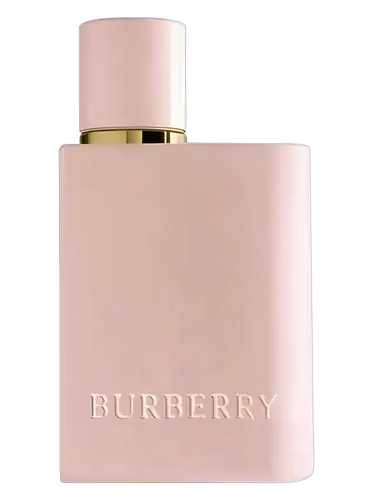
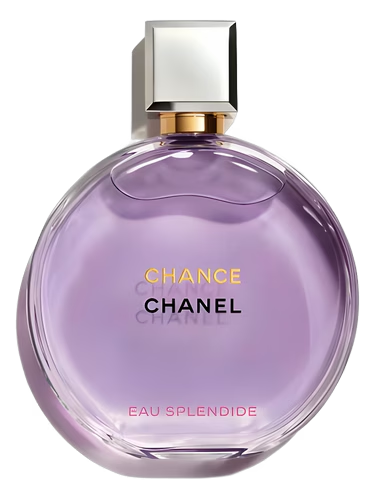
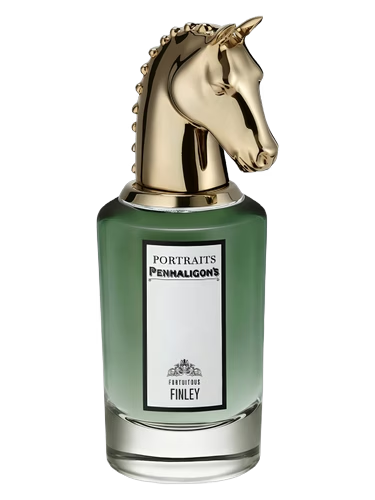
Most Popular Scents Using Floral Notes
What are Floral Notes?
Floral Notes are a diverse fragrance family encompassing scents derived from flowers, ranging from light, green freshness like Lily of the Valley to rich, heady sweetness like Jasmine and romantic, velvety depth like Rose.What do Floral Notes smell like?
The aroma varies by flower type: white florals are often narcotic and indolic, rose-types are warm and honeyed, green florals are crisp and dewy, and powdery florals are dry and cosmetic.How are Floral Notes extracted?
They are captured through various methods including steam distillation for robust flowers like roses, solvent extraction for fragile blossoms like jasmine to create absolutes, and modern supercritical CO2 extraction for a true-to-life scent.What are some iconic perfumes featuring Floral Notes?
Classic and modern examples include Chanel N°5, Robert Piguet Fracas, Jean Patou Joy, Dior J’adore, Diorissimo, and Gucci Bloom.When should I wear floral fragrances?
While versatile year-round, light and dewy florals are traditional for spring, radiant and creamy florals suit the summer heat, and deeper, velvety floral-woody or floral-oriental blends are preferred for autumn and winter.