Fragrance Notes Are Layers Of Scent That Are Layered To Form The Final Fragrance. Fragrance Notes Are Categorised Into Three Main Elements Based On How Long They Take To Evaporate, And How Long They Typically Last Following Application: Top Notes, Heart Notes And Base Notes.
Flax
Flax offers an extremely subtle, natural, and clean aromatic profile, often evoking the scent of fresh linen or sun-dried fabric. It is understated, featuring soft, mildly nutty, and dry earthy nuances. It imparts a delicate, airy freshness and textural complexity, often used to soften compositions or introduce a gentle, wholesome, agricultural feel.

Origin & Extraction Of Flax
While not a primary or foundational ingredient like classic citrus notes, Flax has a history in perfumery dating back to ancient times, reportedly as far back as the Egyptian era, where it was utilized as a base note. Historically, the plant was prized mainly for its textile fibers (linen) and its oil (linseed), but its extremely subtle, mildly nutty, and clean aromatic profile—often associated with fresh linen—was incorporated into early fragrant preparations.
In modern fine perfumery, the Flax note is a relatively subtle and sophisticated addition. It is valued not for its strength, but for its textural complexity and ability to introduce a delicate, airy freshness and a clean, dry, earthy nuance. Perfumers use it to soften compositions, evoke a gentle agricultural or natural clean linen feel, often bridging cleaner top notes with warmer, slightly nutty base notes.
Extraction Methods of Flax
The extraction of flax fiber is a multi-stage process centered on retting, which breaks down the pectins binding the fibers to the stem. Historically, this was achieved through water retting, where bundles of pulled flax were submerged in slow-moving streams or ponds for several weeks. This anaerobic process, while effective at producing high-quality golden fibers, was labor-intensive and caused significant water pollution. Another traditional method, dew retting, involves spreading harvested stalks in fields to be decomposed by moisture and soil microorganisms over three or more weeks, resulting in silvery-grey fibers.
Modern commercial production has shifted primarily to mechanized dew retting to minimize environmental impact, utilizing specialized machines called pullers to harvest the entire plant by the root. Once retted, the stalks undergo mechanical scutching to remove the woody core (shives) and hackling, where fibers are combed through metal teeth to align them. Latest advancements include controlled water tank retting with temperature regulation and water recycling, as well as experimental mechanical decortication and enzymatic retting to improve efficiency and fiber consistency. For flaxseed oil, extraction has evolved from traditional mechanical screw pressing to advanced techniques like supercritical CO2 extraction and ultrasonic-assisted extraction, which provide higher yields and preserve sensitive omega-3 fatty acids without solvent residue.
The use of Flax in perfumery is generally subtle, aimed at enhancing clean, textural, and gentle aromatic compositions rather than dominating them. While Flax is not a headline note like rose or jasmine, it is often employed by houses seeking a sophisticated, understated freshness reminiscent of clean laundry or dry earth. This makes it a crucial supportive element in many contemporary 'clean' and 'white musk' fragrances, where it adds a mild, nutty dryness and an airy texture, helping to bridge cleaner top notes with the muskier, warmer bases without adding sweetness or heaviness.
- One famous fragrance that subtly incorporates the clean, wholesome texture of Flax is L’Eau d’Issey Pour Homme by Issey Miyake. While primarily known for its Yuzu and aquatic notes, the subtle, dry-earthy, and clean fabric undertones align with the effect of Flax, reinforcing the fragrance’s signature minimalist, sheer aesthetic.
- Another notable example of this delicate style is found in the DNA of certain Jo Malone London scents, such as Oat & Cornflower, where the agricultural, natural grain scent profile relies on a soft, dry element similar to the nutty, clean nuances provided by the Flax note.
Due to its association with fresh linen and natural fibers, the Flax note is especially favored in designer and niche lines dedicated to evoking domestic comfort and simple luxury. It helps create a feeling of sun-dried fabric and subtle warmth, often appearing in compositions that feature white florals, cotton, or aldehydes. This specialized function ensures that while Flax remains a supporting note, its influence is significant in imparting a refined, non-synthetic cleanliness and longevity to the overall composition.
In modern high-end perfumery, Flax can be found providing depth in fragrances that aim for a "skin scent" or a "your-skin-but-better" effect. For instance, the clean, slightly vegetal, and dry quality of Flax is an ideal partner for iris, vetiver, or ambrette seed, enhancing the skin-like texture of fragrances such as those found in the clean-beauty movement. This positioning highlights its versatility in lending an authentic, natural, and highly sophisticated clean finish.
- Flax typically begins its active growth in early spring as soon as the soil becomes manageable and ground frost has disappeared, with seeds often sown between March and May depending on the region
- The blooming period generally occurs from late spring through mid-summer, typically spanning from May to July, though succession sowing can extend the display into autumn
- Harvesting of stalks for fiber usually takes place in late summer, often about 25 to 30 days after flowering when the stems have turned yellow
- Seeds and capsules mature in the fall and winter, providing essential forage for local wildlife during the colder months
- Dormancy begins in the early fall, at which point stems can be cut back to the ground to prepare for new growth the following spring
Sustainability Of Flax
Sustainability of Flax
- Utilizing a zero-waste crop model where every part of the plant is repurposed, including fibers for textiles, seeds for food and oil, and woody shives for building insulation and composite materials
- Promoting low-impact agriculture by cultivating a hardy species that requires minimal to no irrigation and significantly fewer pesticides and fertilizers compared to cotton
- Enhancing soil health and biodiversity through mandatory crop rotation systems, typically every six to seven years, which prevents disease and preserves land fertility
- Supporting carbon sequestration and decarbonization efforts as a climate-positive plant that captures atmospheric carbon during its rapid 100-day growth cycle
- Advancing ethical production through mechanical, chemical-free processing and the establishment of regional fiber cooperatives to support smallholder farmer resilience
- Implementing strict environmental standards for processing, such as dew retting on the ground to conserve water and using energy-efficient mechanical scutching
Trivia
In ancient Egypt, flax was so highly regarded for its association with purity that it was the only material priests were permitted to wear, and it was used to embalm mummies.
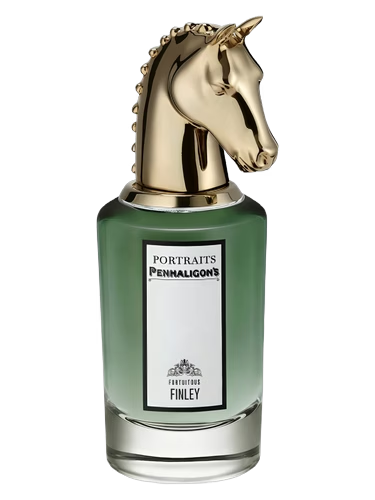
Most Popular Scents Using Flax


What is Flax?
Flax is an ancient plant prized for its textile fibers and seeds, whose subtle aromatic profile is used in modern perfumery to evoke the scent of clean linen and sun-dried fabric.What does Flax smell like?
It offers an extremely subtle, natural, and clean aroma featuring soft, mildly nutty, and dry earthy nuances with an airy freshness.How is Flax essence extracted?
The aromatic profile is often captured through processes related to the harvesting and treatment of the plant, such as retting, or through advanced methods like supercritical CO2 extraction for flaxseed oil.What are some top perfumes featuring Flax?
Notable fragrances include Moschino Toy Boy, Versace The Dreamer, The Different Company Pure eVe, and Bvlgari BLV.When is Flax in season?
Flax typically grows in early spring, blooms from late spring through mid-summer, and is harvested for its fibers in late summer once the stalks turn yellow.