Fragrance Notes Are Layers Of Scent That Are Layered To Form The Final Fragrance. Fragrance Notes Are Categorised Into Three Main Elements Based On How Long They Take To Evaporate, And How Long They Typically Last Following Application: Top Notes, Heart Notes And Base Notes.
Fire Lily
Fire Lily offers a sultry, sun-drenched, and honeyed floral aroma. It combines the sweet, opulent warmth of vanilla and orange blossom with the bright, citrusy lift of neroli and bergamot, rounded out by hints of rich, tangy mandarin petitgrain and herbal chamomile for an exotic, sensual quality.

Origin & Extraction Of Fire Lily
The Fire Lily (often associated with the genus Lilium or Gloriosa, though the specific perfumery note is sometimes an accord) has a long history of cultural and symbolic significance in its native regions, where it represents beauty, passion, and rebirth, due to its resilience in blooming even after harsh conditions. Some cultures historically valued the plant for purported medicinal properties. However, its direct incorporation into classic fine Western perfumery is less pronounced compared to foundational ingredients like Bergamot or Neroli, which date back to the 18th-century Eau de Cologne structure.
The use of the Fire Lily note in modern perfumery is driven by its delicate, alluring, sweet, and floral fragrance, which adds an exotic and sensual quality to compositions. Perfumers are inspired by its unique scent profile, which combines honeyed warmth with citrusy and sometimes spicy nuances. While it does not boast an ancient perfumery legacy, the Fire Lily essence is a valued component in contemporary fragrances, allowing perfumers to create sophisticated, opulent, and often oriental-red themed scents that convey passion and vibrancy.
Extraction Methods of Fire Lily
Historically, the fire lily (Gloriosa superba) has been processed through traditional harvesting and preparation for medicinal use rather than aromatic capture. Folk healers and Ayurvedic practitioners traditionally dug up the plant's tubers post-monsoon, when alkaloid concentrations peak, and then sun-dried and ground them into a powder. These powders were often prepared as decoctions by simmering them in water to extract therapeutic compounds like colchicine.
In modern pharmaceutical and laboratory settings, the extraction of fire lily's potent alkaloids is achieved through more precise mechanical and chemical methods. Soxhlet extraction using methanol as a solvent is considered highly effective for recovering colchicine from the tubers. Recent technological advancements have introduced microwave vacuum oven drying and sonication (ultrasonic extraction) to improve yield efficiency and maintain the stability of heat-sensitive compounds. Because the flower's delicate, waxy scent is not commercially captured, its presence in perfumery is primarily a fantasy note reconstructed from other botanical materials.
The Fire Lily note, known for its sultry, honeyed, and sun-drenched floral profile, is often utilized in contemporary perfumery to create exotic and opulent compositions. Due to its complex scent profile—combining warmth, vanilla, and citrusy lift—it lends itself particularly well to niche and natural fragrance houses that focus on unique floral accords. One direct example of its utilization is in the Living Libations Fire Lily Petal Perfume, which blends this rich floral essence with neroli, bergamot, vanilla, and mandarin petitgrain to achieve a sensual and sun-drenched effect.
- The unique, sweet-citrus profile of Fire Lily makes it a compelling choice for perfumers seeking a tropical or intense floral heart that offers more dimension than traditional white flowers. This complexity allows it to bridge the gap between bright top notes (like the bergamot and neroli often associated with the note) and rich, warm bases.
While the note may be listed as an accord in many designer and high-end fragrances, its specific characteristics—the combination of orange blossom and vanilla-like warmth—are frequently featured in compositions from houses known for opulent florals and orientals. Brands such as Guerlain, Yves Saint Laurent, and Tom Ford often employ rich, exotic lily/floral blends that evoke the same passionate and vibrant qualities attributed to the Fire Lily note, demonstrating its influence in creating sophisticated, sensual depth in luxury scents.
Sustainability Of Fire Lily
Sustainability of Fire Lily
- Adopting peat-free cultivation by using organic flower compost and coconut fiber-based substrates to reduce environmental impact
- Implementing integrated pest management by encouraging natural enemies like aphids through deadwood corners and insect hotels rather than chemical pesticides
- Promoting water conservation through the use of drainage layers, soil moisture monitoring, and precision watering to prevent root rot and waterlogging
- Supporting biodiversity and ecosystem restoration as the fire lily acts as a pioneer species that leads post-fire regeneration in its native habitats
- Utilizing organic mulching to regulate soil temperature, suppress weeds, and naturally enhance soil fertility and moisture retention
Trivia
The Fire Lily, specifically Gloriosa superba, is so resilient and uniquely adapted to its environment that it is known for its ability to bloom even in the immediate aftermath of a wildfire, serving as a powerful botanical symbol of regeneration and rebirth.
Most Popular Scents Using Fire Lily
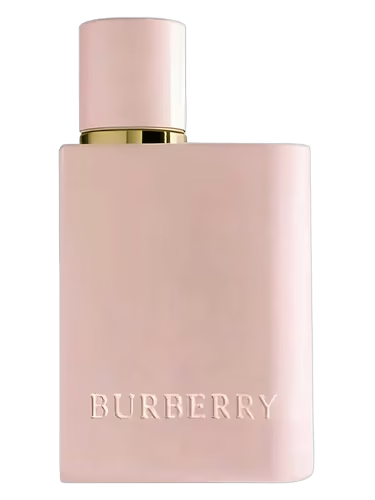
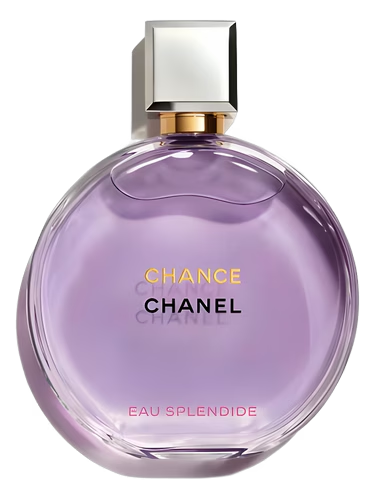
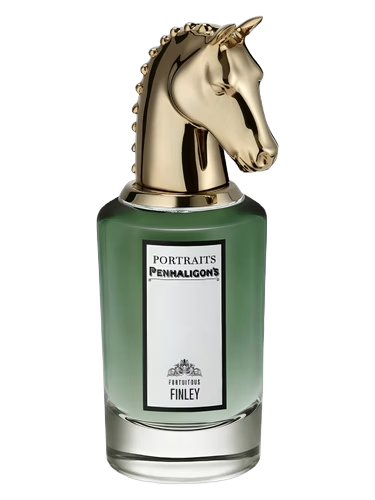
What is Fire Lily?
Fire Lily is a fragrance note inspired by the Gloriosa superba flower, known for its sun-drenched, honeyed, and exotic floral profile that combines warmth with a bright citrusy lift.What does Fire Lily smell like?
It offers a sultry and opulent aroma featuring sweet vanilla and orange blossom facets, complemented by the fresh, zesty notes of neroli, bergamot, and tangy mandarin petitgrain.Is Fire Lily a natural or synthetic note?
In perfumery, Fire Lily is primarily a synthetic fantasy note reconstructed from other botanical materials because the flower's delicate scent is not commercially captured through direct extraction.What are some top perfumes featuring Fire Lily?
The most direct example is Living Libations Fire Lily Petal Perfume, while brands like Guerlain, Yves Saint Laurent, and Tom Ford often use similar exotic lily accords to evoke its passionate quality.When is Fire Lily in season?
The plant follows a summer-growing cycle, typically blooming from mid-summer through autumn, and enters a period of dormancy during the colder winter months.