Fragrance Notes Are Layers Of Scent That Are Layered To Form The Final Fragrance. Fragrance Notes Are Categorised Into Three Main Elements Based On How Long They Take To Evaporate, And How Long They Typically Last Following Application: Top Notes, Heart Notes And Base Notes.
Filbertone
Filbertone delivers a rich, warm, gourmand hazelnut scent with creamy, toasted nuances and subtle woody undertones. It adds nutty accents and deep, authentic flavor to fragrances, enhancing chocolate, vanilla, and woody compositions for a comforting and decadent feel.

Origin & Extraction Of Filbertone
Filbertone, the molecule primarily responsible for the rich, warm, and gourmand scent of hazelnut, represents a modern development in perfumery. Since natural hazelnut oil is volatile and does not yield a consistent or potent enough aroma for stable fragrance compositions, perfumers rely on synthetic molecules like Filbertone (5-methyl-2-hepten-4-one). The use of Filbertone gained prominence with the rise of the gourmand fragrance category in the late 20th and early 21st centuries, where notes replicating edible treats—such as hazelnut, chocolate, and vanilla—became highly sought after.
Because it is a synthetic ingredient, Filbertone provides superior stability, diffusion, and longevity compared to natural accords. It is frequently employed to add depth, richness, and comforting, toasted nuances to compositions, particularly when paired with woody notes like sandalwood or cedar, or when reinforcing creamy, sweet facets in decadent, dessert-like perfumes. Its introduction allowed perfumers to authentically and consistently capture the sweet, buttery essence of freshly roasted hazelnut in fine fragrances.
Extraction Methods of Filbertone
Historically, filbertone was obtained from natural sources through traditional preconcentration steps such as steam distillation-extraction, which allows for the isolation of the principal flavor component from hazelnut oil. In laboratories and industrial settings, racemic filbertone has been produced through various synthetic pathways, including Grignard addition, fragmentation of tertiary bis-homoallylic alcohols, and aldol-Knoevenagel condensation. Specifically, one traditional synthetic route involves the condensation of butanone and acetaldehyde to create an intermediate enone, which is then processed to yield the final ketone.
Modern extraction and analysis techniques have shifted toward high-precision methods to preserve and determine the compound's delicate enantiomeric distribution. Solid-phase microextraction (SPME) using poly(dimethylsiloxane)/divinylbenzene fibers is now a standard for rapidly extracting filbertone from the headspace of oil samples for gas chromatography analysis. Furthermore, advanced methods like supercritical fluid extraction, ultrasonically assisted solid-phase extraction, and headspace-programmed temperature vaporization-gas chromatography-mass spectrometry (HS-PTV-GC-MS) are employed to identify filbertone without the need for extensive filtration or manual preconcentration.
Filbertone, the powerful synthetic molecule that captures the rich, toasted essence of hazelnut, is a key ingredient in the modern gourmand category. Due to its stability and authentic flavor, it allows perfumers to construct decadent, edible-smelling compositions that last much longer than natural hazelnut extracts. It is frequently employed to deepen woody or creamy accords, lending a comforting and sophisticated nutty warmth.
One notable fragrance that utilizes this captivating note is **Some Like It Hot By Kilian**. This perfume leverages Filbertone to introduce a warm, slightly boozy, and creamy hazelnut accord, setting a sensual, gourmand tone. Other contemporary fragrances that feature the rich hazelnut note include **Sandalsun** by Hermetica and **Oh là là** by Téo Cabanel, where it acts as a comforting bridge between sweeter notes and deep woods.
In addition to the modern niche and designer offerings, Filbertone's contribution to the toasted, nutty profile can be inferred in fragrances that rely on complex gourmand structures, enhancing accompanying notes like chocolate, praline, and vanilla. This molecule ensures that the hazelnut scent is bright, long-lasting, and capable of providing superior diffusion in rich, enveloping scents, making it indispensable for creating truly decadent and memorable cold-weather compositions.
Sustainability Of Filbertone
Sustainability of Filbertone
- Promoting ethical sourcing by partnering with growers and farmers who prioritize biodiversity and responsible land management
- Implementing traceable supply chains to ensure every ingredient is responsibly harvested from trusted, long-term suppliers
- Utilizing advanced, energy-efficient extraction techniques to minimize environmental impact and preserve raw material purity
- Adhering to strict environmental regulations and international standards, such as ISO 9001, to maintain accountability in production
- Supporting local agricultural communities through fair trade practices that enhance livelihoods and foster economic resilience
Trivia
Filbertone is the principal flavor compound of hazelnuts, but it was only scientifically identified in the nuts as recently as 1989.
Most Popular Scents Using Filbertone
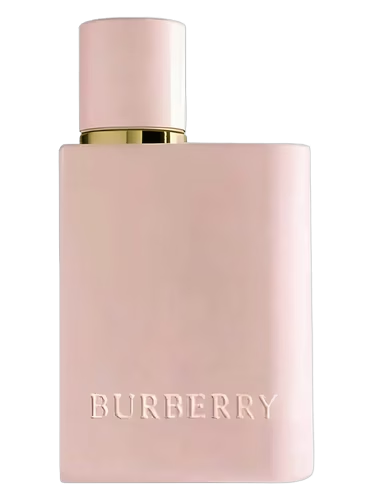
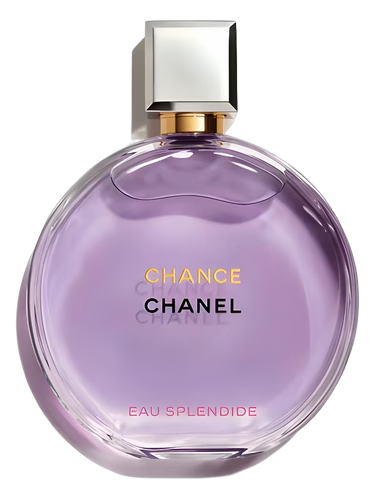
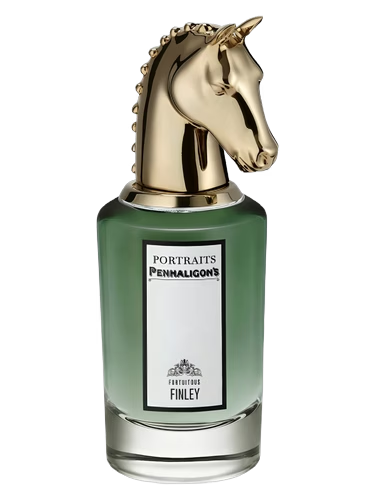
What is Filbertone?
Filbertone is a synthetic aroma molecule, naturally found in hazelnuts, that is used in perfumery to create a stable and authentic hazelnut scent.What does Filbertone smell like?
It features a rich, warm, and gourmand hazelnut aroma with creamy, toasted nuances and subtle woody undertones.How is Filbertone extracted?
While it occurs naturally in hazelnut oil, it is primarily produced synthetically for perfumery through chemical processes like aldol-Knoevenagel condensation to ensure stability and potency.What are some top perfumes featuring Filbertone?
Notable fragrances include Some Like It Hot By Kilian, Hermès Hermessence Vetiver Tonka, and Mugler Angel Muse.Is Filbertone natural or synthetic?
In the fragrance industry, Filbertone is typically a synthetic ingredient used to replicate the volatile and delicate scent of natural hazelnuts.