Fragrance Notes Are Layers Of Scent That Are Layered To Form The Final Fragrance. Fragrance Notes Are Categorised Into Three Main Elements Based On How Long They Take To Evaporate, And How Long They Typically Last Following Application: Top Notes, Heart Notes And Base Notes.
Eustoma | Lisianthus
A delicate, often stylized floral note in perfumery, Eustoma/Lisianthus lacks natural fragrance in commercial varieties. It is often synthesized to embody a fresh, slightly green, slightly sweet floralcy, sometimes blended with subtle fruity or clean nuances, serving as a soft, ethereal heart note in sophisticated compositions.

Origin & Extraction Of Eustoma | Lisianthus
Eustoma, commonly known as Lisianthus, is native to the American prairies and has traditionally been cultivated as an ornamental flower rather than an aromatic source. Unlike many classic floral notes that are derived via distillation or enfleurage, the use of Eustoma in fine fragrance is entirely modern and abstract. Because commercial varieties of the flower possess little to no natural scent, its presence in perfumery relies on synthesized molecules (a "stylized" note) designed to capture the delicate, fresh, slightly sweet and green floral character often associated with the flower's visual beauty. This synthetic approach positions Eustoma as a contemporary perfumery element, reflecting a trend toward greater creative freedom beyond naturally extracted materials.
As a result of its synthesized nature, Eustoma is not part of the historical canon of perfumery, such as notes foundational to 19th-century French fragrance. Its relevance has grown in the late 20th and 21st centuries, where it is utilized primarily as an ethereal heart note in lighter, cleaner, and more sophisticated floral compositions. Perfumers employ the Eustoma accord to add a subtle, watery freshness and a touch of sweetness, helping to bridge sharper top notes with deeper bases while maintaining a gentle, elegant transparency in the finished fragrance.
Extraction Methods of Eustoma (Lisianthus)
Historically, the aromatic and medicinal compounds of Eustoma grandiflorum were obtained through traditional solvent extraction and maceration techniques. Ancient methods involved steeping the fresh flowers or plant material in oils or alcohols to capture their delicate floral essence. For more concentrated applications, steam distillation has long been used, where pressurized steam passes through the petals to evaporate volatile oils, which are then condensed and collected. Traditional manual methods also included air-drying the flowers and roots for use in herbal preparations.
Modern extraction techniques have evolved to include more efficient and safer methods, such as supercritical CO2 extraction. This process uses carbon dioxide at high pressure and low temperatures to selectively extract pure essential oils and phytonutrients without the risk of solvent residue or heat degradation. Additionally, vacuum absorption and fractional distillation are utilized to isolate specific high-volatility fragrance components while preserving the flower's complex aromatic profile. Recent developments also include cellular extraction and the use of biofertilizers, like arbuscular mycorrhizal fungi, to enhance the natural accumulation of these desirable compounds within the plant tissues before harvesting.
The Eustoma or Lisianthus note is characterized by its delicate, stylized floral scent—a modern construct in perfumery since the natural flower lacks a strong fragrance. It is used to impart a subtle, fresh, slightly green, and ethereal quality to the heart of compositions, moving away from heavy, traditional florals. Its synthetic nature makes it perfect for contemporary, sophisticated scents that aim for transparency and cleanliness.
- A recent example showcasing the note is **Lisianthus** by Flora Pura, launched in 2022. In this fragrance, Eustoma is placed in the middle notes, seamlessly blending with traditional florals like Grasse Rose and Jasmine Sambac. It is brightened by top notes of Tangerine and Bergamot, illustrating how Eustoma's airy quality supports and modernizes classic citrus and floral accords.
While often used subtly to enhance transparency, the Lisianthus note has appeared across various designer and niche brands, including mentions within collections from houses like Loewe. When utilized by perfumers, the goal is typically to capture the flower's visual elegance, providing a gentle floralcy that complements rather than dominates, often bridging sparkling fresh top notes with warmer, woody bases like Musk and Vetiver for an elegant drydown.
Sustainability Of Eustoma | Lisianthus
Sustainability of Eustoma (Lisianthus)
- Adopting organic farming practices and biofertilizers, such as arbuscular mycorrhizal fungi (AMF), to enhance nutrient uptake and reduce reliance on chemical fertilizers
- Implementing water-efficient drip irrigation systems and regenerative soil management techniques, including the use of low-salt compost and plastic mulch to conserve water
- Utilizing integrated pest management and crop rotation strategies to naturally mitigate disease pressure and support local biodiversity
- Advancing sustainable floriculture through breeding for heat tolerance and disease resistance to improve crop resilience and quality
- Reducing environmental impact by using energy-efficient greenhouse automation and soilless culture systems
Trivia
The Eustoma, or Lisianthus, is often called the "rose without thorns" and is uniquely geotropic, meaning if the stems are placed horizontally, the flowers will naturally curl upwards toward the sky as they grow.
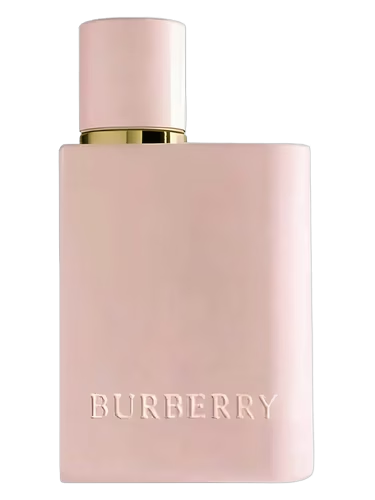
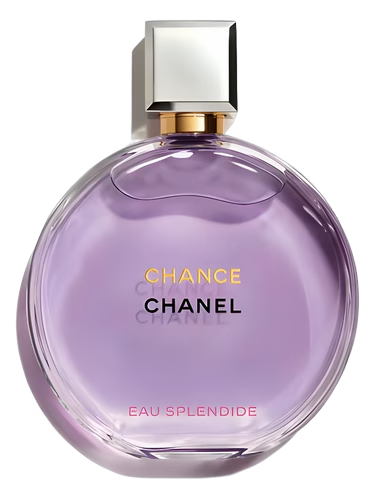
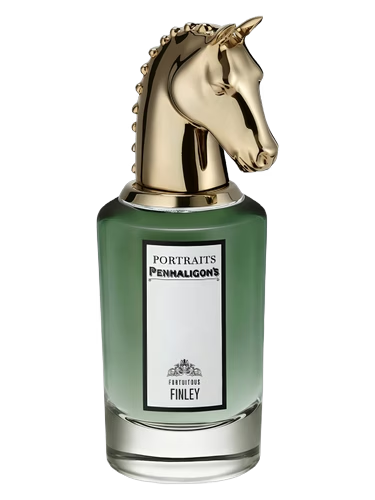
Most Popular Scents Using Eustoma | Lisianthus
What is Eustoma (Lisianthus)?
Eustoma, also known as Lisianthus, is a modern and abstract floral note in perfumery, originally native to the American prairies and often referred to as the "rose without thorns."What does Eustoma smell like?
It offers a delicate, fresh, and slightly green floral aroma with subtle sweet and fruity nuances, often used as an ethereal heart note in sophisticated scents.Is Eustoma a natural or synthetic fragrance note?
Because commercial flowers possess little to no natural scent, it is typically a synthesized "stylized" note created by perfumers to capture the flower's visual elegance and airy quality.What are some top perfumes featuring Lisianthus?
A notable example featuring this note is Lisianthus by Flora Pura, where it is used as a middle note to modernize classic floral accords.When is Lisianthus in season?
The plant follows a summer to early autumn blooming cycle, typically flourishing from June until the first frost.