Fragrance Notes Are Layers Of Scent That Are Layered To Form The Final Fragrance. Fragrance Notes Are Categorised Into Three Main Elements Based On How Long They Take To Evaporate, And How Long They Typically Last Following Application: Top Notes, Heart Notes And Base Notes.
Encian
Encian (Gentian) offers a unique floral profile, distinguished by a crisp, somewhat bitter freshness. The scent often incorporates notes of anise and subtle bitterness from the root, providing an earthy depth with light musky or honeyed nuances for a sophisticated and refreshing aroma.

Origin & Extraction Of Encian
Encian, or Gentian, derived primarily from the root of the Gentiana plant, has a long history rooted in medicinal and culinary applications, celebrated for its intense bitterness, particularly in European alpine regions. Historically, its primary use was in tonics, liqueurs (such as amaro), and herbal remedies. Its distinctive, earthy bitter-fresh profile—often incorporating notes of anise—meant that for centuries, its application in fine perfumery was minimal compared to classic floral or citrus notes.
Its relevance in perfumery remains limited, often appearing as a supporting note in niche and artisanal fragrances seeking a crisp, green, or sophisticated bitter freshness. Early commercial applications were rare, with notable historical mentions including a glycerine soap by Crabtree & Evelyn and its inclusion in Corday's perfume, Possession (1937). Today, when used, the Encian note provides an unusual earthy depth and a unique alternative to more common aromatic or herbaceous elements.
Extraction Methods of Encian
Historically, the extraction of aromatic and medicinal compounds from encian (gentian) roots has relied on traditional maceration and infusion techniques. These conventional methods involve soaking the dried, powdered roots in solvents such as water, ethanol, or a mixture of both to slowly leach out the bitter glycosides and volatile components. In some cases, decoction—boiling the roots in water—was used to create more concentrated medicinal preparations, though this required careful temperature control to avoid degrading sensitive molecules.
Modern extraction approaches for encian have evolved to include more efficient, technology-driven processes such as ultrasound-assisted extraction (UAE) and microwave-assisted extraction (MAE). These techniques utilize sound waves or electromagnetic radiation to disrupt the tough plant cell walls more effectively than simple soaking, resulting in higher yields and shorter processing times. Additionally, supercritical fluid extraction (SFE) using CO2 is increasingly employed to produce high-purity extracts without the need for harsh chemical solvents, preserving the botanical's complex, bittersweet aromatic profile for use in high-end perfumery and liqueurs.
The Encian (Gentian) note, prized for its unique bitter freshness and herbaceous depth, has historically been a challenging element to incorporate into mainstream perfumery. Due to its intense profile, which is more commonly associated with bitters and liqueurs, its use is rare and often confined to supporting roles in complex compositions. One of the earliest commercial applications mentioned was in Corday's classic perfume, Possession (1937), where the bitterness would have provided a sophisticated, dry contrast to the primary accords, lending the fragrance an unusual, intellectual character.
In modern perfumery, Encian remains a niche ingredient, but when used, it often signals a sophisticated or abstract approach to freshness, moving beyond traditional floral or citrus top notes. Its appearance is generally found in contemporary artisanal and niche creations seeking an earthy, green, or unexpectedly crisp structure. The note is valued for its ability to prevent a composition from becoming overly sweet or simplistic, lending an alpine-like austerity and natural depth.
One of the few specific instances where the gentian root's complex profile is noted in classic designer perfumery is in Shiseido's original Zen chypre formulation. Here, the unique floral and bitter aspects of the gentian root contribute to the fragrance's distinctive, clean, and mossy drydown. This use demonstrates the note’s potential to integrate into a sophisticated structure, providing a crisp, sophisticated freshness that complements deeper, earthier components.
Sustainability Of Encian
Sustainability of Encian
- Sourcing natural and organic ingredients for healthy food products and cosmetics to minimize environmental impact and promote chemical-free living
- Focusing on sustainable practices in the retail of supplements and skincare to support long-term well-being and environmental health
- Promoting a healthier lifestyle through the distribution of superfoods and natural products that rely on responsible agricultural methods
- Supporting the local economy in Croatia by providing access to natural and sustainably sourced goods since 1992
Trivia
Encian is named after the Illyrian king Gentius, who according to legend was the first to discover the plant's medicinal and tonic properties.
Most Popular Scents Using Encian


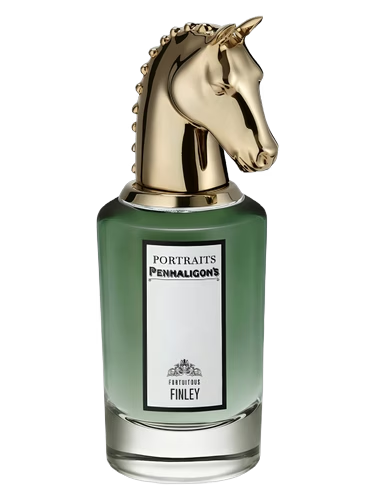
What is Encian (Gentian)?
Encian, also known as Gentian, is a floral note derived primarily from the roots of the Gentiana plant, native to alpine regions of Europe and prized for its unique bitter-fresh aromatic profile.What does Encian smell like?
It offers a crisp, earthy, and sophisticated bitterness with subtle nuances of anise, damp earth, and a faint honey-like sweetness, providing a refreshing alternative to traditional floral notes.How is Encian essence extracted?
The aromatic compounds are traditionally obtained through maceration and infusion, while modern perfumery uses steam distillation or supercritical CO2 extraction to preserve its complex bittersweet character.What are some top perfumes featuring Encian?
Notable fragrances include Hermès Eau de Gentiane Blanche, Essential Parfums Mon Vetiver, Viktor&Rolf Good Fortune, and Guerlain Aqua Allegoria Gentiana.What is the history of Encian in perfumery?
While historically used in medicinal tonics and liqueurs like Suze, its use in fine fragrance is more recent and niche, appearing in compositions like Corday's Possession (1937) and Shiseido's original Zen.