Fragrance Notes Are Layers Of Scent That Are Layered To Form The Final Fragrance. Fragrance Notes Are Categorised Into Three Main Elements Based On How Long They Take To Evaporate, And How Long They Typically Last Following Application: Top Notes, Heart Notes And Base Notes.
Eglantine Rose
Eglantine Rose (Sweetbriar) offers a fresh, delicate, and green rose aroma, distinctively characterized by a bright, sharp apple-like facet. It is lighter and airier than traditional rose, featuring subtle tea nuances and a wild, slightly musky cleanliness, often conveying a springtime, dewy freshness to floral compositions.

Origin & Extraction Of Eglantine Rose
Eglantine Rose, commonly known as Sweetbriar (Rosa rubiginosa), has a history rooted more in poetry, horticulture, and traditional remedies than in the earliest foundational structures of perfumery, which relied primarily on notes like Damask or Centifolia rose. The Sweetbriar is celebrated for its distinctive foliage that, when wet or brushed against, releases a strong, fresh, apple-like scent, a key characteristic that sets it apart from the heavy, oil-rich traditional rose varieties. This unique aroma—combining greenness with a bright, crisp fruitiness—made it popular in fragrant waters and scented gardens across Europe during the medieval and Renaissance periods.
Its relevance to modern perfumery is primarily as a specialized, conceptual note. Rather than serving as a source for bulk essential oil, Eglantine is often reconstructed synthetically or used as an abstract reference to convey a lighter, wilder, and more youthful rose profile. It provides a sharp, delicate, and dewy freshness, ideal for bridging sparkling top notes with a clean, floral heart. This "apple-rose" quality has made it popular in contemporary floral compositions that aim for transparency, naturalism, and a departure from the heavier, jammy rose scents of the past.
Extraction Methods of Eglantine Rose
The primary methods for extracting the aromatic essence of Eglantine Rose (Rosa rubiginosa) include steam distillation and solvent extraction. Historically, this wild rose was processed through traditional infusion and maceration techniques, where petals were steeped in oils or honey to capture their scent and medicinal properties. Early perfumery also utilized enfleurage, a labor-intensive process where rose petals were placed on layers of fat to absorb their fragrance, which was then washed with alcohol to create an absolute.
In modern production, steam distillation is widely used to produce rose otto, a process where pressurized steam passes through the petals to release volatile oils that are then condensed and collected. Solvent extraction is frequently employed to produce a more concentrated rose absolute; this involves submerging petals in a solvent like hexane to create a waxy concrete, which is then refined with ethanol. Recent technological advancements have introduced supercritical CO2 extraction, which uses carbon dioxide at high pressure and low temperatures to yield a highly pure extract that more closely mirrors the chemical profile of the living flower without chemical residues.
The Eglantine Rose note, valued for its delicate, green, and sharp apple-like facet, is frequently used in niche and modern perfumery to achieve a light, airy, and dewy freshness, departing from traditional heavy rose scents. One contemporary example where this note plays a role is **Fleur De Sable** by Les Liquides Imaginaires, a unisex fragrance released in 2019 that utilizes the Eglantine Rose to contribute to its unique, dry floral composition.
- * * *
In addition to conceptual niche fragrances, the Eglantine Rose note has been featured in more accessible modern floral compositions. For instance, **Crystal Peony** by Brocard (2021) is a female fragrance where this specific rose note adds a bright, springtime freshness and subtle tea nuances, creating a clean and sophisticated floral heart. Another fragrance utilizing this note for its light, romantic profile is **Venice Kiss**.
- * * *
Furthermore, Eglantine Rose often acts as a specialized naming convention, as seen in **Eglantine Rose Parfum** by Erica Elizabeth Designs. This fragrance highlights the note's fresh rose quality, blending it with other florals like gardenia and Arabian rose, brightened by blood orange, and deepened with base notes of rich amber and musk. This exemplifies how the distinctive "apple-rose" quality of Eglantine provides a unique, modern interpretation of the classic rose aroma in both specialized and high-end scents like **Green Garden** by Birkholz.
Sustainability Of Eglantine Rose
Sustainability of Eglantine Rose
- Supporting biodiversity by providing nectar for pollinators and winter food for birds and mammals through its abundant red hips
- Improving soil health and preventing erosion by utilizing its vigorous root system to stabilize slopes and banks
- Promoting sustainable cultivation through the use of biostimulants like arbuscular mycorrhizal fungi to reduce synthetic fertilizer dependence
- Advancing ecological resilience by breeding disease-resistant varieties that require fewer chemical inputs and pesticides
- Encouraging responsible land management by controlling its spread in non-native regions to protect local ecosystems from displacement
Trivia
Unlike most roses where the scent is concentrated in the petals, the Eglantine rose releases its signature apple-like fragrance primarily from its leaves when they are brushed, rubbed, or dampened by rain.
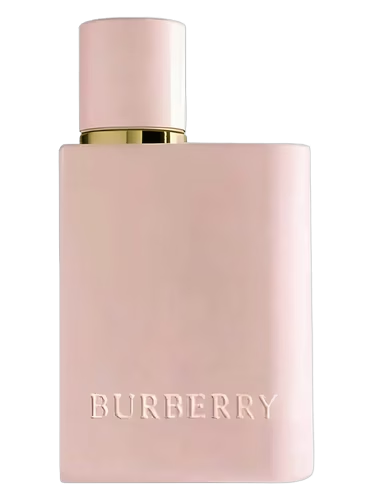
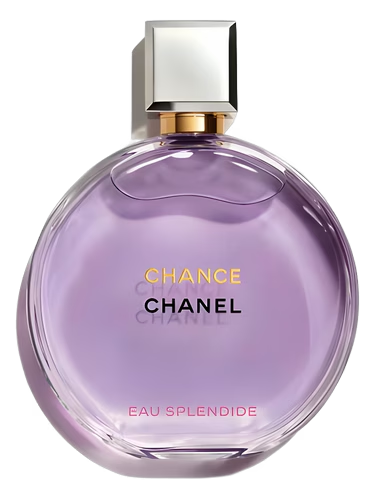
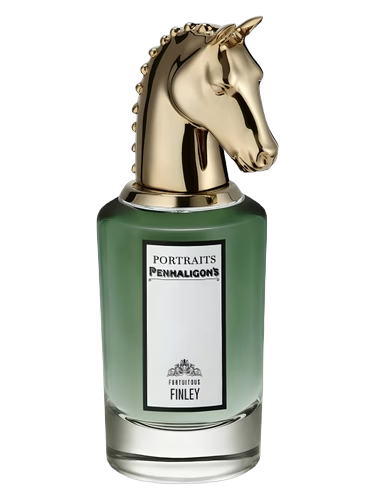
Most Popular Scents Using Eglantine Rose
What is Eglantine Rose?
Eglantine Rose, also known as Sweetbriar or Rosa rubiginosa, is a wild rose species native to Europe and Western Asia, celebrated for its fragrant foliage and delicate blossoms.What does Eglantine Rose smell like?
It offers a fresh, delicate, and green rose aroma characterized by a unique, bright, and sharp apple-like facet that is lighter and airier than traditional rose notes.How is Eglantine Rose essence extracted?
The aromatic essence is primarily obtained through steam distillation to produce rose otto or solvent extraction to create a concentrated rose absolute.What are some top perfumes featuring Eglantine Rose?
Notable fragrances include Erica Elizabeth Designs Eglantine Rose Parfum, Les Liquides Imaginaires Fleur De Sable, Hermès Hermessence Myrrh Eglantine, and Brocard Crystal Peony.When is Eglantine Rose in season?
The plant typically blooms in late spring and early summer, from May to July, while its apple-scented foliage remains fragrant throughout the growing season, especially after rain.