Fragrance Notes Are Layers Of Scent That Are Layered To Form The Final Fragrance. Fragrance Notes Are Categorised Into Three Main Elements Based On How Long They Take To Evaporate, And How Long They Typically Last Following Application: Top Notes, Heart Notes And Base Notes.
Edelweiss
Edelweiss is a fantasy floral note, often interpreted as a delicate, sheer, and airy mountain blossom. It is typically a light, slightly sweet, and powdery scent, with white floral nuances and a clean, cool, high-altitude freshness. It imparts an ethereal, subtle elegance and a sense of purity to compositions.

Origin & Extraction Of Edelweiss
Edelweiss is classified as a "fantasy floral note" in perfumery, meaning its scent profile is largely synthesized to evoke a concept rather than being extracted from the actual flower. Historically, the Edelweiss (Leontopodium alpinum) flower is celebrated in the Alpine regions of Europe as a symbol of rugged purity, rare beauty, and high-altitude freshness. Due to its status as a protected species and the difficulty in extracting a true essential oil, its significance in perfumery is symbolic, leveraging its cultural history—where it was often used as a token of love or a symbol of devotion—to convey a delicate, ethereal mountain scent.
As a fragrance note, Edelweiss gained relevance in modern perfumery, particularly as brands sought to capture clean, natural, and high-altitude freshness in compositions. The note's interpretation typically leans toward a sheer, light, and slightly sweet powdery scent with white floral nuances. Its use is contemporary, allowing perfumers to inject a sense of unique, almost mysterious elegance and purity into modern floral, fresh, or sophisticated niche compositions, distinct from traditional florals like rose or jasmine.
The extraction of edelweiss (Leontopodium alpinum) is primarily achieved through advanced solvent extraction techniques designed to preserve its potent polyphenols and antioxidants. Modern commercial production often utilizes a cold process to prevent the degradation of heat-sensitive phytochemicals like chlorogenic acid and luteolin. This typically involves extracting organically grown, pesticide-free plant material with a specific eluant, which is then concentrated and stabilized in a solution of glycerin and water. Recent technological advancements include pressurized solvent extraction (PSE) and supercritical CO2 extraction, which offer high efficiency and purity for pharmaceutical and cosmetic applications.
Historically, edelweiss was processed through simpler traditional methods rooted in European folk medicine. These methods involved harvesting the leaves, flowers, and stems, followed by air-drying and manual maceration in alcoholic solutions or water to create medicinal tinctures and infusions. In contemporary laboratory settings, these traditional principles are modernized through precise freeze-drying (lyophilization) to process the plant into a fine powder before extraction. Additionally, innovative biotechnological methods like callus culture extraction (LACCE) are now used to produce high-quality extracts in controlled bio-reactors, ensuring sustainability and consistency without depleting wild alpine populations.
The Edelweiss note, cherished for its symbolism of purity and high-altitude freshness, is primarily featured in modern fragrances seeking to evoke a clean, airy, and sophisticated scent profile. As a fantasy note, it allows perfumers to infuse compositions with an ethereal lightness, often interpreted as a sheer, slightly sweet, and powdery mountain blossom scent. One of the earliest and most notable fragrances to champion this Alpine inspiration is **Swiss Army** (1997) by Victorinox, establishing the note's association with invigorating, crisp freshness.
The contemporary use of Edelweiss extends across various fragrance genres, from masculine to unisex compositions, where its delicate white floral nuances add depth without overpowering the main accord. Recent niche and designer houses have utilized Edelweiss to anchor fresh, light florals or aquatic fragrances, differentiating them from heavier, traditional florals. Examples of this modern approach include **Loon** (hima jomo, 2023) and **Felicity** (Paradis des Sens, 2020), which leverage the note's subtle elegance to convey a sense of natural, protected beauty.
Edelweiss also plays a significant role in scents designed to be light and uplifting, particularly within lines that celebrate purity and clarity. Fragrances like **Morning Dew** (Victorinox Swiss Army, 2020) and **Crystal Bloom** (Jill Stuart, 2014) showcase its powdery, clean facet, making it a popular choice for light, feminine, and sheer compositions. The continued presence of Edelweiss in new releases, such as **Mont Cristal** (Poécile Parfums, 2024), confirms its standing as a versatile and inspirational note for modern perfumery.
Sustainability Of Edelweiss
Sustainability of Edelweiss
- Supporting the 30 by 30 goal of the Kunming-Montreal Global Biodiversity Framework to protect 30% of land and water areas by 2030
- Implementing the Alpine Convention, an international treaty between eight countries to preserve the Alps as a vital habitat for endangered plant species
- Advocating for the Day for the Protection of the Alps to combat biodiversity loss caused by climate change and economic exploitation
- Developing digital distribution maps and conservation simulations to identify and protect emerging biodiversity hotspots at various altitudes
- Managing protected areas and national parks, such as the Gran Paradiso Park, to limit hydro-morphological alterations and increase plant resilience
- Utilizing international networks like Emerald-Natura 2000 to coordinate cross-border protection efforts for the 400 plant species endemic to the Alps
Trivia
Known as the "star of the snow," edelweiss was traditionally used as a romantic "love spell" where young men would risk their lives climbing treacherous alpine cliffs to pick the flower as a symbol of bravery and devotion for their beloved.
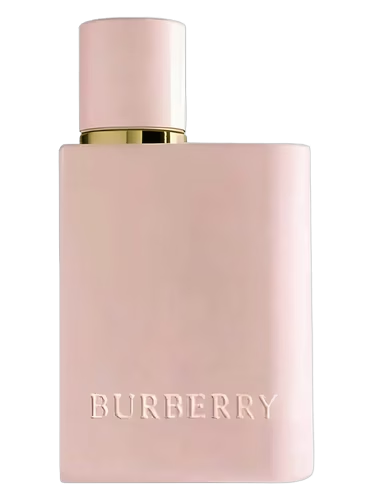
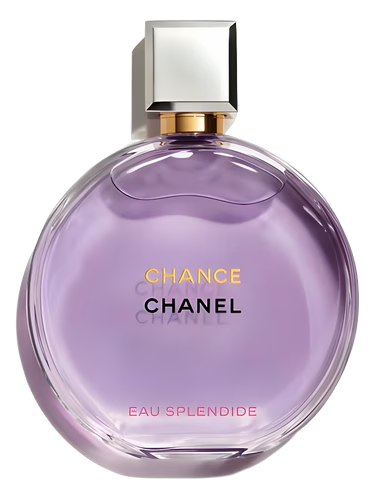
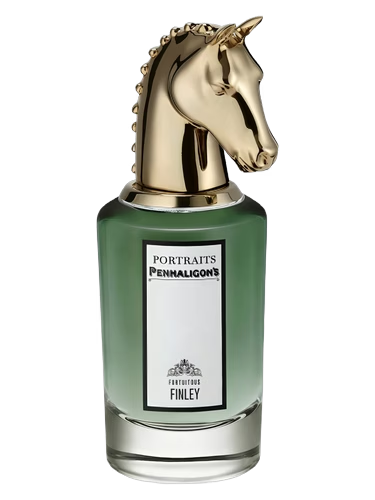
Most Popular Scents Using Edelweiss
What is Edelweiss?
Edelweiss is a protected alpine flower from the European mountain regions that is used as a fantasy floral note in perfumery to symbolize purity, rarity, and high-altitude freshness.What does Edelweiss smell like?
As a fantasy note, it is interpreted as a delicate, sheer, and airy scent with light powdery facets, white floral nuances, and a cool, mineral, or honey-like sweetness.Is natural Edelweiss used in perfumes?
No, natural Edelweiss is a protected species and has minimal natural scent, so perfumers use synthetic accords to recreate its conceptual aroma of cold mountain air and alpine blossoms.What are some top perfumes featuring Edelweiss?
Notable fragrances include Victorinox Swiss Army, Poécile Mont Cristal, hima jomo Loon, and Jill Stuart Crystal Bloom.When is Edelweiss in season?
The flower typically blooms during the summer months, specifically from July to September, emerging after the spring snowmelt in its native alpine habitats.