Fragrance Notes Are Layers Of Scent That Are Layered To Form The Final Fragrance. Fragrance Notes Are Categorised Into Three Main Elements Based On How Long They Take To Evaporate, And How Long They Typically Last Following Application: Top Notes, Heart Notes And Base Notes.
Dyer's Greenweed
Dyer's Greenweed (Genista tinctoria) offers a distinct, dry, and cool wild floral aroma. Its profile is characterized by an herbaceous, bracken-like freshness, reminiscent of broom. It introduces a subtle, rustic, and slightly airy green complexity to compositions, often used to suggest natural, untamed landscapes.

Origin & Extraction Of Dyer's Greenweed
Dyer's Greenweed, or Genista tinctoria, has a historical lineage tied more closely to traditional European crafts than to early fine perfumery. The plant was famously used throughout the Middle Ages and Renaissance for its vibrant yellow dye—the source of its common name. While other European wild florals like broom (Genista family members) occasionally appeared in historical apothecaries for their aromatic properties, Dyer's Greenweed was not a staple essential oil like lavender or rose. It carries a dry, cool, and rustic floral-herbaceous scent, which did not align with the heavy, opulent styles of early French perfumery or the zesty freshness of 18th-century Eaux de Cologne.
Its relevance in modern perfumery is primarily found in contemporary compositions, especially niche and artisanal fragrances that seek to evoke specific, naturalistic landscapes and unusual green textures. In the 20th and 21st centuries, as perfumers moved toward photorealistic and complex green notes, Dyer's Greenweed became valued for its subtle, slightly bitter, and bracken-like freshness, providing an earthy, untamed complexity that moves beyond simple floral accords. Its use remains specialized, often employed to create a sense of wild, natural scenery rather than a dominant floral heart.
Extraction Methods of Dyer's Greenweed
The primary method for extracting the yellow dye from Dyer's Greenweed involves boiling or simmering the whole plant, particularly the leaves and flowering tops. Historically, the plant was collected in large quantities, dried, and then boiled in water to release its beautiful yellow pigment, luteolin. Traditionally, textiles like wool were first mordanted with alum before being immersed in the yellow dye bath. To achieve the famous "Kendal Green," the yellow-dyed cloth was subsequently overdyed with a blue liquor extracted from woad.
Modern extraction often utilizes more refined techniques to produce concentrated extracts in the form of stable, dark greenish-yellow crystalline powders. These contemporary processes are designed to be environmentally respectful and often comply with organic textile certifications like GOTS. For artisanal use, current methods involve making a paste of the extract with warm water and simmering it with mordanted fibers for 45 to 60 minutes. The addition of an alkali, such as chalk (calcium carbonate) or lime water, is a common contemporary practice used to neutralize acidity and enhance the brilliance of the lemon-yellow hue.
Dyer's Greenweed (Genista tinctoria) is a note largely absent from mainstream heritage fragrances, but it has been embraced by modern niche houses looking to create photorealistic green textures and invoke the scent of wild European meadows. Its dry, cool, and herbaceous profile, reminiscent of broom and bracken, serves to ground compositions and add a rustic, untamed complexity. It rarely forms the dominant central accord but acts as a sophisticated supporting element, enriching green floral and chypre structures with its subtly bitter freshness.
One notable example of Dyer's Greenweed's sophisticated use is found in niche perfumery where specific natural landscapes are the focus. While exact perfume compositions can be proprietary, the general aromatic character of Genista is frequently integrated into fragrances designed to replicate the aroma of the Scottish Highlands or dense, dry European forests. These compositions, such as those from artisanal brands like Olympic Orchids Perfumes or specialized European naturals houses, often utilize it to blend the sharpness of gorse or broom with earthy, mossy bases, creating an enduring sense of natural wildness.
Its application in fragrances often aims for transparency and luminosity, contrasting with heavy, classic florals. For instance, Dyer's Greenweed can be found supporting the bright, green opening in fragrances like those in the Hermès Jardin Collection (though not explicitly named in all, its nuances are often suggested in the green accords), offering a light, airy, and slightly bitter freshness that cuts through sweetness. It helps to elevate standard green notes into something more architectural and evocative, appealing to consumers who seek unique, botanical accuracy in their scent profiles.
- Blooming typically occurs during the summer months, with bright yellow flowers appearing from June to August or September
- The plant follows a deciduous cycle, entering its active growing phase in the spring and losing its foliage in late fall and winter
- Fruit development occurs in late summer and autumn, with seed-bearing pods maturing and ripening between August and October
- Winter interest is maintained by the shrub's upright, twiggy green stems after the leaves have fallen
- Optimal periods for maintenance and propagation include pruning in late winter or early spring to encourage new growth and sowing seeds in the spring or fall
Sustainability Of Dyer's Greenweed
Sustainability of Dyer's Greenweed
- Supporting biodiversity conservation by providing a critical habitat and food source for over 58 insect species, including rare specialist moths like the Large Gold Case-bearer and Greenweed Flat-body
- Promoting the preservation of unimproved neutral and calcareous grasslands through traditional management practices such as extensive cattle grazing and timed hay-cutting
- Utilizing natural nitrogen fixation properties to improve soil health and allow for growth in nutritionally poor or degraded landscapes without the need for synthetic fertilizers
- Encouraging the use of eco-friendly, plant-based dyes as a sustainable alternative to synthetic pigments, utilizing the whole plant to produce high-quality, light-fast yellow and green colors
- Implementing reintroduction and propagation programs through organizations like Butterfly Conservation and local Wildlife Trusts to reverse the decline of vulnerable populations and restore functional ecosystems
Trivia
The scientific name for Dyer's greenweed, Genista tinctoria, provided the name for the Plantagenet kings and queens of England, and it was also the source of the first isolated isoflavone, genistein, in 1899.
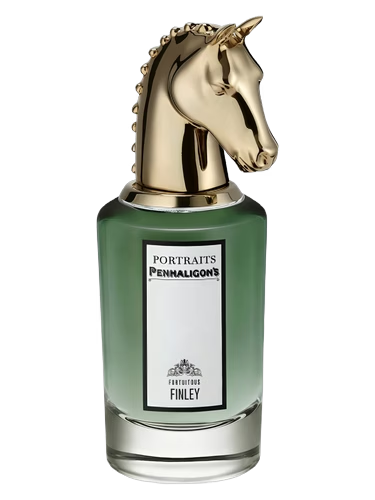
Most Popular Scents Using Dyer's Greenweed


What is Dyer's Greenweed?
Dyer's Greenweed, or Genista tinctoria, is a wild flowering shrub native to Europe and Western Asia, historically used for making yellow dye and now valued in niche perfumery for its unique green profile.What does Dyer's Greenweed smell like?
It offers a distinct dry, cool, and herbaceous aroma with bracken-like freshness, providing a rustic and slightly bitter green complexity reminiscent of broom.How is Dyer's Greenweed essence extracted?
In perfumery, the aromatic compounds are typically obtained through distillation of the plant's leaves and flowering tops to capture its airy, wild floral essence.What are some top perfumes featuring Dyer's Greenweed?
Notable fragrances include Tom Ford Champaca Absolute, Amouage The Library Collection Opus III, Boucheron Trouble, and Dior La Collection Couturier Parfumeur Granville.When is Dyer's Greenweed in season?
The plant typically blooms during the summer months, from June to August or September, which is the optimal period for capturing its vibrant aromatic profile.