Fragrance Notes Are Layers Of Scent That Are Layered To Form The Final Fragrance. Fragrance Notes Are Categorised Into Three Main Elements Based On How Long They Take To Evaporate, And How Long They Typically Last Following Application: Top Notes, Heart Notes And Base Notes.
Decalepis hamiltonii
Decalepis hamiltonii offers a rich, aromatic profile with a distinctive sweet, vanilla-like gourmand quality, often described as vanilla-honey. It features strong aromatic undertones due to HMB (2-hydroxy-4-methoxy benzaldehyde), lending a creamy, slightly earthy, and subtly spiced sweetness to compositions, reminiscent of a natural cola flavoring with a comforting, sophisticated vanillic warmth.

Origin & Extraction Of Decalepis hamiltonii
Decalepis hamiltonii, known in South India as 'Nannari' or 'Makali Beru', is a root historically significant in traditional Ayurvedic medicine, culinary practices, and as a natural coolant beverage ingredient, often used as a Sarsaparilla substitute. Its rich, aromatic profile, characterized by HMB (2-hydroxy-4-methoxy benzaldehyde), provides a distinctive sweet, vanilla-like gourmand quality, reminiscent of cola or vanilla-honey. While the root has a long cultural history, its application in contemporary fine perfumery as a dedicated note is relatively recent.
In perfumery, Decalepis absolute is valued as a multi-faceted ingredient. It is a modern note adopted for its sophisticated gourmand and balsamic characteristics, offering a creamy, slightly earthy, and spiced sweetness that is less common than traditional vanillic materials. Perfumers utilize it to construct gourmand and amber accords or to facet and add roundness to floral notes, lending a unique, comforting warmth and depth to modern compositions.
Historically, the aromatic compounds of Decalepis hamiltonii, particularly the major flavor component 2-hydroxy-4-methoxybenzaldehyde (HMB), have been extracted through traditional steam-hydro distillation. This process involves grating the tuberous roots and subjecting them to steam to release volatile oils, which are then recovered via solvent extraction using chlorinated hydrocarbons like dichloromethane. The roots have also been traditionally prepared by cleaning and soaking in alcohol to remove surface contamination before being processed into pastes for local medicinal and culinary uses.
Modern extraction techniques have expanded to include more sophisticated methods such as Soxhlet extraction using a series of organic solvents like hexane, chloroform, ethyl acetate, and methanol to isolate various bioactive fractions. Recent research has optimized batch conditions for solvent extraction, identifying that a 60-minute extraction time at 60°C with an aqueous acetone or ethanol system significantly improves the yield of antioxidants and polyphenols. Additionally, advanced methods like GC-MS and NMR spectroscopy are now standard for verifying the purity and identifying the complex molecular structures of the extracted compounds.
Decalepis hamiltonii, a note prized for its vanilla-honey and slightly spiced gourmand profile, has recently emerged in contemporary perfumery, particularly among niche and artisanal houses seeking unique, comforting warmth. Vanitas Parfums, a house dedicated to exploring complex and sophisticated materials, has been a key proponent of this note, utilizing its creamy, earthy sweetness in several notable compositions.
- Among the most prominent uses are in the Vanitas Parfums line, including Le Messe Noire, A Thousand Layers, and A Flutter Of Hearts, where the Decalepis note adds a distinctive, long-lasting vanillic depth that goes beyond standard sweet accords.
- The note’s sophisticated gourmand characteristics are further showcased in Vanitas Parfums releases such as Where The Sea Roars And The Wind Cries and Dance With The Devil, demonstrating its versatility in complementing both complex oriental and more atmospheric fragrances.
While smaller, niche producers have embraced the note as a central feature, its unique profile suggests a growing influence among larger, established fragrance houses. Its aromatic complexity—reminiscent of natural cola or sarsaparilla—makes it an ideal component for enriching modern gourmand and amber compositions, offering a contemporary twist on traditional vanilla and benzoin notes. Houses such as Lattafa Perfumes, Guerlain, Tom Ford, and Parfums de Marly are noted to have compositions where this sophisticated sweet root could be utilized, often subtly, to facet and provide an unconventional depth to their signature offerings.
The continuing appeal of Decalepis hamiltonii lies in its ability to bridge fresh openings with rich, warm bases, a feature particularly sought after in new releases. For instance, the upcoming Vanitas Parfums fragrances, A Dance Of Shadows and Lovers In The Lemon Grove (2025 releases), highlight the note's adaptability, pairing its creamy sweetness with diverse accords ranging from dark masculine structures to bright, unisex citrus concepts, solidifying its position as a unique, sophisticated ingredient for the future of fine perfumery.
Sustainability Of Decalepis hamiltonii
Sustainability of Decalepis Hamiltonii
- Addressing endangered status by implementing biotechnological interventions such as micropropagation and tissue culture to enable mass production without depleting wild populations
- Transitioning from destructive wild harvesting to large-scale cultivation and organized plantations to reduce pressure on natural forest ecosystems
- Promoting community-based conservation through licensed forest cooperatives that follow government-certified rotational harvesting and regenerative practices
- Developing integrated pest management systems using plant-derived bioactive agents as ecologically safe alternatives to chemical pesticides
- Ensuring socio-economic resilience for local collectors through fair trade partnerships and capacity-building initiatives for sustainable resource management
Trivia
Decalepis hamiltonii is often referred to as swallowroot because its fragrant roots possess a strong, natural vanilla-like aroma, making it a popular substrate for producing vanillin and flavoring ice creams.
Most Popular Scents Using Decalepis hamiltonii
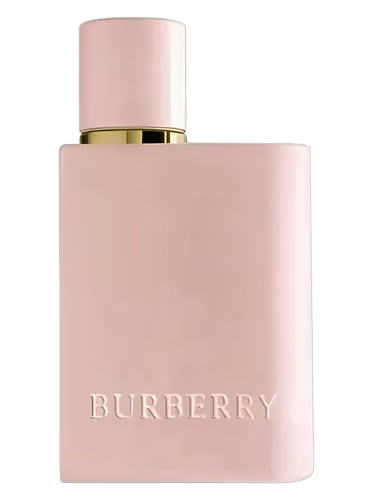
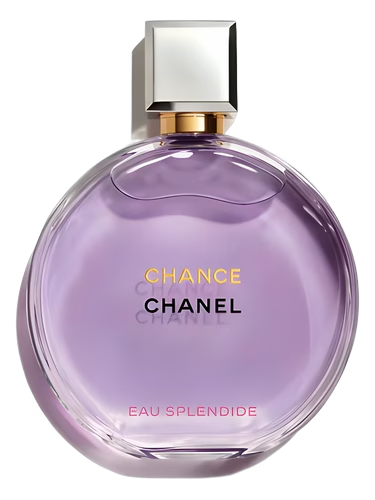

What is Decalepis hamiltonii?
Known as Nannari in South India, it is a tuberous root historically used in Ayurvedic medicine and as a natural sarsaparilla substitute for coolant beverages.What does Decalepis hamiltonii smell like?
It offers a rich vanilla-honey gourmand profile with creamy, earthy, and subtly spiced undertones reminiscent of natural cola flavoring.How is Decalepis hamiltonii essence extracted?
The essence is primarily obtained through steam-hydro distillation or solvent extraction of the plant's grated tuberous roots.What perfumes feature Decalepis hamiltonii?
This note is featured in niche fragrances such as Vanitas Parfums' Le Messe Noire, A Thousand Layers, and A Flutter Of Hearts.Is Decalepis hamiltonii sustainable?
As an endangered species, sustainability efforts focus on biotechnological interventions like tissue culture and transitioning from wild harvesting to organized cultivation.