Fragrance Notes Are Layers Of Scent That Are Layered To Form The Final Fragrance. Fragrance Notes Are Categorised Into Three Main Elements Based On How Long They Take To Evaporate, And How Long They Typically Last Following Application: Top Notes, Heart Notes And Base Notes.
Daylily
Daylily offers a complex, intense floral aroma, often described as a fantasy note since its natural scent is ephemeral. It presents a velvety, voluptuous, and luminous floral character, reminiscent of jasmine or lily of the valley, with a subtle sweetness and an evolving profile that captures the flower's life cycle.

Origin & Extraction Of Daylily
The Daylily (Hemerocallis) is a fascinating subject in perfumery because it is considered a "fantasy note." While the flowers themselves have a rich, complex, and intoxicating aroma, the natural scent cannot be extracted using traditional methods like distillation or solvent extraction; it is ephemeral and lost once picked. Therefore, the history of Daylily in perfumery is not one of ancient extraction, but of modern headspace technology and synthetic reconstruction. Perfumers must rely on their creativity and technology to capture its velvety, luminous, and slightly sweet floral profile, constructing an accord that evokes the flower's essence rather than isolating its natural oil.
The use of the Daylily accord gained traction in the late 20th and early 21st centuries, mirroring a broader trend in the fragrance industry toward replicating elusive or non-extractable scents, such as lilac, freesia, and lily of the valley. Daylily's appeal lies in its ability to offer a unique, voluptuous floral note that stands apart from classic notes like jasmine or rose. Its inclusion in modern compositions allows for the creation of intensely floral, yet often fresh and luminous fragrances, often bridging the gap between soft garden florals and more intense white florals to provide a sophisticated, contemporary floral heart.
Extraction Methods of Daylily
Historically, daylily extracts were obtained through simple maceration and solvent steeping. Traditional techniques involved soaking the flowers or roots in ethanol or water at low temperatures for extended periods, typically 18 to 48 hours, to capture bioactive compounds. These methods often relied on multiple stages of filtration and re-soaking to maximize the recovery of phenolic compounds and other medicinal properties.
Modern commercial and scientific extraction utilizes advanced technologies to enhance yield and purity. Current standard practices include ultrasonic-assisted extraction (UAE) and enzymatic-assisted extraction (EAE) using solvents like ethanol or water, which significantly improve the release of antioxidants and flavonoids compared to traditional soaking. Additionally, supercritical fluid extraction using carbon dioxide (SFE-CO2) is employed to isolate specific components like lutein and zeaxanthin under high pressure and temperature, providing a cleaner and more efficient alternative to mechanical or solvent-based methods.
The Daylily note, often synthesized to capture its ephemeral, velvety scent, has been utilized in modern perfumery to create luminous and intensely floral heart notes. Since the natural essence cannot be extracted, perfumers craft an accord that evokes its sweet, voluptuous character. One notable example is the inclusion of a Daylily-like accord in fragrances that emphasize clean, dewy white florals, bridging the gap between soft garden scents and more intense compositions.
- The scent of Daylily is often evoked in contemporary floral compositions such as some of the iterations within the *L'eau d'Issey* line by Issey Miyake, where a fresh, watery floral heart is key, and fragrances like Tommy Hilfiger Tommy Girl, which features a lively, bright floral blend where a fantasy lily note plays a central role.
For designers aiming for a sophisticated, slightly aquatic floral presence, the Daylily accord provides a distinctive freshness. This note is particularly effective when blended with green facets or light musk to enhance its luminous quality, avoiding the heaviness associated with traditional white florals like tuberose or gardenia. It contributes to a modern sense of airy elegance.
- Another prominent use of a synthetic floral note akin to Daylily can be found in fragrances like Estée Lauder Pleasures, a scent famous for pioneering the "sheer floral" category, often listing fantasy flower notes to create its clean, bright, and slightly metallic floral bouquet.
The Daylily note, therefore, remains important in niche and mainstream fragrance design as a creative tool. It allows perfumers to express a complex floral life cycle—from dewy bud to full, sweet bloom—resulting in a vibrant, sophisticated floral signature that is modern, intoxicating, and memorable, often standing out in compositions built around fresh and uplifting themes.
Sustainability Of Daylily
Sustainability of Daylily
- Enhancing livelihood resilience for smallholder farmers in ecologically fragile regions through specialty agriculture and economic stability
- Promoting ecological conservation by using dense clumps to naturalize landscapes, suppress weeds, and prevent soil erosion on slopes
- Utilizing climate-resilient farming practices as the plant is remarkably drought-tolerant and adaptable to various soil types and environmental stressors
- Supporting zero-waste and permaculture principles by repurposing all parts of the plant as a sustainable food source, including edible shoots, buds, petals, and tubers
- Implementing integrated pest management by relying on natural predators like ladybugs and using organic, less-toxic control options such as neem oil or insecticidal soap
- Advancing sustainable gardening through low-maintenance cultivation that requires minimal chemical inputs and provides multiple functions within an ecosystem
Trivia
In Chinese cuisine, dried daylily buds, known as golden needles, are a staple ingredient in hot and sour soup, but they must be dried before consumption because fresh blooms contain a toxin that can cause nausea.
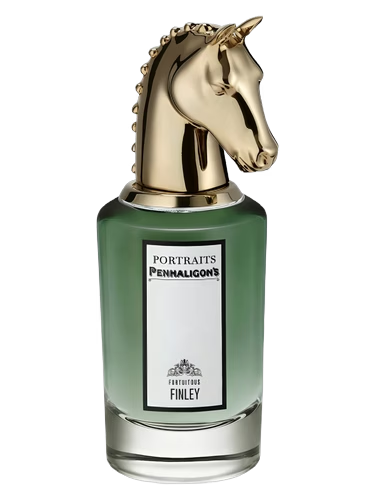
Most Popular Scents Using Daylily


What is Daylily in perfumery?
Daylily is a complex floral note often referred to as a "fantasy note" because its natural scent is ephemeral and requires modern technology to reconstruct for use in fragrances.What does Daylily smell like?
It possesses a velvety, voluptuous, and luminous floral profile reminiscent of jasmine or lily of the valley, with a subtle sweetness and an evolving character.How is the Daylily note created?
Since natural extraction is difficult, perfumers use headspace technology and synthetic reconstruction to capture the flower's essence and create a sophisticated floral heart.What are some top perfumes featuring Daylily?
Popular fragrances include Alyssa Ashley Waterlilys Daylily, House of Matriarch Daylily, Tommy Hilfiger Tommy Girl, and Estée Lauder Pleasures.When is Daylily in season?
The plant's seasonal cycle varies by climate, but blooming typically begins in early spring and peaks during midsummer, often between June and July.