Fragrance Notes Are Layers Of Scent That Are Layered To Form The Final Fragrance. Fragrance Notes Are Categorised Into Three Main Elements Based On How Long They Take To Evaporate, And How Long They Typically Last Following Application: Top Notes, Heart Notes And Base Notes.
Daphne
Daphne presents a gentle, highly luminous, and airy floral profile. It is often characterized by sweet, creamy white-floral nuances (sometimes compared to gardenia or tuberose) combined with green, slightly spicy, and subtle honeyed undertones. It offers sophisticated, tranquil freshness and a delicate, ethereal sweetness.

Origin & Extraction Of Daphne
The use of the Daphne note in perfumery is relatively modern. The Daphne plant itself is highly regarded for its intensely fragrant, ephemeral blooms, but the flower does not yield a natural essential oil through traditional distillation methods, meaning its scent must be recreated synthetically, or as a reconstitution, known as an accord. This technical challenge prevented its widespread adoption in classical perfumery, which historically relied on readily extractable materials like rose, jasmine, and citrus oils.
Daphne began to gain traction in the late 20th and early 21st centuries as synthetic chemistry advanced, allowing perfumers to capture its delicate, luminous, and slightly spicy white-floral profile with greater accuracy. It is primarily featured in niche and sophisticated contemporary fragrances where its unique character—often described as a blend of gardenia and tuberose with green nuances—is sought to add a unique, tranquil, and ethereal freshness that distinguishes compositions from more traditional floral notes.
Extraction Methods of Daphne
Historically, Daphne has been processed through traditional techniques such as enfleurage, where flowers were placed on layers of animal fat to capture their delicate scent, and simple hydrodistillation to produce small yields of essential oil from aerial parts. Because many Daphne species are highly toxic and produce very little oil, they have long been considered difficult or impossible to extract commercially for fine fragrance, leading to the use of tinctures in traditional medicine made by steeping dried flowers or leaves in water or alcohol.
Modern extraction methods have evolved to include ultrasound-assisted extraction (sonication) and Soxhlet extraction using solvents like methanol or ethyl acetate to isolate bioactive compounds such as polyphenols and flavonoids. Recent research also utilizes supercritical CO2 extraction and advanced laboratory techniques like vacuum infiltration vitrification for plant preservation. In contemporary perfumery, because natural extraction remains scarce due to toxicity and low yields, the scent of Daphne is typically achieved through sophisticated fantasy accords or high-end floral bases that recreate its unique aromatic profile.
The Daphne note, prized for its luminous, airy white-floral profile often likened to a blend of gardenia and tuberose, is a feature of many contemporary and niche fragrances. Since the Daphne scent must be recreated as an accord (as it doesn't yield a natural essential oil), its appearance often signifies a sophisticated approach to floral composition. One example of a fragrance featuring this delicate note is **Women of Earth** by Avon (1998), which showcases the Daphne's ethereal sweetness in a classic feminine structure.
- Other modern fragrance houses have centered compositions entirely around this complex floral. **Daphne Bouquet** by Penhaligon's (2025) is a forthcoming example highlighting the note, while **Daefne** by Helan (2024) also puts the delicate flower in the spotlight, demonstrating its appeal for creating tranquil and unique floral freshness.
In the realm of niche perfumery, Daphne provides an intriguing sophistication, moving beyond traditional floral ingredients. For instance, **Dangerous Curves** by The Zoo (2022) and **Ukiyo-E** by Gri Gri Parfums (2016) incorporate Daphne to introduce its distinctive green, slightly spicy nuances into their unique, gender-neutral structures. This complex usage highlights Daphne’s versatility in balancing creamy sweetness with a fresh, herbaceous lift.
- Another noteworthy fragrance that utilizes Daphne to achieve a sparkling and uplifting signature is **Radiant Gem** by Tokyo Milk Parfumerie Curiosite (2021), appealing to a modern audience seeking brightness and vitality in a sophisticated floral scent.
The development of the Daphne note in perfumery is tied to advancements in synthetic chemistry, allowing perfumers to capture its fleeting, intense scent. This has allowed it to become a staple for houses looking to innovate within the floral category. Whether it provides a subtle, creamy sweetness as in **Pearl** by Ikiryō (2017) or contributes to a more complex, dark zest, the Daphne note adds a layer of tranquil, ethereal elegance to contemporary fragrance compositions.
Sustainability Of Daphne
Sustainability of Daphne
- Adopting green science innovations, such as air extraction and molecular capture, to harvest the scent of live flowers without damaging the plant or generating waste
- Developing synthetic and biotechnological alternatives to reduce reliance on wild-harvested Daphne, which is highly toxic and sensitive to over-harvesting
- Implementing eco-friendly packaging initiatives, including the use of 100% recycled paper, sugar cane eco-foam, and organic mineral-oil-free inks
- Utilizing upcycling models like SymTrap to recover aromatic residues from other industries, reducing the carbon footprint and energy consumption of extraction
- Promoting biodiversity through the cultivation of compact, hardy hybrids like 'Perfume Princess' that support early-season pollinators in diverse urban environments
Trivia
Despite its delicate appearance, the Daphne plant is so fragrant that its aroma can scent an entire garden in late winter, and it is known for its extreme sensitivity to being moved, often "sulking" or dying if its roots are disturbed or if it is transplanted.
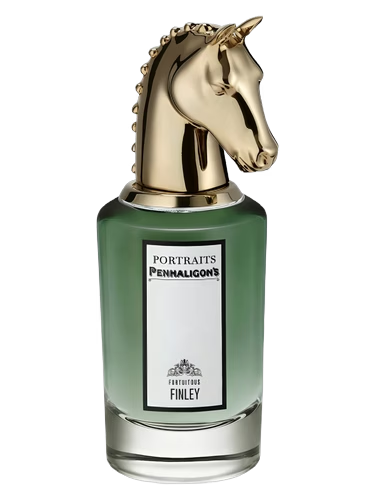
Most Popular Scents Using Daphne


What is Daphne?
Daphne is a genus of fragrant shrubs native to Asia, Europe, and North Africa, highly valued in perfumery for its luminous and airy white-floral scent.What does Daphne smell like?
It offers a gentle, creamy floral profile often compared to gardenia or tuberose, balanced by green, slightly spicy, and subtle honeyed undertones.How is the Daphne note extracted?
Because the flower is toxic and yields very little oil, its scent is typically recreated in modern perfumery through synthetic fantasy accords or high-end floral bases.What are some top perfumes featuring Daphne?
Notable fragrances include Comme des Garcons Daphne, Penhaligon's Daphne Bouquet, Tokyo Milk Radiant Gem, and Avon Women of Earth.When is Daphne in season?
Daphne species are known for their winter and spring flowering periods, with many popular varieties blooming from mid-winter to early spring.