Fragrance Notes Are Layers Of Scent That Are Layered To Form The Final Fragrance. Fragrance Notes Are Categorised Into Three Main Elements Based On How Long They Take To Evaporate, And How Long They Typically Last Following Application: Top Notes, Heart Notes And Base Notes.
Daisy
Daisy is typically a fantasy floral note in perfumery, characterizing a delicate, light, and fresh wildflower scent. It is often airy and subtle, intended to convey a cheerful, natural, and innocent impression, making it a popular choice for bright, feminine, and spring-like compositions.

Origin & Extraction Of Daisy
The Daisy note in perfumery is primarily categorized as a 'fantasy floral' note, meaning it is a synthetic interpretation rather than an extract from the actual daisy flower, which does not yield an essential oil. Its use reflects a modern trend toward abstract, light, and fresh scents that evoke the feeling of a wildflower field. Prior to its popularization, the fragrance world relied on more robust or chemically distinct florals.
The note gained widespread recognition and commercial success with the launch of Marc Jacobs' Daisy Eau de Toilette in 2007. Created by perfumer Alberto Morillas, the fragrance centered a delicate, cheerful, and innocent impression, using the 'Daisy' accord (comprised of notes like wild berries, white violet, and jasmine) to establish a major contemporary genre of bright, feminine, and subtle compositions. Its success established Daisy as a popular and influential modern floral signature.
Extraction Methods of Daisy
Historically, daisy extracts were obtained through simple traditional techniques such as maceration, infusions, and decoctions. In ancient Rome, surgeons extracted the juice from hand-picked daisies for medicinal use on the battlefield. Herbalists and folk medicine practitioners typically steeped the flowers or leaves in water for teas or in carrier oils, such as olive oil, for several weeks to capture the plant's active properties for topical treatments and wound healing.
Modern commercial extraction for perfumery and skincare utilizes more advanced and diverse methodologies. The essential oil is primarily produced through steam distillation or solvent extraction using ethanol. Innovative contemporary techniques include ultrasonic extraction, which uses sound waves to rupture plant cells, and hyper-fermentation, which combines enzymatic bio-liquefaction and fermentation to maximize the yield of antioxidants and amino acids. Other sophisticated processes such as pressurized liquid extraction and supercritical fluid extraction are also employed to isolate specific bioactive compounds without denaturing them.
The "Daisy" note is most famously and influentially tied to the fragrance that shares its name: **Marc Jacobs' Daisy (2007)**. This Eau de Toilette is credited with establishing the Daisy accord as a major signature in contemporary perfumery, embodying a delicate, cheerful, and innocent impression. The composition uses a blend of notes like Wild Berries, White Violet, and Jasmine to create a light, fresh wildflower scent that is widely appealing and modern.
- The scent's commercial success spawned an entire line of popular flankers and variations, further cementing the Daisy note as a recognizable and well-loved modern floral signature.
While the original **Daisy** remains the iconic representation, the success of this fragrance led to numerous best-selling expansions that utilize similar accords, focusing on brightness and subtle femininity. Notable variations include **Daisy Eau So Fresh**, which adds sparkling fruit notes, and **Daisy Love**, which leans into a more radiant and youthful sweetness. These fragrances continue to use the cheerful, fresh wildflower essence of the fantasy Daisy note as their core uplifting element.
- The Daisy franchise is known for its light, non-serious elegance, and its distinctive presentation, which together have made it a staple fragrance for young women globally, embodying a contemporary cottagecore aesthetic.
The profound commercial impact of the original **Marc Jacobs' Daisy** inspired many subsequent perfumes across the market, especially those targeting a bright, spring-like, and airy floral mood. Although Daisy is a fantasy note (not a natural extract), its successful synthetic interpretation of wildflowers and clean freshness set a trend for luminous, subtly sweet florals that prioritize a delicate, ethereal quality over heavy, traditional bouquets, solidifying its place as one of the most recognizable and successful modern floral accords.
- The common daisy (Bellis perennis) typically blooms from March to September, exhibiting heliotropism to follow the sun's position
- While most varieties peak during the spring and summer months, some species like the Marguerite daisy thrive in cooler weather and bloom most heavily in spring and fall
- Specific varieties such as the Michaelmas daisy provide vibrant color late in the year, blooming from late summer through the autumn months
- In semi-tropical climates, certain species like the Gerbera daisy can grow year-round, though their primary blooming periods typically occur in spring and summer
- The plant enters a dormant phase during the winter, although ideal conditions and mild winters can occasionally produce scattered blooms during the off-season
Sustainability Of Daisy
Sustainability of Daisy
- Supporting biodiversity by providing a critical nectar source for urban pollinators, including bees, butterflies, and hoverflies
- Promoting water conservation through the use of drought-tolerant varieties that require minimal irrigation and resist extreme temperatures
- Enhancing soil health and stability via deep root systems that prevent erosion and partnerships with soil fungi that facilitate nutrient cycling
- Advancing sustainable land management by rehabilitating natural habitats and protecting seasonal desert varieties to maintain ecological balance
- Implementing zero-waste and circular economy practices in floral design by composting organic remains and repurposing arrangements for community donation
- Reducing carbon footprints through local and seasonal sourcing to minimize transportation emissions and supporting regional farmers
Trivia
While the daisy is the namesake and visual icon of one of the world's most famous perfumes, the flower itself is actually odorless and yields no natural essence, requiring perfumers to create a "fantasy" scent to represent it.
Most Popular Scents Using Daisy
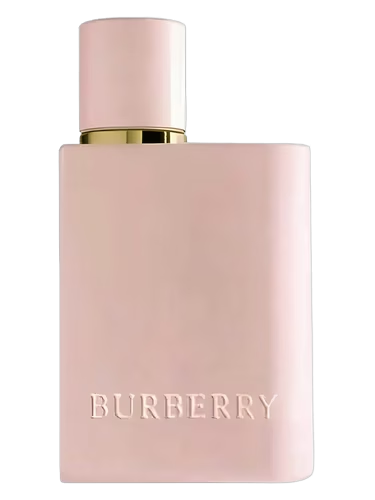
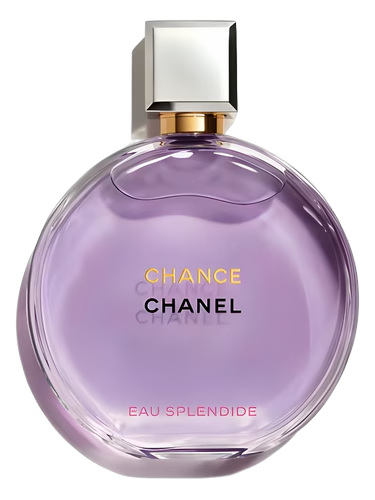
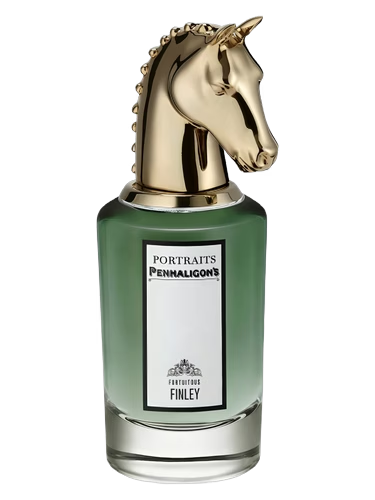
What is the Daisy note in perfumery?
The Daisy note is a "fantasy floral" accord, meaning it is a synthetic creation designed to evoke the scent of wildflowers, as natural daisies do not yield an essential oil.What does Daisy smell like?
It is characterized as a delicate, light, and fresh wildflower scent that is often airy, green, and dewy, conveying a cheerful and innocent impression.How is the Daisy accord created?
Perfumers typically build the accord using green-leaf materials, transparent white florals, ozonic notes, and clean musks to mimic the fragrance of a sunlit meadow.What is the most famous perfume featuring the Daisy note?
Marc Jacobs' Daisy (2007), created by perfumer Alberto Morillas, is the most iconic fragrance credited with popularizing the note and establishing it as a modern floral signature.When is the Daisy note best worn?
Due to its bright, feminine, and ethereal quality, it is a popular choice for spring and summer daytime wear and is often featured in light, airy compositions.