Fragrance Notes Are Layers Of Scent That Are Layered To Form The Final Fragrance. Fragrance Notes Are Categorised Into Three Main Elements Based On How Long They Take To Evaporate, And How Long They Typically Last Following Application: Top Notes, Heart Notes And Base Notes.
Crinum Lily
Striking, complex, and unambiguous. Lily features a profile that is indolic, honeyed, green, and spicy, often with unique savory facets (salty/meaty) balanced by sweetness (vanilla). It evokes a tropical, hot-house atmosphere, delivering a unique blend of green freshness and heavy, narcotic floralcy.

Origin & Extraction Of Crinum Lily
The Crinum Lily note, while prized for its complex and narcotic floral profile, does not possess the long history in traditional Western perfumery associated with classic notes like rose or jasmine. Crinum lilies, belonging to the Amaryllidaceae family and native to tropical and subtropical regions, have long been appreciated as ornamental plants. Their large, often highly fragrant flowers, which can feature indolic, green, and spicy facets, made them aromatic inspirations, but the specific note was historically challenging to extract or replicate synthetically in a convincing manner.
In modern perfumery, the Crinum Lily note is generally a sophisticated reconstruction used to evoke a lush, tropical, or "hot-house" floral atmosphere. Its inclusion, often seen in contemporary and niche fragrances from the late 20th and 21st centuries, reflects a growing trend towards using exotic, photorealistic, and complex white floral compositions. The note's unique combination of heavy narcotic floralcy and savory/spicy undertones makes it a distinctive ingredient when perfumers aim to create luxurious, striking, and unambiguous tropical scents.
Extraction Methods of Crinum Lily
Crinum lilies are not traditionally extracted on a commercial scale for the perfume industry, and the fragrance note used in modern perfumery is typically a fantasy accord reconstructed from other white-floral materials like tuberose and gardenia. Historically, extraction focused on medicinal and artisanal applications. Ancient Egyptian techniques involved oil maceration, where hundreds of flowers were steeped in base oils like balanos or jojoba, a process often "recharged" multiple times with fresh blooms to saturate the scent. Traditional Thai medicine utilizes various physical preparations of the herb, such as grilling leaves over charcoal, pounding fresh bulbs for topical pastes, or boiling them in water or alcohol to create decoctions and tinctures for internal use.
Modern extraction methods for research and high-purity applications utilize advanced laboratory techniques. For scientific and pharmaceutical purposes, solvent extraction using 95% ethanol (maceration) or Soxhlet extraction with polar and non-polar solvents is the standard for isolating bioactive alkaloids like lycorine and crinamine. Recent developments include the use of ultrasonic-assisted extraction to improve yields, followed by vacuum precision distillation and rectifying to achieve essential oil purity higher than 99%. Additionally, biotechnological approaches like in vitro callus culture and micropropagation are being explored to obtain secondary metabolites sustainably without harvesting wild plants.
A notable example of a fragrance that employs the Crinum Lily accord to great effect is **Issey Miyake L'Eau d'Issey Absolue**, where the note is crucial in creating an intense, luminous, and honeyed white floral heart. It provides a luxurious depth that grounds the brighter notes, contributing to a sense of opulent warmth and exotic femininity.
- The use of Crinum Lily here contrasts its heavy sweetness with lighter floral and aquatic elements, highlighting its versatility.
Another fragrance often associated with this complex floral scent profile is **Aerin Lauder Hibiscus Palm**, which aims to capture the essence of a tropical vacation. Although sometimes listed generally as "tuberose" or "white floral," the distinct, spicy, and green-tinged tropical lily facet highly suggests the influence or reconstruction of the Crinum Lily to deliver a photorealistic, lush, and slightly narcotic floral experience.
- Blooming typically occurs from late spring through autumn, with peak flowering for many varieties in mid to late summer
- Individual stalks produce numerous buds that open sequentially, allowing each plant to remain in bloom for several weeks
- Planting is best performed from early spring through late October, typically between April and May, to allow bulbs to establish before their next growth cycle
- Certain hybrids and species offer a sequence of flowers that can extend from April until the first frost of autumn
- Dormancy occurs during the winter months in colder regions, during which time the foliage may die back before new growth emerges in the spring
Sustainability Of Crinum Lily
Sustainability of Crinum Lily
- Promoting low-maintenance landscaping by utilizing the plant's extreme longevity and ability to thrive for decades or even centuries with minimal human intervention
- Enhancing climate resilience through the use of drought-tolerant and flood-resistant bulbs that adapt to various soil types and extreme weather patterns
- Supporting urban biodiversity by providing a reliable nectar source for essential pollinators, including bees, butterflies, hummingbirds, and moths
- Implementing natural pest management strategies by leveraging the plant's inherent resistance to deer and common garden pests, reducing the need for chemical interventions
- Encouraging sustainable propagation practices such as bulb division and seed sharing, which provide an eco-friendly way to expand plant collections without commercial transport or packaging
- Utilizing crinums in rain gardens and drainage easements to manage stormwater runoff and mitigate soil erosion in suburban and coastal landscapes
Trivia
Crinum lilies are often called cemetery plants because they were historically planted in graveyards due to their extreme longevity and ability to thrive for decades with virtually no maintenance.
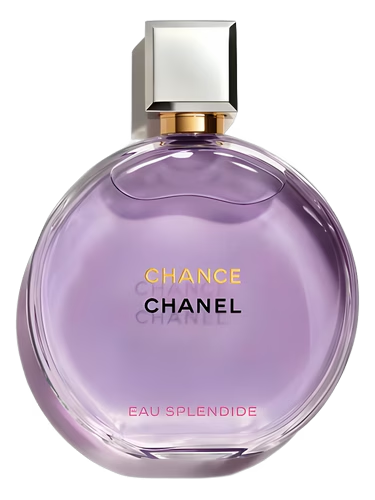
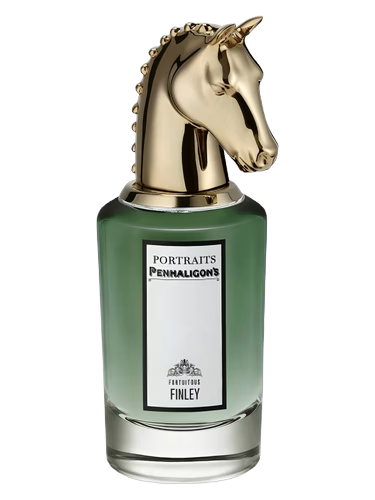
Most Popular Scents Using Crinum Lily

What is Crinum Lily?
Crinum Lily is a tropical and subtropical flowering plant from the Amaryllidaceae family, prized in modern perfumery as a sophisticated fantasy note used to evoke lush, exotic, or "hot-house" floral atmospheres.What does Crinum Lily smell like?
It features a striking, complex aroma that is indolic, honeyed, green, and spicy, often described as a heavy, narcotic white floral scent sitting somewhere between tuberose and gardenia.How is the Crinum Lily note extracted?
Crinum lilies are not commercially extracted for the fragrance industry; instead, perfumers create a reconstruction or "fantasy accord" using other white-floral materials, lactonic elements, and spicy-green molecules.What are some top perfumes featuring Crinum Lily?
Notable fragrances that utilize this note include Issey Miyake L'Eau d'Issey Absolue, Aerin Lauder Hibiscus Palm, and Première Peau Nuit Elastique.When is Crinum Lily in season?
Blooming typically occurs from late spring through autumn, with peak flowering in mid to late summer, though in some tropical climates, the plants can bloom on and off year-round.