Fragrance Notes Are Layers Of Scent That Are Layered To Form The Final Fragrance. Fragrance Notes Are Categorised Into Three Main Elements Based On How Long They Take To Evaporate, And How Long They Typically Last Following Application: Top Notes, Heart Notes And Base Notes.
Count's Fruit
Count's Fruit (Sugar Apple) offers a unique tropical profile: creamy, sweet, and custardy, often likened to a blend of banana, pineapple, and pear with subtle vanilla and milky undertones. It has a delicate, slightly acidic freshness, providing a lush, enveloping, and exotic fruit nuance in compositions.

Origin & Extraction Of Count's Fruit
Count's Fruit, also known as Sugar Apple or Cherimoya (*Annona squamosa*), is native to the tropical Americas, with a history spanning back to ancient Aztec and Incan civilizations. While the fruit itself has a rich traditional and culinary history, its use as a specific, isolated note in classical European perfumery is quite modern. Traditional perfumery favored floral, resinous, and sharper citrus notes; tropical fruits with their delicate, creamy, and highly volatile profiles were historically challenging to extract and reproduce authentically, making them niche ingredients until the advent of sophisticated synthetic aroma chemicals.
The note gained relevance in contemporary perfumery, particularly with the rise of fruity-gourmand and exotic fragrance categories in the late 20th and 21st centuries. Perfumers utilize Count's Fruit's unique profile—creamy, custardy, and subtly acidic, blending nuances of banana, pineapple, and vanilla—to create lush, enveloping, and vibrant top and heart notes. It is valued for providing an authentic, exotic tropical sweetness that lends a modern, distinctive character and depth to compositions, moving beyond common fruity notes like apple or peach.
Historically, the extraction of information regarding fruit counts and biomass relied on manual labor-intensive visual estimations and physical collection. Early methods involved researchers walking along 25-meter or 50-meter transects to manually count fruits, or the use of fruit traps to collect, dry, and weigh samples from the forest canopy. These traditional techniques were often time-consuming and prone to human error, but they established the foundational protocols for estimating yield in both natural forests and managed orchards.
Modern extraction methods have shifted toward digital phenotyping, leveraging advanced computer vision and machine learning. Current techniques utilize high-resolution video and smartphone applications to detect and count fruits in seconds using deep neural networks like YOLOv4 or Deep Layer Aggregation (DLA). Furthermore, cutting-edge frameworks like FruitLangGS and Fruit-NeRF employ 3D spatial reconstruction, terrestrial LiDAR scanners, and language-guided instance estimation to accurately localize fruits even under heavy occlusion, providing real-time data for agricultural automation and yield forecasting.
As a modern and exotic ingredient, Count's Fruit (Sugar Apple) is primarily featured in niche and high-end compositions that aim to capture a lush, creamy, and distinctive tropical sweetness. Because this note—often described as a blend of banana, pineapple, and custard—is highly volatile and complex, its appearance in commercial perfumery signifies a sophisticated use of aroma chemicals to achieve an authentic, lasting tropical accord. Its presence helps differentiate a fragrance from common fruity florals, providing a unique, enveloping depth in the heart or top notes.
While the note is not tied to a single historical masterpiece like Bergamot is to Eau de Cologne, it has been used by influential houses seeking unique gourmand and oriental profiles. Perfumes often cited as featuring the essence of Count's Fruit include oriental fragrances like **Maison Francis Kurkdjian’s Grand Soir** and complex gourmands such as **Tom Ford’s Tobacco Vanille** (as listed in community tagging), where the creamy, custardy quality supports rich base notes like vanilla and amber, lending an unexpected, exotic lift.
The fruit's unique profile—which blends subtle acidity with milky sweetness—makes it perfect for contemporary designers who want to inject a vibrant, modern twist. The note is increasingly seen in niche collections, allowing perfumers to explore exotic sweetness and lush texture. Examples from the wider fragrance community include scents like **Lattafa Perfumes Ishq Al Shuyukh Gold** and **Nishane Musiqa Oud**, showcasing its versatility in both traditional and modern Eastern-inspired compositions.
Sustainability Of Count's Fruit
Sustainability of Fruit Count
- Optimizing resource allocation by using accurate fruit counting to precisely manage water, fertilizers, and labor, reducing waste and environmental impact
- Enhancing yield prediction through deep learning and AI-powered counting, which allows for better food supply planning and reduced post-harvest losses
- Promoting sustainable agricultural interventions, such as the use of phytoseiid mites to naturally increase fruit counts and productivity without synthetic chemicals
- Supporting precision agriculture by identifying spatial variations in orchard health, enabling targeted management that protects soil and water resources
- Reducing the carbon footprint of fruit production by improving monitoring efficiency, which helps growers transition toward more sustainable and productive farming models
Trivia
The first fruity note in modern perfumery was created in 1919 with Jacques Guerlain's Mitsouko, which famously featured a rare, synthetic peach note as its star ingredient.
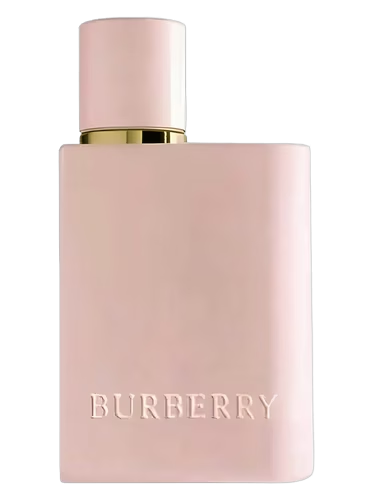
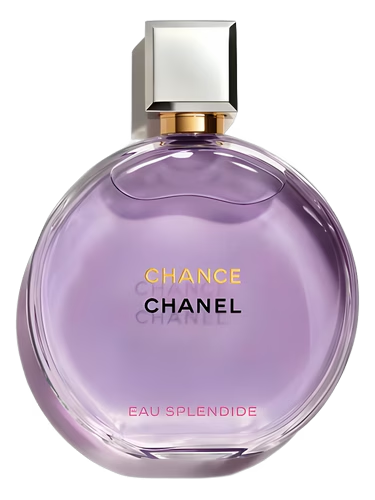
Most Popular Scents Using Count's Fruit

What is Count's Fruit?
Count's Fruit, also known as Sugar Apple or Cherimoya, is a tropical fruit native to the Americas that is used in modern perfumery to provide a creamy, exotic sweetness.What does Count's Fruit smell like?
It offers a unique tropical profile that is creamy and custardy, often described as a blend of banana, pineapple, and pear with subtle vanilla and milky undertones.How is Count's Fruit essence extracted for perfumery?
Because its natural aromatic profile is delicate and highly volatile, it is typically reproduced in perfumery using sophisticated synthetic aroma chemicals to achieve an authentic and lasting accord.What are some top perfumes featuring Count's Fruit?
While it is a niche note, its creamy quality is associated with fragrances like Maison Francis Kurkdjian’s Grand Soir, Tom Ford’s Tobacco Vanille, Lattafa Perfumes Ishq Al Shuyukh Gold, and Nishane Musiqa Oud.When is Count's Fruit in season?
Also known in some contexts as the Rangpur lime hybrid, it is typically in season during winter and early spring, with peak harvest and aromatic quality occurring from November through March.