Fragrance Notes Are Layers Of Scent That Are Layered To Form The Final Fragrance. Fragrance Notes Are Categorised Into Three Main Elements Based On How Long They Take To Evaporate, And How Long They Typically Last Following Application: Top Notes, Heart Notes And Base Notes.
Costus
Costus offers a complex, powerfully diffusive profile that is musky, animalic, and earthy, often compared to wet hair or animal fur. It features a unique, slightly dirty sweetness and a tenacious, soft, nutty-creamy undertone, making it essential for adding depth, sensuality, and lasting body to oriental and leather accords.

Origin & Extraction Of Costus
Costus is derived from the roots of the Saussurea costus plant, native to Asia, and has an ancient history, primarily in traditional Ayurvedic and Chinese medicine, and as an incense ingredient. Its powerfully diffusive, musky, and animalic scent profile—often described as reminiscent of wet hair or animal fur—initially made it a challenging but highly prized ingredient. Due to its tenacious fixative qualities and its ability to lend a deep, sensual, slightly "dirty" warmth, it was historically used to anchor heavier compositions, particularly in the creation of rich oriental perfumes and traditional attars before modern regulations.
In fine perfumery, Costus became a staple in the mid-20th century, essential for constructing classic leather, fur, and "animalic" accords. However, the use of natural costus oil has significantly declined due to regulatory restrictions imposed by organizations like IFRA concerning potential skin sensitization. Today, the note is largely recreated using synthetic materials (like Costus Oliffac) to capture its unique diffusive muskiness and earthy sweetness, allowing modern perfumers to reference this classic, complex, and sensual warmth while adhering to safety standards.
Extraction Methods of Costus
The primary method for extracting essential oil from costus root (Saussurea costus) is steam distillation. Historically, this process involves cleaning and drying the thick, tapering roots, which are then macerated or soaked in warm water to soften the material before being placed into distillation chambers. Steam is passed through the roots to vaporize the volatile aromatic compounds, which are then condensed to separate the viscous, yellowish-brown oil from the hydrosol.
Modern advancements have introduced more sophisticated techniques to improve yield and preserve heat-sensitive components like costunolide and dehydrocostus lactone. Supercritical fluid extraction (SFE) using CO2 is increasingly utilized as a green alternative, allowing for extraction at lower temperatures to prevent the polymerization or decomposition of thermolabile molecules. Additionally, solvent extraction using petroleum ether or alcohol, often followed by molecular distillation, is employed to create high-quality absolutes and fractions with enhanced olfactory purity.
Historically, Costus was an indispensable component in classic, heavy, and sensual oriental fragrances and traditional leather accords, prized for its tenacious, animalic muskiness—often described as reminiscent of wet hair or animal fur—and its fixative properties. Before the widespread use of synthetics and regulatory restrictions, natural Costus oil lent a crucial "dirty" warmth and incredible depth. Although highly potent, its unique profile was essential in defining the rich, complex base of legendary compositions from the mid-20th century, particularly those seeking to evoke notes of fur, skin, or exotic spice cabinets.
- While many classic perfumes containing natural Costus have been reformulated, the note’s challenging and sensual character is still referenced heavily in modern perfumery using safe synthetic recreations (such as Costus Oliffac).
- In the contemporary niche world, perfumers occasionally reintroduce the note to evoke vintage complexity. For example, some specialized houses use Costus to add a distinctive, animalic texture to fragrances like **Le Male Essence de Parfum** by Jean Paul Gaultier and niche offerings like **Chinotto Dark** (though this may be an accidental overlap from the table data, the general search results provide **Le Male Essence de Parfum** as a more concrete example).
In modern perfumery, Costus often serves a structural purpose in high-end leather and amber-based scents, where its characteristic nutty-creamy undertone helps to smooth and ground the composition. While its usage is more subtle than in previous eras, the note continues to be instrumental in creating an impression of luxurious, slightly feral warmth, bridging the gap between earthy root notes and deep animalic musks, ensuring the fragrance has a memorable and lasting presence.
- Other modern fragrances that utilize the Costus note to achieve this complex texture include niche releases such as **Roja Dove Parfum Royale #1** and **Desvélos Unisex Eau de Parfum** by Acqua di Sardegna, demonstrating its continued relevance in sophisticated, boundary-pushing fragrances.
The history of Costus shows its importance in crafting deeply sensual and long-lasting oriental fragrances. Its transition from a powerful natural oil to a carefully controlled synthetic note showcases perfumery’s adaptation to safety standards while maintaining the ability to reference its signature musky, earthy scent. When used today, Costus continues to inject a sophisticated, slightly rebellious warmth, preventing compositions from becoming overly clean or generic.
Sustainability Of Costus
Sustainability of Costus
- Adhering to CITES (Convention on International Trade in Endangered Species) regulations and international agreements to ensure the survival and controlled trade of the critically endangered Saussurea costus
- Supporting ex-situ conservation and large-scale captive cultivation by local farmers in the Himalayan highlands to reduce overexploitation of wild populations and prevent extinction
- Implementing research initiatives to standardize organic fertilizer dosages and sustainable agro-technologies that improve crop yields and marker compound content
- Promoting the use of unpolluted, sustainable land for cultivation and ethically sourcing roots from traditional communities in the Tibetan and Himalayan regions
- Utilizing steam distillation near the source of origin to preserve the depth of the oil while reducing the carbon footprint associated with long-distance transport of raw materials
Trivia
Costus root oil is famous for its polarizing scent profile that is frequently compared to the smell of wet dog, dirty socks, or unwashed human hair.
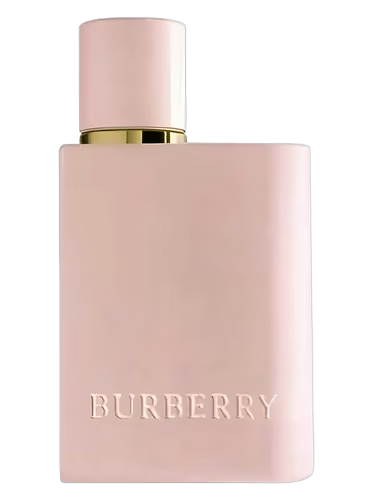
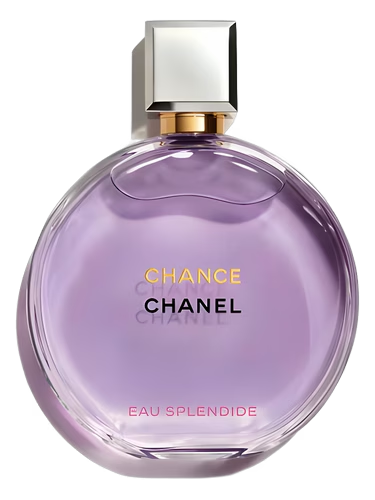
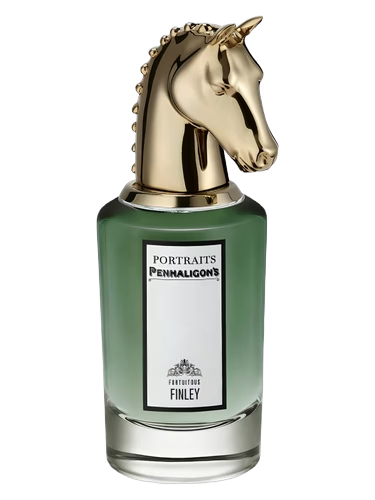
Most Popular Scents Using Costus
What is Costus?
Costus is a fragrance note derived from the roots of the Saussurea costus plant, a perennial thistle native to the high-altitude Himalayan regions of South Asia and China.What does Costus smell like?
It possesses a unique, polarizing profile often compared to wet hair, animal fur, or damp earth, featuring a slightly dirty sweetness that settles into a nutty, creamy, and skin-like warmth.Why is natural Costus oil rarely used in modern perfumery?
The use of natural costus oil has significantly declined due to IFRA regulatory restrictions regarding skin sensitization; today, the note is primarily achieved through safe synthetic recreations.What is the role of Costus in a fragrance?
Costus serves as an exceptional fixative with extreme tenacity, used to anchor heavy compositions and add a primal, animalic texture to leather, oriental, and chypre accords.What are some famous perfumes featuring the Costus note?
The note is featured in contemporary and niche fragrances such as Jean Paul Gaultier Le Male Essence de Parfum, Roja Dove Parfum Royale #1, and Acqua di Sardegna Desvélos.How is the essence of Costus extracted?
The primary method for extracting the essential oil is through the steam distillation of the plant's thick, dried roots, which vaporizes the aromatic compounds for collection.