Fragrance Notes Are Layers Of Scent That Are Layered To Form The Final Fragrance. Fragrance Notes Are Categorised Into Three Main Elements Based On How Long They Take To Evaporate, And How Long They Typically Last Following Application: Top Notes, Heart Notes And Base Notes.
Corn Silk
Corn Silk offers a delicate, subtly sweet, and slightly powdery aroma, reminiscent of fresh hay and soft grain. It imparts a creamy, mild vegetal note, evoking the clean scent of the corn field. As it develops, it reveals a hint of floral delicacy, adding a touch of unexpected complexity, bringing a sense of pastoral simplicity and nourishing beauty.

Origin & Extraction Of Corn Silk
Corn Silk, the fine, thread-like fibers found on an ear of corn, is a non-traditional note in perfumery. While corn itself has deep historical roots across the Americas, its silk was primarily known for its use in traditional medicine, particularly for its diuretic and anti-inflammatory properties, long before it was considered for fine fragrance. The concept of using corn silk in scent composition is a modern development, driven by perfumers seeking unique, subtle, and naturalistic notes that evoke pastoral simplicity, soft textures, and mild vegetal sweetness.
The incorporation of Corn Silk into perfumes is reflective of a 21st-century trend towards abstract gourmand, soft floral, and 'clean skin' fragrances. Since the actual essential oil is not commonly extracted, the note is typically created as a synthetic accord designed to capture its delicate, powdery, and hay-like nuances. It is used to provide a mild, creamy texture and a hint of unexpected complexity, often serving as a subtle bridge between soft floral or white musk accords and more traditional food or grain notes.
Extraction Methods of Corn Silk
Historically, corn silk extracts were obtained through simple traditional methods such as maceration or decoction. In folk medicine, the styles and stigmas were often harvested shortly after sprouting, cleaned of impurities, and either used fresh or air-dried under shade before being steeped in hot water to create medicinal teas and infusions. Early extraction efforts focused on manual processing, where the silk was cut into small sections and simmered to release its bioactive compounds, primarily for diuretic and anti-inflammatory purposes.
Modern commercial and laboratory extraction has evolved significantly, utilizing more sophisticated techniques to isolate specific bioactive components like flavonoids and polysaccharides. The primary contemporary method is ethanol reflux extraction, where corn silk is heated with an ethanol solution under controlled temperatures (typically 70-80°C) for several hours. This is often followed by vacuum drying and concentration using rotary evaporators to preserve the potency of the extract. Advanced "green" technologies are now frequently employed to improve efficiency and sustainability, including ultrasonic-assisted extraction (UAE), supercritical fluid extraction (SFE) using CO2, and microwave-assisted methods, which reduce solvent usage and processing time while capturing a more complex aromatic and therapeutic profile.
The Corn Silk note, valued for its subtle sweetness and powdery, hay-like aroma, is a modern and often niche addition to perfumery, utilized to evoke a sense of soft texture and pastoral simplicity. In contemporary indie fragrances, the note is sometimes explored in more direct, concept-driven ways. An example includes **Seems Legit** by Sucreabeille (2019), where the corn silk contributes to a unique, comforting, and mildly gourmand composition.
In the mainstream luxury market, Corn Silk is generally used to add textural complexity, often bridging vegetal or grain accords with soft florals and musks. **Primrose & Rye** by Jo Malone London (2018) features this note to enhance its pastoral theme, providing a delicate, slightly creamy backdrop to the primary floral and grain notes. This usage highlights how corn silk provides a clean, subtle sweetness that avoids the heaviness of traditional gourmand notes.
Other unique applications of the Corn Silk note appear across various niche and independent brands, demonstrating its versatility in creating specific olfactory textures. For instance, the note is listed in **Saltwater Taffy** by Demeter Fragrance (2013), where its powdery sweetness complements the confectionery theme. It is also found in fragrances like **After Rain** by Balint Parfums (2019) and the earlier **Hothouse Flower** by Ineke (2012), where it contributes a delicate, vegetal freshness or a soft, mild grain-like quality to the overall scent profile.
Sustainability Of Corn Silk
Sustainability of Corn Silk
- Promoting a circular economy by upcycling corn silk, which is a major agricultural byproduct often discarded as waste, into high-value ingredients for cosmetics and perfumery
- Supporting the bio-economy through the use of corn-derived solvents like propanediol, which serve as renewable, petrochemical-free alternatives to traditional glycols
- Improving farmers' economic resilience by creating a market for secondary crop materials that would otherwise have no commercial value
- Reducing environmental impact by utilizing natural extracts that are 100% biodegradable and derived from sustainable food crops like sugar cane and corn
- Advancing sustainable agriculture through research into the corn silk microbiome, which may lead to natural, bug-based crop protection strategies that reduce the need for synthetic fungicides
Trivia
The soft, wavy silk of a corn plant is actually the flower's elongated stigma, and its unique scent was historically used in traditional perfumery to capture a "pastoral" aroma that mimics the smell of a sun-drenched harvest.
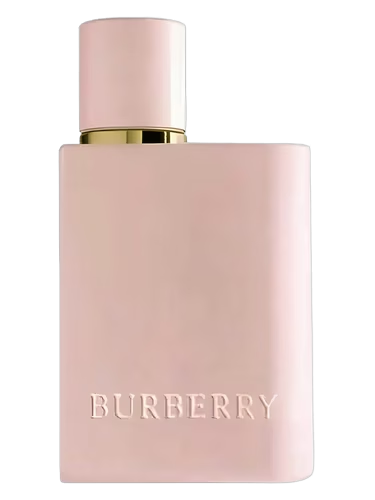
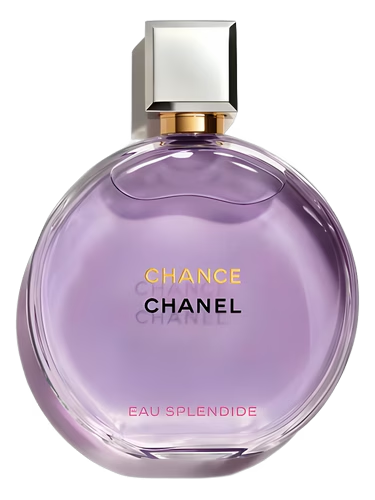
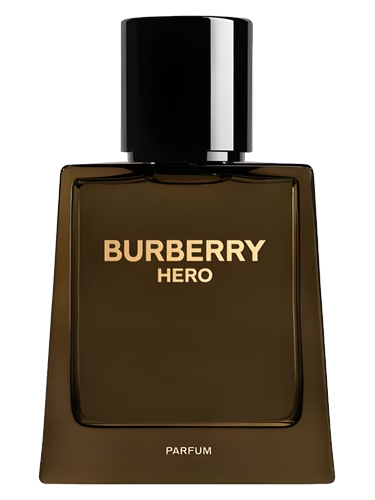
Most Popular Scents Using Corn Silk
What is Corn Silk?
Corn Silk refers to the fine, thread-like fibers found on an ear of corn, utilized in modern perfumery as a non-traditional note to evoke pastoral simplicity and soft, naturalistic textures.What does Corn Silk smell like?
It offers a delicate, subtly sweet, and slightly powdery aroma reminiscent of fresh hay and soft grain, providing a creamy, mild vegetal quality to fragrance compositions.How is the Corn Silk note produced for perfumery?
As actual essential oil is not commonly extracted, the note is typically created as a synthetic accord designed to capture its unique powdery, hay-like, and creamy nuances.What are some top perfumes featuring Corn Silk?
Notable fragrances featuring this note include Jo Malone London Primrose & Rye, Sucreabeille Seems Legit, Balint Parfums After Rain, and Ineke Hothouse Flower.When is Corn Silk in season?
The note is linked to the reproductive phase of the corn plant, primarily emerging during the silking stage in late July before drying out as the crop reaches maturity in late summer.