Fragrance Notes Are Layers Of Scent That Are Layered To Form The Final Fragrance. Fragrance Notes Are Categorised Into Three Main Elements Based On How Long They Take To Evaporate, And How Long They Typically Last Following Application: Top Notes, Heart Notes And Base Notes.
Conifer
Conifer notes are intensely fresh, resinous, and woody, characterized by a bright, invigorating, terpenic quality. They evoke the scent of a dense forest, featuring elements of pine, cedar, and cypress, with aromatic, sometimes smoky or peppery facets that add a natural, spicy lift to compositions.

Origin & Extraction Of Conifer
The history of conifer notes in perfumery stretches back to ancient times, long before modern fragrance structures emerged. Resins and woods from coniferous trees, such as pine, cedar, and cypress, were prized in various cultures—from Egyptian embalming rituals to ancient Roman and Greek temples—for their aromatic, preservative, and spiritual properties. These materials offered powerful, natural scents that were fresh, earthy, and distinctly woody. In early perfumery, the oils and extracts from these trees provided some of the most stable and long-lasting natural fixatives and aromatic compounds available, establishing them as fundamental elements in incense and medicinal applications before transitioning fully into fine fragrance.
In modern perfumery, conifer notes, characterized by their resinous and terpenic quality, gained significant traction with the emergence of the Fougère and Chypre families in the late 19th and early 20th centuries. They are essential components in compositions aiming to evoke the great outdoors, ruggedness, and freshness, particularly in men's fragrances. Today, sophisticated extraction methods and synthetic molecules allow perfumers to capture the entire spectrum of the conifer scent—from the bright, needle-like freshness of pine to the deep, smoky bitterness of cedar and the aromatic spice of cypress—ensuring this ancient note remains a vibrant and versatile cornerstone of complex, naturalistic, and fresh-woody fragrances.
Extraction Methods of Conifer
The primary and most traditional method for extracting conifer essential oils, including those from pine, spruce, and fir, is steam distillation. In this process, raw materials such as needles, twigs, or cones are placed in a still where high-temperature steam vaporizes the volatile aromatic compounds. These vapors are then cooled in a condenser, returning them to a liquid form where the oil naturally separates from the water. Hydrodistillation is also widely used, particularly in smaller-scale operations, where the plant material is boiled directly in water to release the essence.
Historically, extraction often involved simple maceration or destructive distillation. Destructive distillation, used for woods and resins of the Pinaceae family, involves heating the material in the absence of air to drive off volatile matter, which then separates into a tarry liquid and an aqueous layer. Another traditional manual method is enfleurage, where odorless fats are used to absorb fragrances from delicate plant parts, though this is less common for hardy conifers. For local or medicinal uses, simple oil infusions were created by soaking needles in carrier oils for several weeks.
Modern commercial production has introduced advanced techniques to improve efficiency and chemical purity. Solvent extraction using hexane or toluene is frequently employed to produce hyper-concentrated absolutes for the fragrance industry. One of the latest developments is Microwave-Assisted Extraction (MAE), which uses microwave energy to rapidly heat solvents, significantly reducing production cycles and increasing yields of specific terpenes. Additionally, innovative supercritical CO2 extraction is increasingly used to capture delicate aromatic molecules without the high heat of traditional distillation, preserving the complex, fresh profile of the conifer.
Conifer notes, beloved for their resinous, woody, and intensely fresh character, are pivotal in compositions that evoke the rugged natural world and provide an invigorating outdoor freshness. While many modern niche and artisanal brands embrace this note—such as Goat and Boar from Wolf Brothers, or Anubis from Redwood Alchemy—the conifer essence is also deeply embedded in classic fragrance archetypes, particularly in the Fougère and Chypre families where it contributes structure and longevity.
In modern perfumery, conifer notes frequently appear in fragrances designed for a masculine or unisex audience, providing a crisp, sophisticated edge. For instance, the use of conifer elements in scents like Biker (Karen Doué) and Monarch Homme (Camara Perfumes) highlights its versatility, blending the bright, terpenic freshness of pine or cypress with deeper wood and spice accords to create dynamic and long-lasting compositions. This allows perfumers to move beyond simple 'green' freshness into territories of aromatic complexity.
The contemporary interpretation of Conifer continues to evolve, as seen in newer releases like Kaszebsczi Mech (PerfumeCraft) and Tigerwood Antique (Jinx Smells). Whether capturing the sharp, needle-like aroma or the dark, smoky resin of cedar and cypress, the conifer note remains essential for adding natural depth, ruggedness, and an aromatic lift to any fragrance, proving its enduring appeal across various fragrance genres, from traditional classics to avant-garde niche creations.
Sustainability Of Conifer
Sustainability of Conifer
- Utilizing renewable biomass by sourcing essential oils from forestry side-streams, such as needles and branches collected from managed timber harvests
- Promoting biodiversity conservation through the protection of native coniferous forests, which serve as critical carbon sinks and habitats for diverse species
- Advancing green chemistry by developing nature-identical molecules like alpha-pinene and beta-pinene, reducing the need for over-harvesting wild resources
- Implementing low-impact extraction methods such as hydrodistillation and cellular extraction to capture aromatic compounds with minimal chemical waste
- Supporting regenerative forestry practices and local livelihoods in primary growing regions to ensure the long-term resilience of the natural ecosystem
Trivia
The balsam fir is considered one of the most fragrant of all conifer trees, a quality that has made it the most popular variety used for Christmas trees.
Most Popular Scents Using Conifer


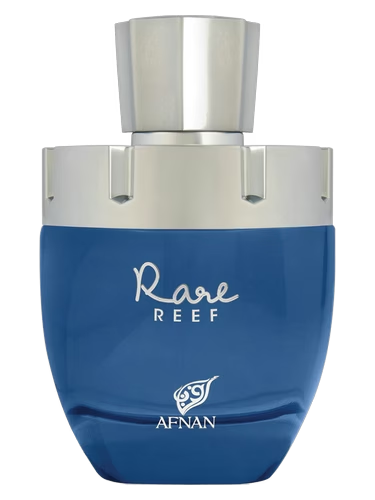
What is the Conifer fragrance note?
Conifer notes are intensely fresh, resinous, and woody scents derived from evergreen trees like pine, cedar, and cypress, often used to evoke the atmosphere of a dense forest.What does Conifer smell like?
It possesses a bright, invigorating, and terpenic quality with aromatic, sometimes smoky or peppery facets that add a natural, spicy lift to perfume compositions.How is Conifer essence extracted?
The primary method for extracting essential oils from conifer needles, twigs, and cones is steam distillation, though modern techniques like supercritical CO2 extraction are also used to preserve its fresh profile.What are some top perfumes featuring Conifer?
Iconic fragrances highlighting conifer notes include Serge Lutens Fille en Aiguilles, Profumum Roma Arso, Annick Goutal Nuit Etoilee, and Polo Original (Green).When is the Conifer note typically worn?
While quintessential year-round, conifer is most deeply associated with autumn for its crisp forest air qualities and winter for its refreshing, holiday-themed evergreen aroma.