Fragrance Notes Are Layers Of Scent That Are Layered To Form The Final Fragrance. Fragrance Notes Are Categorised Into Three Main Elements Based On How Long They Take To Evaporate, And How Long They Typically Last Following Application: Top Notes, Heart Notes And Base Notes.
Cogumelo Porcino
Cogumelo Porcino offers a deep, earthy, and intensely woody profile, evoking the damp richness of the forest floor. It features savory, fungal undertones with a subtle nuttiness and leathery facet, adding unique texture and sophistication to chypre or gourmand compositions.

Origin & Extraction Of Cogumelo Porcino
Cogumelo Porcino, known in English as Porcini mushroom, is a relatively modern and specialized note in fine perfumery. While culinary mushrooms have been appreciated for their earthy aroma for centuries, the use of a distinct "mushroom" or "porcino" accord in fragrance gained traction with the rise of complex, often abstract, naturalistic scents in niche perfumery during the late 20th and early 21st centuries. Perfumers utilize this note not merely as a simple forest scent, but to convey a sophisticated olfactory texture, adding depth, an earthy richness, and a damp, autumnal woodiness to compositions.
The relevance of Cogumelo Porcino lies in its ability to anchor fragrance accords, serving as a unique bridge between earthy-woody base notes and savory or chypre structures. Its intense, fungal-savory profile provides a naturalistic counterpoint to sweeter ingredients, lending a distinctive, sometimes leathery, facet that suggests the damp, fertile ground of a deep forest. This usage reflects a contemporary trend to introduce unconventional, photorealistic natural elements into high-end perfumery for texture and uniqueness.
Extraction Methods of Cogumelo Porcino
Historically, the aromatic compounds of Cogumelo Porcino (Boletus edulis) were captured through traditional culinary and medicinal techniques such as hot water decoction and maceration. These methods involved simmering the mushrooms for extended periods or soaking them in spirits to create flavorful broths and tinctures, effectively unlocking water-soluble and some alcohol-soluble nutrients from the fungal cell walls. Traditional sun-drying and subsequent grinding into powder also served as a fundamental preparation step, increasing the surface area for more effective extraction during cooking or infusion.
Modern extraction has evolved to utilize more precise and high-performance technologies to isolate bioactive compounds like polysaccharides and triterpenes. The current standard often involves dual extraction, which combines pressurized hot water and ethanol solvent extraction to capture a full spectrum of both water-soluble and fat-soluble molecules. Furthermore, advanced techniques such as ultrasonic-assisted extraction are employed to rapidly lyse the sturdy chitin cell walls using sound waves, while supercritical CO2 extraction and molecular distillation are used to produce highly concentrated, pharmaceutical-grade extracts that preserve the mushroom's characteristic earthy, nutty aroma without thermal degradation.
The Cogumelo Porcino (Porcini Mushroom) note, valued for its deep, earthy, and sophisticated fungal texture, is primarily utilized in niche perfumery to create photorealistic forest and autumnal scents. One prominent example is the work of independent houses seeking to push the boundaries of naturalistic accords. These fragrances use the porcino note not for sweetness, but to ground compositions in a damp, rich earthiness, often contrasting it with brighter elements like cypress or pine to evoke a forest floor experience.
- Black Afgano (Nasomatto) is often cited as featuring a profound earthy-fungal texture that shares characteristics with the Cogumelo Porcino note, lending a deep, dark, and almost narcotic quality.
- The unique, earthy core of certain fragrances from the house of Comme des Garçons, such as those in their **Scent One: Hinoki** series, occasionally employs notes that lean into the savory, damp wood territory reminiscent of porcini.
In modern high-end perfumery, the mushroom note serves as a bridge, connecting sharp, green opening notes with heavy, leathery or woody bases. While not always explicitly listed as 'Cogumelo Porcino,' its savory, umami-like depth is essential for adding complexity and a non-sweet gourmand facet. This approach differentiates these scents from traditional woody fragrances, offering a unique texture that feels dense, damp, and organic. This is particularly appealing to connoisseurs of chypre and abstract nature scents.
While the note remains specialized, its incorporation highlights a trend towards olfactory realism. For instance, the use of similar mushroom/earth accords appears in fragrances like **Moth** (Zoologist Perfumes), where the composition intentionally aims for dark, dusty, and subterranean environments. The Cogumelo Porcino note provides the necessary earthy richness to achieve this level of textural complexity, ensuring the fragrance maintains a distinctive, non-traditional depth that is both challenging and captivating to sophisticated noses.
Sustainability Of Cogumelo Porcino
Sustainability of Porcini (Cogumelo Porcino)
- Preserving natural ecosystems by relying exclusively on wild harvesting, as the symbiotic relationship with host trees makes industrial cultivation impossible
- Maintaining biodiversity through traditional foraging practices (fungaioli) that respect the forest's ecological balance and the health of host trees like oak, chestnut, and pine
- Lowering carbon footprints compared to farmed crops by avoiding the energy and water demands of artificial greenhouses and controlled environments
- Promoting a chemical-free product, as wild porcini grow naturally in forest soils without the need for synthetic pesticides or fertilizers
- Supporting local economies and traditional knowledge through seasonal, hand-picked harvests that prioritize authenticity and the rhythm of nature
Trivia
The name porcini translates to piglets in Italian, a reference to the plump, chubby appearance of the young mushrooms, which were also known as suilli or hog mushrooms by the ancient Romans.
Most Popular Scents Using Cogumelo Porcino

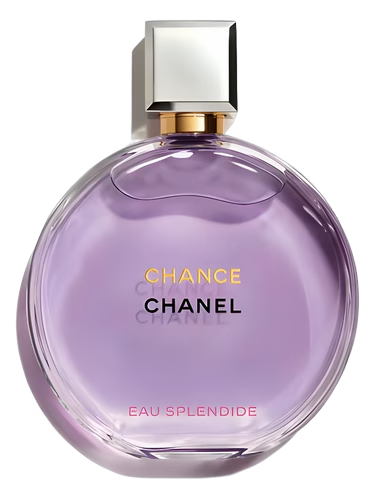

What is Cogumelo Porcino?
Cogumelo Porcino, also known as the Porcini mushroom or Boletus edulis, is a wild fungus valued in niche perfumery for its deep, earthy, and naturalistic aromatic profile.What does Cogumelo Porcino smell like?
It offers a sophisticated, savory, and intensely woody aroma with fungal undertones, evoking the scent of a damp forest floor, roasted nuts, and leathery textures.How is the Cogumelo Porcino note extracted for perfumes?
The essence is typically obtained through the solvent extraction of dried mushrooms to create an absolute, or via advanced dual extraction and molecular distillation to capture its full spectrum of earthy volatiles.What are some top perfumes featuring Cogumelo Porcino?
Notable fragrances include Zoologist Perfumes Sloth, Tom Ford Black Orchid, Montale Greyland, Andrea Maack Coven, and Serge Lutens Borneo 1834.Is Cogumelo Porcino a sustainable fragrance ingredient?
Yes, it is considered sustainable as it relies on wild foraging by hand (fungaioli), preserving natural ecosystems since the mushroom grows in symbiosis with host trees and cannot be industrially cultivated.