Fragrance Notes Are Layers Of Scent That Are Layered To Form The Final Fragrance. Fragrance Notes Are Categorised Into Three Main Elements Based On How Long They Take To Evaporate, And How Long They Typically Last Following Application: Top Notes, Heart Notes And Base Notes.
Clover
Clover offers a unique, complex floral note blending sweet honey and cocoa nuances with a refreshing green, slightly herbaceous, and metallic freshness. It presents a gentle, sweet floral character, often likened to hyacinth or orchid, with underlying hints of cooling spice and waxy refinement, lending an unexpected depth to compositions.

Origin & Extraction Of Clover
Clover, derived primarily from the red clover flower, has a history in perfumery that connects it more closely to traditional aromatic uses than to foundational classical perfumery like that of rose or jasmine. Historically, clover was more valued for its medicinal properties and its sweet, hay-like scent in the natural landscape. As a fragrance ingredient, its use remained niche for centuries, often utilized implicitly within complex "fougère" or "hay" accords to add a green, slightly sweet, and herbaceous freshness. It wasn't until the late 19th and early 20th centuries, with the rise of abstract and nature-inspired fragrances, that the clover note began to be isolated and explicitly celebrated for its unique olfactory profile.
In modern perfumery, the Clover note is prized for its complexity, as it naturally blends sweet honey and cocoa nuances with refreshing green and subtle metallic facets. Its contemporary relevance lies in niche and artisanal perfumery, where it is used to give compositions an unexpected depth, bridging fresh green top notes with sweet, powdery floral hearts. While it has not achieved the ubiquitous status of mainstream floral notes, Clover is often employed to evoke photorealistic scents of meadows, adding a pastoral, refined, and distinctly natural touch to modern fresh and abstract compositions.
Extraction Methods of Clover (Clove)
Historically, the extraction of essential oil from clover (clove) buds, leaves, and stems has relied heavily on traditional steam distillation and hydro-distillation. In these classic methods, dried plant material is either boiled in water or subjected to pressurized steam for several hours—typically around six—to vaporize the volatile compounds, such as eugenol. The resulting vapor mixture is then condensed and collected in a separator where the oil, being immiscible and less dense than water, floats to the top to be siphoned off. Maceration is another long-standing technique where ground cloves are soaked in solvents like water, ethanol, or methanol for several days to release their aromatic essence.
In modern production and laboratory settings, more efficient and advanced techniques have been implemented. The Soxhlet extraction method is frequently used to achieve a higher yield by continuously cycling warm solvents through the ground material. Supercritical CO2 extraction has emerged as a high-tech alternative, using carbon dioxide at low temperatures to capture delicate aromatic molecules without the heat degradation associated with steam. Recent innovations even include the use of unmodified household espresso machines for rapid extraction, utilizing high pressure and hot water to isolate eugenol in mere minutes. Furthermore, latest developments focus on the stability and application of the oil through technologies like encapsulation in hydrogels or cyclodextrins and the use of NMR spectroscopy to verify the purity of the final extract.
The Clover note, cherished for its unique complexity that blends sweet honey, green herbaceousness, and subtle metallic facets, is a specialized ingredient often found in fragrances designed to evoke pastoral freshness or unexpected depth. While not a classic centerpiece like Rose or Jasmine, it plays a vital supporting role in modern compositions. One notable example is **Versace Pour Femme Dylan Blue**, a fragrance that utilizes the refreshing, gentle sweetness of Clover to add a bright, natural, and slightly dewy opening that complements its fruit and floral heart, giving the scent a contemporary, airy quality.
- **Versace Pour Femme Dylan Blue** (2017) is a prominent designer fragrance utilizing the Clover note.
In niche perfumery, Clover is often embraced for its photorealistic qualities, bridging the gap between fresh top notes and sweeter, more comforting bases. For instance, **Noel au Balcon** by Etat Libre d'Orange employs the honeyed, cocoa-like nuances of Clover to enhance a warm, spicy, and resinous composition, creating an aroma reminiscent of holiday sweetness and comfort. Similarly, the unique fragrance **Sova** by Slumberhouse is known for incorporating Sweet Clover (Melilot) to add complexity, using its hay-like sweetness and subtle spice to deepen a rich, animalic, and resinous profile, demonstrating its versatility beyond simple freshness.
- **Noel au Balcon** (2007) showcases the sweeter facets of Clover.
- **Sova** (2012) features the related Sweet Clover (Melilot) note for a rich, complex aroma.
Contemporary houses like L'Occitane en Provence have also highlighted the Clover note in their fresh, nature-inspired lines. Their scents, such as **Herbae L'Eau** and **Mélilot Eau De Parfum**, often emphasize the clean, green, and slightly floral aspects of Clover (or Sweet Clover/Melilot), aiming to capture the invigorating scent of a spring meadow. These fragrances illustrate how Clover is utilized to provide an uplifting, slightly sophisticated natural lift that is clean, inviting, and highly wearable for everyday compositions.
- **Herbae L'Eau** (2020) by L'Occitane en Provence utilizes the note for a green, natural freshness.
- **Mélilot Eau De Parfum** (2025) centers around the Sweet Clover note.
Sustainability Of Clover
Sustainability of Clover
- Utilizing selective extraction techniques to minimize the environmental impact on peatland ecosystems
- Implementing peatland rehabilitation programs through rewetting and reforestation post-harvest
- Adopting regenerative farming practices, such as no-till farming and rotational grazing, to protect soil health and water resources
- Promoting a circular economy by recycling 100% of manure production into organic fertilizer or composted animal bedding
- Reducing carbon footprint through the development of low-carbon processing methods and the use of renewable energy sources
- Partnering with conservation groups and government agencies to ensure biodiversity protection and responsible land management
Trivia
According to tradition, it is estimated that there are approximately 10,000 three-leaf clovers for every one rare four-leaf clover, and by legend, each leaflet represents a different virtue: hope, faith, love, and luck.
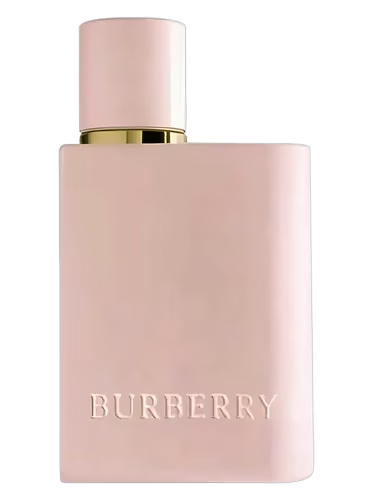
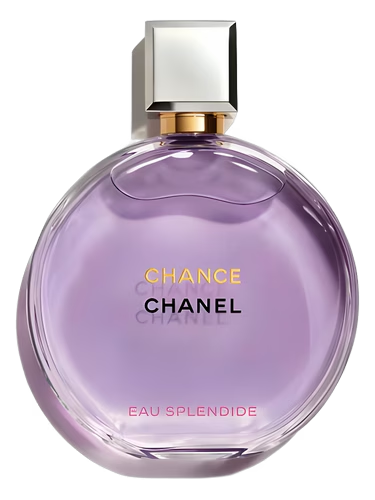
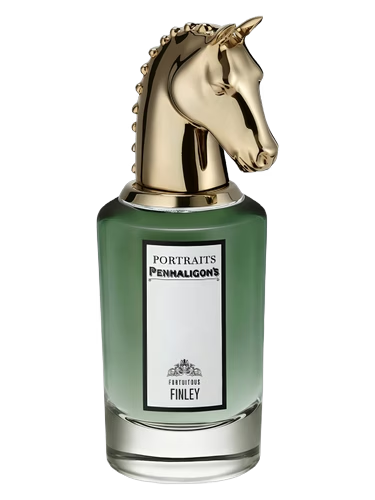
Most Popular Scents Using Clover
What is Clover?
Clover is a floral-green note derived from varieties like red clover or sweet clover, used in perfumery to evoke pastoral freshness and a honeyed, meadow-like atmosphere.What does Clover smell like?
It features a complex aroma of sweet honey and cocoa nuances blended with refreshing green, herbaceous, and slightly metallic facets for a gentle, floral-green finish.How is the Clover note produced for perfumes?
Clover can be solvent-extracted to create an absolute, though the note is often reconstructed by perfumers using ingredients like coumarin to replicate its natural hay-like warmth and floral sweetness.What are some top perfumes featuring Clover?
Prominent fragrances include Versace Pour Femme Dylan Blue, Zoologist Perfumes Rabbit, Guerlain Aqua Allegoria Herba Fresca, and L'Occitane en Provence Herbae L'Eau.When is Clover in season?
Clover typically blooms from April to December, with peak growth and aromatic intensity occurring during the cool, moist conditions of spring and early summer.