Fragrance Notes Are Layers Of Scent That Are Layered To Form The Final Fragrance. Fragrance Notes Are Categorised Into Three Main Elements Based On How Long They Take To Evaporate, And How Long They Typically Last Following Application: Top Notes, Heart Notes And Base Notes.
Clementine
Clementine offers a brighter, sweeter citrus scent compared to orange, with less sharpness than lemon or lime. It possesses juicy, slightly floral, and subtly honeyed nuances, creating a cheerful, refreshing, and uplifting opening note often used for a sparkling, light, and tender feel in various fragrance compositions.

Origin & Extraction Of Clementine
The Clementine, a hybrid of mandarin and sweet orange, does not possess the long historical legacy in perfumery associated with foundational citruses like Bergamot or Lemon, which date back to the 18th-century origin of Eau de Cologne. As a sweet, tender, and less acidic alternative to classic citrus notes, Clementine gained prominence in modern perfumery, particularly from the late 20th century onwards. Its inclusion reflects a contemporary trend toward softer, juicier, and more easily recognizable fruit aromas, moving away from the sharper, drier citrus profiles of traditional colognes.
In fragrance compositions, Clementine is highly valued for its ability to deliver an instant burst of cheerful, bright sweetness that is more complex than simple orange due to its subtle floral and honeyed undertones. It primarily functions as a sparkling top note, perfect for contemporary fresh, aquatic, and light floral fragrances designed to evoke optimism and sun-drenched vitality. Its popularity grew alongside the development of advanced extraction and synthesis techniques that better captured its delicate, ephemeral scent, making it a key element in many niche and designer fresh fragrances today.
Extraction Methods of Clementine
The primary method for extracting clementine essential oil is cold expression, a traditional process where the fresh fruit peel is mechanically pressed to rupture the oil sacs and release the essence. Historically, this was a manual labor-intensive task, but modern commercial production utilizes specialized machinery like the pelatrice, which rasps the skin under a water spray to create an emulsion that is then separated by centrifugation.
Recent technological advancements have introduced greener and more efficient alternatives, such as microwave-assisted steam distillation (MASD) and solvent extraction using ethanol. These latest methods aim to improve yield and reduce extraction time while preserving the oil's delicate aromatic profile. Additionally, modern refining often includes a winterization process, where the oil is chilled for several weeks to precipitate and remove waxes and other impurities, ensuring a high-quality, stable final product.
Clementine, due to its sweet, sparkling, and less-tart profile compared to traditional citruses, is often utilized to add a cheerful and light opening to modern fragrances. A prominent example is **Atelier Cologne's Clémentine California**, which showcases the note's bright, juicy facet alongside a heart of juniper and star anise, creating an exceptionally luminous and uplifting scent designed for year-round wear.
- The note is valued for its ability to provide an immediate sense of cheerfulness without the sharp acidity of lemon or lime.
In feminine compositions, Clementine lends a tender, slightly floral sweetness. It plays a significant role in scents like **Moschino Cheap & Chic I Love Love**, where it contributes to a vibrant, youthful cocktail of citruses blended with tea rose, lily-of-the-valley, and musk, resulting in an energetic and optimistic aroma.
- Its honeyed nuances bridge the gap between volatile top notes and the more enduring floral or heart notes.
Clementine’s versatility allows it to brighten sophisticated, deep fragrances as well. For instance, in **L’Occitane en Provence’s Verbena Clementine**, the note provides a sunny, inviting introduction that contrasts beautifully with the sharp greenness of verbena, making the overall composition fresh, clean, and tender. It is increasingly popular in niche perfumery for creating unique, sparkling top notes that are simultaneously familiar and refined.
Sustainability Of Clementine
Sustainability of Clementine
- Upcycling citrus peels, often discarded as waste, into high-value ingredients for the fragrance, cosmetic, and food industries to support a circular economy
- Implementing modern irrigation techniques, such as drip and subsurface irrigation, to significantly reduce water consumption and minimize environmental runoff
- Utilizing organic farming methods, including cover cropping and mulching, to improve soil health, prevent desertification, and reduce reliance on synthetic pesticides
- Enhancing biodiversity by adopting integrated pest management and moving away from monoculture farming to protect local aquatic and terrestrial ecosystems
- Reducing the carbon footprint of production through efficient logistics and the processing of side-streams into dietary supplements or fertilizers
Trivia
The clementine was named after Father Clément Rodier, a French missionary monk in Algeria who is credited with discovering and cultivating the hybrid fruit in the garden of his orphanage in the early 20th century.
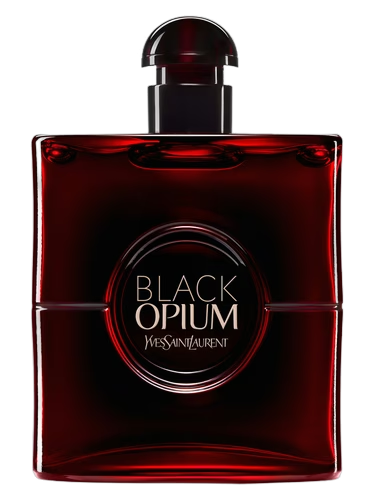
Most Popular Scents Using Clementine


What is clementine?
A clementine is a hybrid citrus fruit, specifically a cross between a mandarin orange and a sweet orange, prized for its sweet, tender, and seedless flesh.What does clementine smell like?
It offers a bright, cheerful, and honeyed citrus aroma that is sweeter and less acidic than lemon or lime, often featuring subtle floral nuances.How is clementine oil extracted?
The essential oil is primarily obtained through cold expression, where the fresh peel of the fruit is mechanically pressed to release its aromatic essence.What are some top perfumes featuring clementine?
Popular fragrances featuring this note include Atelier Cologne Clémentine California, Guerlain Aqua Allegoria Mandarine Basilic, and Moschino Cheap & Chic I Love Love.When is clementine in season?
Clementines are quintessential winter fruits, with a peak harvest season typically spanning from November through January in the Northern Hemisphere.