Fragrance Notes Are Layers Of Scent That Are Layered To Form The Final Fragrance. Fragrance Notes Are Categorised Into Three Main Elements Based On How Long They Take To Evaporate, And How Long They Typically Last Following Application: Top Notes, Heart Notes And Base Notes.
Citruses
Citruses in perfumery encompass a bright, vibrant, and refreshing palette. This category offers an array of scents, typically sharp, juicy, and effervescent. Notes range from sparkling lemon and tart lime to sweet mandarin and zesty bergamot. They are primarily used as top notes to provide an immediate burst of freshness and lift to a fragrance, creating an exhilarating and clean opening. They evoke feelings of energy, cleanliness, and sunny warmth.

Origin & Extraction Of Citruses
Citruses are arguably the most essential family of notes in perfumery, forming the historical bedrock of the classic Eau de Cologne structure. Their bright, sparkling, and volatile nature makes them perfect for the initial burst in a fragrance, providing immediate freshness and energy. This tradition dates back centuries, with classic scents like Guerlain's Eau de Cologne Impériale (1853) and Acqua di Parma Colonia relying heavily on invigorating blends of lemon, bergamot, and sweet orange to establish a clean, universally appealing signature. This foundational role secured citruses as the quintessential starting point for any fragrance aiming to convey vitality and cleanliness.
In modern perfumery, citrus notes continue to play a crucial role beyond the cologne format. They are frequently amplified using contemporary techniques to capture hyper-realistic and longer-lasting freshness, and are essential in adding contrast and buoyancy to heavier compositions. Perfumers use the variety within the category—from the sharp bitterness of grapefruit to the syrupy sweetness of mandarin—to create complex olfactory narratives. This strategic blending allows citruses to cut through the richness of Oriental and Gourmand scents, introducing a vibrant top-note sheen and ensuring their continued relevance across all fragrance genres.
Extraction Methods of Citruses
The primary method for extracting citrus essential oils is cold expression, a mechanical process that involves rasping or pressing the fruit's peel to release aromatic oils without using heat. Historically, this was done through manual techniques like the sponge method, where peels were pressed against sponges to absorb the oil, or the ecuelle à piquer, where fruit was rolled over spikes. In the early 18th century, devices like the "calabrese machine" were developed in Italy to automate this process for bergamot and other citruses.
Modern commercial extraction utilizes advanced mechanical peelers and automated systems that rasp the skin under water spray to create an emulsion, which is then separated using high-speed centrifuges. Beyond traditional cold pressing, latest innovations include microwave-assisted extraction (MAE) and ultrasound-assisted extraction (UAE), which offer higher yields and lower energy consumption. Other sophisticated techniques like supercritical fluid extraction (SFE) using CO2 and molecular distillation are also employed to create high-purity, terpene-free, or bergaptene-free oils for specialized fragrance and skin-safe applications.
As a foundational element of the fresh fragrance family, the 'Citruses' accord—a general blend of lemon, bergamot, and orange—is famously associated with the traditional Eau de Cologne structure. This genre was popularized by fragrances like **4711 Original Eau de Cologne** and the classic **Eau Sauvage** by Dior, where the bright, effervescent citrus top notes provide an immediate, invigorating rush before settling into a subtle, clean base. Citruses are critical for providing lift and ensuring a sparkling, clean opening, making them indispensable in hot weather and daytime scents.
- **4711 Original Eau de Cologne**
- **Eau Sauvage**
- **Acqua di Parma Colonia**
Modern perfumery frequently uses the overall Citruses category to denote a vibrant, complex opening that utilizes more than one fruit. A prominent example is **Light Blue Pour Homme** by Dolce & Gabbana, which features a strong blend of grapefruit, mandarin, and bergamot to create its signature Mediterranean freshness. Similarly, fragrances from the niche market, such as those from the Atelier Cologne house, are built almost entirely around magnifying the naturalistic, energetic facets of various citrus notes, achieving superior projection and longevity compared to their classic ancestors.
- **Light Blue Pour Homme**
- **Terre d'Hermès**
The versatility of citruses allows them to serve as a luminous counterpoint in heavier compositions, such as floral or oriental scents. Even perfumes known for their deep bases, like the vibrant opening of **Coco Mademoiselle** by Chanel, utilize bright mandarin and orange to provide a necessary jolt of energy and clarity. This integration shows that the 'Citruses' note is not merely reserved for simple fresh scents but is a crucial tool for adding brilliance and multifaceted complexity across all major olfactive families.
- **Coco Mademoiselle**
- **Chanel No 5** (utilizing Bergamot/Lemon)
Sustainability Of Citruses
Sustainability of Citruses
- Promoting a circular economy by repurposing post-processing waste, such as peels and pulp, into essential oils, animal feed, biofuels, and biodegradable food packaging
- Implementing Integrated Pest Management (IPM) strategies, including the use of natural predators like ladybugs and red kaolin clay, to reduce reliance on chemical pesticides
- Adopting precision agriculture technologies, such as micro-irrigation systems and soil moisture sensors, to significantly optimize water usage and nutrient delivery
- Enhancing soil health and preventing erosion through the use of cover crops and organic fertilizers derived from composted urban plant debris
- Advancing social sustainability by establishing fair trade practices and producer cooperatives to ensure ethical labor conditions and economic resilience for farmers
Trivia
The term "Hesperidic," used to classify citrus scents, refers to the Hesperides of Greek mythology, the three daughters of Atlas who guarded a garden of golden apples—believed to be lemons or oranges—that granted immortality.
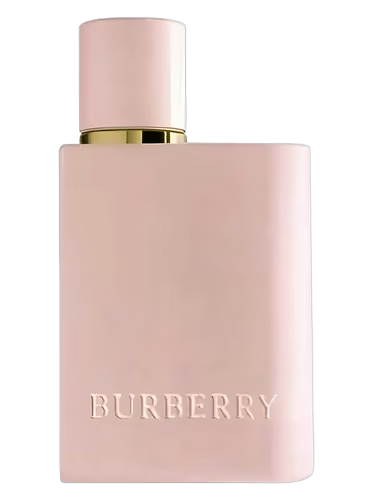
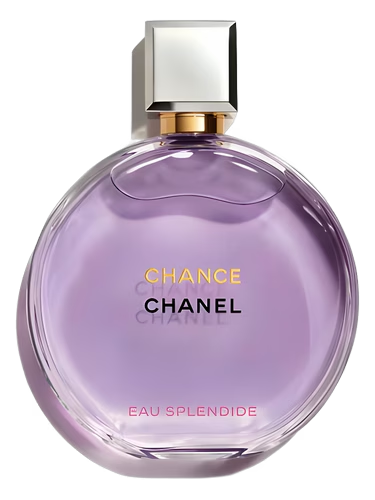
Most Popular Scents Using Citruses

What are citrus notes in perfumery?
Citruses are a family of bright, sharp, and effervescent scents like lemon, bergamot, and mandarin, typically used as top notes to provide an immediate burst of freshness and energy to a fragrance.How are citrus essential oils extracted?
The primary method is cold expression, a mechanical process where the fruit's peel is rasped or pressed to release aromatic oils without the use of heat, preserving their delicate character.What is the history of citruses in fragrances?
Citruses are the historical bedrock of the classic Eau de Cologne structure, used for centuries in foundational scents like Guerlain's Eau de Cologne Impériale and Acqua di Parma Colonia.What are some top perfumes that feature citrus notes?
Famous examples include Jo Malone Lime Basil & Mandarin, Tom Ford Neroli Portofino, Dior Eau Sauvage, and Dolce & Gabbana Light Blue.When are citrus fruits typically in season?
Most citrus varieties reach their peak flavor and oil quality during a winter and spring ripening cycle, specifically from November through April.