Fragrance Notes Are Layers Of Scent That Are Layered To Form The Final Fragrance. Fragrance Notes Are Categorised Into Three Main Elements Based On How Long They Take To Evaporate, And How Long They Typically Last Following Application: Top Notes, Heart Notes And Base Notes.
Cherry
Cherry in perfumery offers a multifaceted aroma, typically showcasing a sweet, syrupy, and slightly tart fruitiness, often with an almond-like nuance from the kernel, which lends a rich, sometimes boozy or confectionary depth. It can range from bright and juicy to dark and liqueur-like, providing a bold, often romantic and slightly gourmand accent.

Origin & Extraction Of Cherry
The use of the cherry note in perfumery was historically often relegated to a supporting fruity accent, primarily used to add a touch of tart sweetness to broader compositions. It wasn't until modern perfumery, particularly in the 21st century, that cherry ascended from a background ingredient to a celebrated, dominant star. This shift was largely fueled by a demand for more luxurious, decadent gourmand and "boozy" fragrance profiles.
The contemporary renaissance of the cherry note was notably solidified by high-profile fragrance launches that redefined its character, showcasing its versatility to transition from simple sweetness to dark, liqueur-like, almond-nuanced, and smoky profiles. Today, perfumers utilize cherry as a central theme, pairing its potent sweetness and tartness with complex bases like roasted tonka bean, vanilla, or even rich exotic woods such as oud, cementing its status as a sophisticated and dynamic element in modern fragrance narratives.
Extraction Methods of Cherry
Historically, capturing the aromatic essence of cherry was considered nearly impossible because it is a stone fruit that does not produce a natural essential oil through traditional means like cold pressing or steam distillation. While ancient civilizations utilized basic maceration in oils or fats, these methods largely failed to yield a stable fragrance that resembled the fruit itself. Consequently, early perfumers often relied on the "enfleurage" method for cherry blossoms, using odorless fats to absorb delicate floral scents over several weeks, or they used cherry kernels to extract a fixed oil that, while nutritious, lacked a strong fruity aroma.
In modern perfumery, cherry notes are primarily "reconstructions" created synthetically using aromachemicals such as benzaldehyde to evoke its characteristic sweet, almond-like scent. However, recent technological advancements have introduced high-pressure Supercritical Fluid Extraction (SFE) using CO2, which allows for the extraction of bioactive compounds and subtle aromatic molecules from cherry seeds and pulp at low temperatures without heat degradation. Additionally, latest laboratory techniques like molecular distillation and GC-MS (Gas Chromatography-Mass Spectrometry) analysis enable perfumers to precisely deconstruct the fruit's scent profile and rebuild it with high-purity synthetic and natural-identical molecules.
The Cherry note has seen a major resurgence, often associated with dark, luxurious, and gourmand fragrances. The note is exemplified by Tom Ford's Lost Cherry, which arguably pioneered the modern, high-end interpretation. This perfume showcases a rich, boozy blend of black cherry, cherry liqueur, and bitter almond, wrapped in an Oriental structure of Tonka bean, vanilla, and woods. Its immediate popularity established the cherry-almond accord as a decadent staple in contemporary niche and designer perfumery, emphasizing sophistication over simple fruitiness.
- The inherent almond nuance of the cherry pit (often smelling of benzaldehyde) is a key feature, providing the signature depth.
- The use of cherry often signals a transition from traditional fruity scents to more indulgent, dessert-like gourmands.
Other notable fragrances have interpreted the cherry note with unique twists. For example, some designers opt for a brighter, fizzier cherry, while others lean heavily into the syrupy, liqueur-like facets. Guerlain's La Petite Robe Noire offers a chic, lighter take, blending cherry with red fruits, licorice, and tea notes, resulting in a more playful, Parisian-inspired scent. Conversely, scents like Bvlgari’s Opera Collection Lazulia use cherry to complement heavier, resinous notes, giving it a deeper, more mysterious presence.
The versatility of the cherry note allows it to be paired across fragrance categories, moving beyond simple fruit baskets. It provides a sweet, slightly tart counterpoint to florals in women's scents and adds unexpected warmth and depth when combined with tobacco, leather, or dark spices in men's or unisex fragrances. Ultimately, the famed cherry note has cemented its place not just as a fruit, but as a complex aromatic accent that lends immediate recognition and romantic, bold character to modern perfumery, making fragrances like Mancera's Wild Cherry stand out with their intense, juicy profile.
Sustainability Of Cherry
Sustainability of Cherry
- Utilizing synthetic accords and nature-identical molecules to replicate the scent of cherry and cherry blossom, reducing the need for large-scale land use and water consumption required for natural extraction
- Adoption of upcycled ingredients, such as cedarwood side-streams, to provide structural depth to cherry compositions while minimizing industrial waste
- Sourcing ingredients from environmentally responsible suppliers who prioritize sustainable farming practices and biodiversity protection
- Implementing clean-label initiatives by formulating fragrances without parabens, phthalates, or BHT to reduce chemical impact on the environment
- Development of vegan and cruelty-free certifications to ensure ethical standards are maintained throughout the supply chain
- Utilizing thoughtful, eco-friendly packaging and concentrated formulations to lower the carbon footprint associated with shipping and materials
Trivia
While natural cherry extracts are rare and expensive in perfumery, the characteristic "cherry" scent is often recreated using benzaldehyde, the same organic compound that gives cherry cola, marzipan, and almond their distinctive, overlapping aromas.
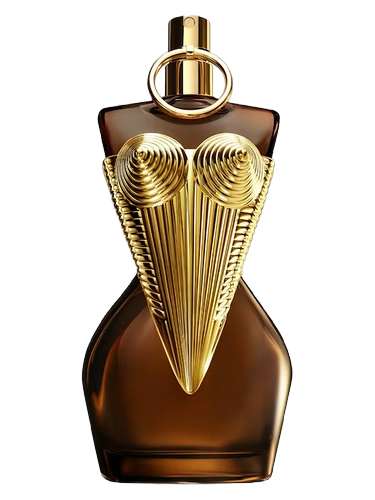
Most Popular Scents Using Cherry


What is the Cherry note in perfumery?
Cherry is a popular fruity note characterized by a sweet, syrupy, and slightly tart aroma, often featuring a distinct almond-like nuance derived from the fruit's kernel.What does Cherry smell like?
It offers a multifaceted scent profile ranging from bright and juicy to dark, boozy, and liqueur-like, frequently accompanied by a signature bitter almond or marzipan undertone.How is Cherry essence extracted?
Because natural essential oil cannot be extracted from the fruit through traditional methods, cherry notes are typically reconstructed synthetically using aromachemicals like benzaldehyde or captured via advanced CO2 extraction.What are some top perfumes featuring Cherry?
Iconic fragrances highlighting this note include Tom Ford Lost Cherry, Guerlain La Petite Robe Noire, BDK Parfums Rouge Smoking, and Kayali Lovefest Burning Cherry 48.When is Cherry in season?
In the Northern Hemisphere, cherries are harvested from late April through mid-August, with peak season in June and July, while the Southern Hemisphere harvest peaks in late December.