Fragrance Notes Are Layers Of Scent That Are Layered To Form The Final Fragrance. Fragrance Notes Are Categorised Into Three Main Elements Based On How Long They Take To Evaporate, And How Long They Typically Last Following Application: Top Notes, Heart Notes And Base Notes.
Champaca
Champaca offers a rich, intoxicating floral profile, blending creamy, sweet white flowers (like magnolia or tuberose) with lush, apricot-like fruitiness and subtle green, tea-like facets. It is deeply sensuous, warm, and slightly spicy, providing a velvety, exotic complexity to fine fragrances.

Origin & Extraction Of Champaca
Champaca, derived from the flowers of the golden michelia (Magnolia champaca), has deep roots in South Asian and Southeast Asian cultural and religious practices, where its intensely fragrant blossoms are revered for temple offerings, adornments, and traditional oil infusions. Unlike many classic European perfume notes that became foundational to Eau de Cologne in the 17th and 18th centuries, Champaca’s introduction into Western fine perfumery was a more recent development, gaining prominence as perfumers sought exotic, rich, and complex white floral profiles beyond traditional jasmine and tuberose.
In modern perfumery, Champaca is valued for its unique and luxurious profile, which blends creamy floral sweetness with a distinct apricot or peach-like fruitiness and sometimes a subtle tea facet. Its complex aroma allows it to bridge the gap between volatile top notes and tenacious bases, often serving as a heart note in exotic or oriental compositions. Its rise to fame is largely thanks to niche and high-end designer houses in the late 20th and early 21st centuries, who utilize its sensual, velvety complexity to create opulent and sophisticated floral-oriental fragrances.
Extraction Methods of Champaca
Historically, the aromatic essence of champaca flowers was captured using traditional methods such as enfleurage, where blossoms were placed on layers of fat to absorb their delicate scent, or through simple steam distillation and hydro-distillation. Ancient practices also involved macerating the flowers in carrier oils or alcohol to create fragrant infusions and tinctures used in ritual and medicinal contexts.
In modern commercial production, solvent extraction is the primary method used to produce champaca concrete and absolute, preserving the complex, heavy floral profile of the fresh blooms. Recent technological advancements have introduced supercritical CO2 extraction, which provides a cleaner, highly precise olfactive profile without solvent residue. Other contemporary techniques include ultrasonic-assisted extraction (UAE) and microwave-assisted extraction (MAE), which offer higher yields and shorter processing times while maintaining the integrity of sensitive volatile compounds.
One of the most notable fragrances to showcase the Champaca note is **Champaca** by Ormonde Jayne. This perfume places the exotic floral note at its heart, blending the creamy, apricot-like sweetness of Champaca Absolute with bright opening notes of Neroli and Pink Pepper. The composition is further refined with unique facets of Bamboo, Basmati notes (fragrant rice), and Green Tea, creating a distinguished, elegant, and intimate interpretation that highlights the flower's natural complexity.
- Champaca's sensual and rich profile makes it a star in luxurious niche and high-end designer creations, often lending a velvety texture to the heart of oriental and white floral compositions. Its natural fruity undertone, reminiscent of apricot or peach, allows it to stand apart from traditional notes like Jasmine or Tuberose, providing depth and a slightly spicy warmth.
Another popular use of the Champaca note is to reinforce rich, exotic white floral bouquets. Because of its opulent, slightly tea-like, and green facets, it excels at providing volume and an intoxicating, creamy quality. This complexity allows it to bridge sweeter components with deeper, resinous bases, ensuring the floral element remains prominent and long-lasting throughout the fragrance's development.
- The note is particularly successful in fragrances aiming for a sophisticated, South Asian-inspired aroma, reflecting the flower's cultural roots. Perfumers utilize Champaca to evoke feelings of warmth, luxury, and exotic travel, distinguishing scents from more commonplace European floral styles.
Beyond niche interpretations, Champaca occasionally appears in more widely distributed designer lines seeking a unique white floral twist. In these fragrances, it is usually blended to emphasize its creamy, sweet qualities while providing an intriguing tropical richness that helps modernize traditional floral structures. When combined with wood or amber notes, Champaca's fruitiness is subdued, allowing its inherent spiciness and velvety texture to shine through, contributing to a complex, enveloping finish.
Sustainability Of Champaca
Sustainability of Champaca
- Implementing sustainable landscaping and urban forestry practices to improve air quality, sequester carbon dioxide, and filter pollutants
- Supporting ecological balance by providing habitats and food for birds and pollinators like bees and butterflies
- Promoting afforestation and reforestation programs using champaca's deep root systems to stabilize soil and reduce surface runoff in degraded lands
- Adopting mixed-planting strategies and biological control methods, such as introducing predatory insects, to manage pests naturally and reduce chemical reliance
- Advancing conservation efforts through the establishment of seed banks and the implementation of sustainable harvesting policies to prevent overexploitation of natural populations
- Encouraging the use of organic mulching and composting to enhance soil organic carbon and maintain moisture levels without synthetic fertilizers
Trivia
Champaca is a variety of magnolia that was deemed sacred in the Indus Valley and is one of the most expensive floral materials in perfumery, featuring a unique aroma that surprisingly blends creamy floral notes with the scent of basmati rice and green tea.
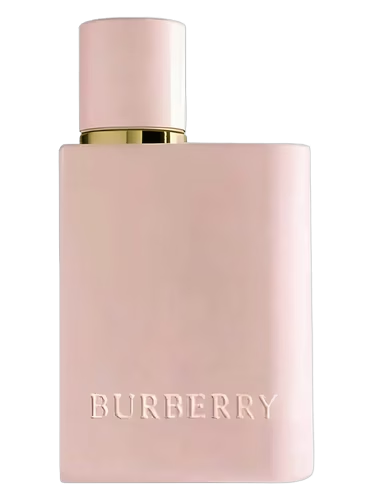
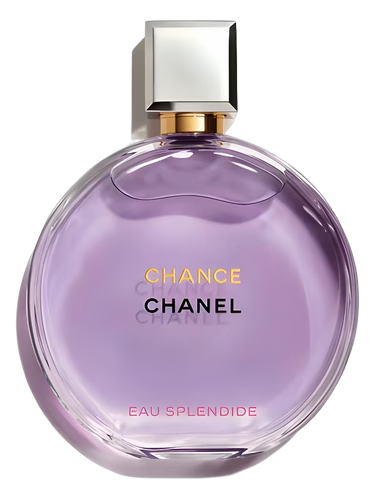
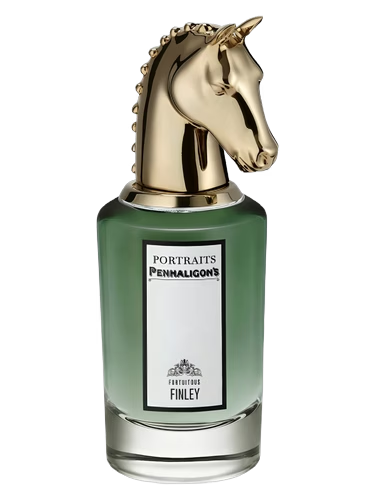
Most Popular Scents Using Champaca
What is Champaca?
Champaca is a variety of magnolia native to South and Southeast Asia, prized in perfumery for its intensely fragrant golden blossoms.What does Champaca smell like?
It offers a rich, intoxicating floral profile with creamy white flower notes, apricot-like fruitiness, and subtle green, tea-like facets.How is Champaca essence extracted?
In modern production, the essence is primarily obtained through solvent extraction to produce a concrete or absolute, preserving its complex floral character.What are some top perfumes featuring Champaca?
Notable fragrances include Ormonde Jayne Champaca, Tom Ford Champaca Absolute, and Escentric Molecules Molecule 01 + Champaca.When is Champaca in season?
In tropical climates, blooming typically begins in mid-winter and can continue through early autumn, often lasting up to six months.