Fragrance Notes Are Layers Of Scent That Are Layered To Form The Final Fragrance. Fragrance Notes Are Categorised Into Three Main Elements Based On How Long They Take To Evaporate, And How Long They Typically Last Following Application: Top Notes, Heart Notes And Base Notes.
Celosia
Perfumery, rooted in the citrus family, offers a radiant, complex, and intensely uplifting profile. It often blends the sharp zest of lemon and lime with the refined bitterness of bergamot and grapefruit, complemented by the juicy sweetness of mandarin and orange. The result is a sparkling, effervescent freshness that provides immediate energy and luminosity, often featuring green and slightly aromatic undertones.

Origin & Extraction Of Celosia
Celosia, a genus of tropical and subtropical flowering plants, is not a traditional or foundational note in classical perfumery history, which historically centered on notes like rose, jasmine, or classic citruses. Native to regions of Africa and the Americas, its use in fine fragrance is contemporary, often appearing in niche and modern compositions that seek to capture exotic, bright, and slightly spicy floral characteristics. The introduction of the Celosia note reflects a modern trend of incorporating unique, highly visual botanicals whose aroma is interpreted synthetically or through modern extraction techniques to convey a distinctive and sophisticated tropical floralcy.
Because Celosia does not yield a natural essential oil that is widely available or historically utilized, its note in perfumery is typically an accord designed to evoke the flower's unique appearance and subtle, warm fragrance. It provides perfumers with a tool to add a sense of vivid color, a hint of spice, and bright vivacity, often supporting solar, tropical, or exotic floral bouquets. Its recent popularity is linked to the increasing demand for fragrances that offer complexity and an escape from traditional scent profiles, positioning it as an innovative element in the modern floral category.
Extraction Methods of Celosia
Historically, the extraction of active compounds from Celosia, particularly Celosia cristata (Cockscomb), relied on traditional methods such as simple maceration and solvent extraction. These processes involved soaking dried flower or seed material in solvents like alcohol (ethanol) or water for extended periods to capture flavonoids and betalin pigments. For medicinal and decorative purposes, the plant material was often air-dried or shade-dried before being processed to maintain the integrity of its bioactive constituents.
Modern extraction techniques have evolved to improve efficiency, yield, and antioxidant activity. Advanced methods such as Sonication-Assisted Extraction (SAE) or ultrasound-assisted extraction are now widely used to break down cell membranes, significantly reducing extraction time and solvent consumption. Current research also utilizes Response Surface Methodology (RSM) to optimize parameters like sonication time, particle size, and ethanol concentration. Other contemporary approaches include the use of orbital shaking apparatus at controlled temperatures and supercritical CO2 extraction to capture delicate aromatic and water-soluble phyto-compounds with high purity.
The Celosia note, interpreted as a bright, slightly spicy tropical floral accord, is utilized by modern houses looking to introduce vivid, unique floralcy. One example where this note makes an appearance is in **Katy Perry Killer Queen Oh So Sheer**. This fragrance uses the Celosia note to reinforce a sense of lighthearted, effervescent femininity, often pairing it with fruit notes to create a cheerful and playful composition, highlighting the flower's visual vibrancy in scent form.
- Other influential houses, such as **Tom Ford**, **Dior**, and **Yves Saint Laurent**, occasionally explore notes that convey the bright, exotic characteristics often associated with Celosia.
- While the note itself might be niche, these large design houses incorporate unique floral accords—similar to Celosia’s profile—in modern releases to stay current with the demand for exotic and highly textured floral compositions.
The contemporary and often synthetic nature of the Celosia note means it is highly versatile, lending itself well to various fragrance families beyond traditional florals. For instance, niche perfumers, including brands like **Lattafa Perfumes**, may incorporate Celosia to enhance oriental or gourmand compositions by adding a layer of dry, warm spice and color to richer bases. This usage showcases how the modern interpretation of unique botanical scents provides depth and an unconventional twist to established fragrance structures.
Sustainability Of Celosia
Sustainability of Celosia
- Utilizing extensive root systems for natural erosion control and soil stabilization in gardens and landscapes
- Supporting local biodiversity by attracting and providing food for bees, butterflies, and other essential pollinators
- Implementing water-efficient cultivation through drought-tolerant characteristics and the use of targeted drip irrigation
- Reducing chemical dependency by utilizing organic fertilizers and compost-enriched soil to maintain plant health and soil structure
- Promoting sustainable manufacturing by using celosia-derived betalains as non-toxic, natural pigments for food, textiles, and cosmetics
- Adopting waste-reduction practices through the use of fully compostable design materials like jute rope for floral arrangements
Trivia
The name Celosia comes from the Ancient Greek word for "burning," and while it is prized as a vibrant ornamental flower, it is also a highly nutritious "Lagos spinach" that is one of the most important leafy green vegetables in Nigeria.
Most Popular Scents Using Celosia
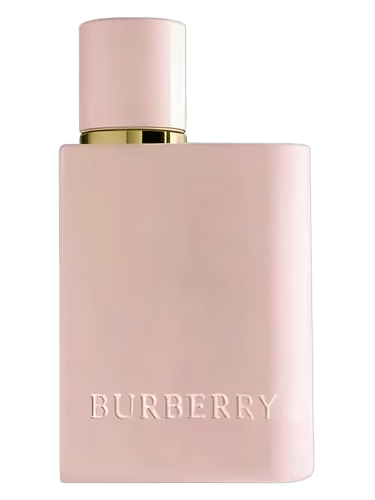
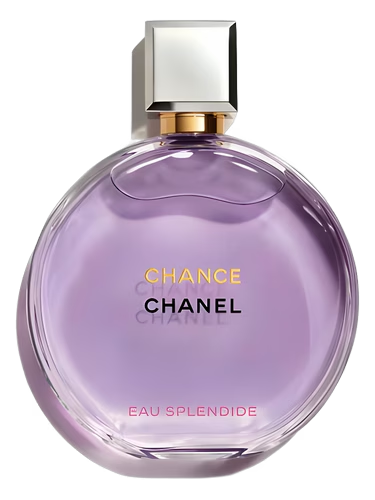
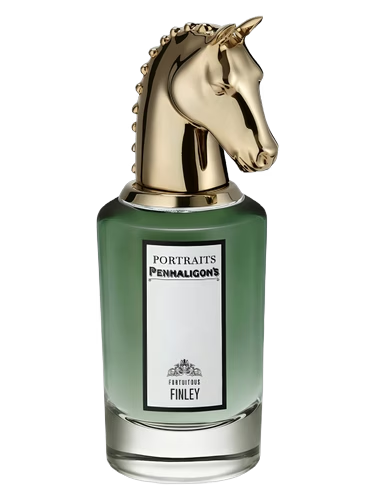
What is Celosia?
Celosia is a genus of tropical flowering plants in the amaranth family, used in modern perfumery as a contemporary accord to evoke exotic, bright, and slightly spicy floral characteristics.What does Celosia smell like?
The note is interpreted as a radiant and uplifting scent, often featuring a blend of tropical floralcy with warm, dry spice and a hint of solar vivacity.How is Celosia used in perfumes?
Because it does not yield a traditional essential oil, perfumers create Celosia accords to add a sense of vivid color and an unconventional twist to floral, oriental, or gourmand compositions.What are some top perfumes featuring Celosia?
Notable fragrances that incorporate this note include Katy Perry Killer Queen, Katy Perry Killer Queen Oh So Sheer, and Yanbal Celos.How is the essence of Celosia extracted?
Modern extraction involves techniques like solvent extraction and supercritical CO2 extraction to capture its delicate aromatic and bioactive phyto-compounds.