Fragrance Notes Are Layers Of Scent That Are Layered To Form The Final Fragrance. Fragrance Notes Are Categorised Into Three Main Elements Based On How Long They Take To Evaporate, And How Long They Typically Last Following Application: Top Notes, Heart Notes And Base Notes.
Cauliflower
Cauliflower in perfumery can present a surprising profile, ranging from vegetable, faint warm, oily, and caramel nuances, often linked to tetrahydrofurfuryl alcohol, to a more complex chemical, winey, fruity, fatty, and terpenic odor. It also has spicy, mustard seed, and tangy facets, with some detecting roasted tones reminiscent of grilled popcorn.

Origin & Extraction Of Cauliflower
The history of Cauliflower in perfumery is brief and situated almost entirely within the realm of modern, avant-garde, and niche fragrance houses. Unlike classic citrus or floral notes, Cauliflower is not rooted in traditional perfumery materials. Its profile—which can include chemical, winey, fatty, and roasted undertones—is generally achieved through clever synthesis or abstract interpretation, often linking to specific molecules like tetrahydrofurfuryl alcohol, which give it unexpected warm and oily nuances.
This note's relevance lies in its use for shock value and abstract texture. Instead of trying to smell like the vegetable itself, perfumers leverage its unusual facets (like a savory, smoky 'grilled popcorn' aspect or a sharp, herbaceous dryness) to create contrast against more traditional sweet or warm components. Its presence is intended to deconstruct traditional expectations, giving a sophisticated, slightly 'dirty' or earthy foundation to conceptual scents, such as those released by experimental brands like Comme des Garçons or Etat Libre d'Orange.
Extraction Methods of Cauliflower
Historically, the extraction of aromatic and bioactive compounds from cauliflower was achieved through traditional manual methods and simple drying processes. Sun-drying and air-drying at ambient temperatures were common pre-treatment steps used to preserve the plant material before subjecting it to basic maceration or infusion in water and oils. These early techniques were valued for their simplicity, though they often resulted in lower yields of delicate antioxidants and volatile constituents compared to modern standards.
Recent advancements have introduced more sophisticated and efficient extraction technologies. Modern commercial production frequently utilizes enzyme-assisted extraction (EAE), a green technology that employs polysaccharide-degrading enzymes like cellulases and pectinases to break down plant cell walls under mild conditions. This process, often followed by alkaline extraction and isoelectric precipitation, significantly improves the yield of high-quality proteins and phenolic compounds. Additionally, ultrasound-assisted extraction (UAE) and the use of optimized aqueous solvent systems, such as 80% methanol or ethanol, are now standard for maximizing the recovery of antioxidants from oven-dried cauliflower material.
The use of Cauliflower in perfumery is highly unconventional and characteristic of avant-garde and niche houses seeking unexpected textures and abstract concepts. This savory, slightly sulfurous, and unexpectedly creamy note is generally employed not as a central theme, but as a subtle, abstract facet to provide contrast or an earthy, mineralic depth to an otherwise familiar composition. A fragrance that has utilized such an unexpected vegetable note is **Comme des Garçons Series 5: Sherbet - Rhubarb**, where, though not strictly Cauliflower, the inclusion of savory and green notes pushes the boundaries of traditional fruit accords.
Due to its highly polarizing nature, Cauliflower is rarely the declared primary note in mainstream perfumery. However, conceptual brands often hide these notes within broader accords. For example, some critics have detected a peculiar, roasted vegetable undertone in certain compositions like **Etra Etro Etrog**, which might stem from complex synthetic molecules designed to replicate abstract green or fatty textures, providing a subtle, almost gourmand savoriness that is far from conventional sweetness. This adds a level of intrigue and challenge to the scent profile.
In modern niche perfumery, the appeal of Cauliflower lies in its ability to introduce a unique, earthy, and mineralic quality, often compared to the scent of damp soil or even grilled vegetables. When utilized correctly, it provides an abstract, slightly bitter-fatty texture. While there are no widely famous commercial perfumes where Cauliflower takes center stage, it is known to be employed in experimental, limited-edition releases by houses like **Demeter Fragrance Library** (known for single-note conceptual scents), or abstract compositions by **A Lab on Fire**, where ingredients are used less for literal representation and more for their unique chemical impact on the overall feel of the perfume.
- While cauliflower is available year-round in grocery stores, it reaches its peak season from late fall to early spring, specifically between October and January
- The primary harvest typically occurs during the autumn months of September through November, which is considered the best time to find crops with the smallest ecological footprint
- Spring harvests are also common, often resulting from winter-overgrown varieties that are sowed in May and harvested between March and May
- In moderate climates like the UK, consistent production is possible throughout the year, although the vegetable is sensitive to frost and extreme summer heat, often requiring greenhouse cultivation during the coldest winter months
Sustainability Of Cauliflower
Sustainability of Cauliflower
- Utilizing SymTrap technology to upcycle sidestreams from the food industry, transforming cauliflower waste into high-value aromatic ingredients
- Maintaining a low environmental footprint due to the crop's high land-use efficiency and relatively low water requirements compared to other vegetables
- Reducing chemical runoff through naturally low agrochemical and pesticide requirements during the cultivation process
- Lowering carbon emissions by sourcing from local agricultural regions, which significantly minimizes food miles and transportation impact
- Supporting a circular economy by repurposing "non-grade" produce that would otherwise be discarded due to aesthetic imperfections
Trivia
Although cauliflower is not a traditional perfumery ingredient, its unique aroma comes in various colors, including purple, orange, and green, each offering a distinct flavor and aesthetic appeal.
Most Popular Scents Using Cauliflower


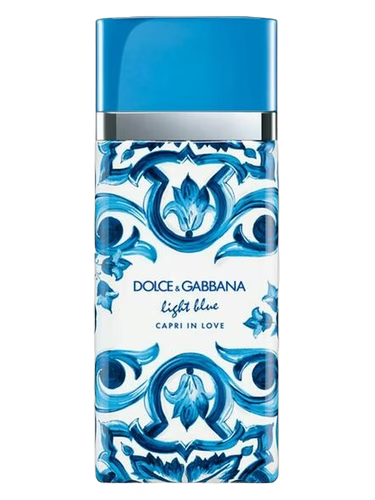
What is Cauliflower in perfumery?
Cauliflower is an unconventional, avant-garde fragrance note used primarily in niche perfumery to provide abstract textures and savory, earthy, or mineralic depth.What does Cauliflower smell like?
It offers a complex profile ranging from vegetable and oily nuances to chemical, winey, and fatty tones, with some detecting roasted facets similar to grilled popcorn.How is Cauliflower essence extracted?
In modern fragrance production, it is typically achieved through enzyme-assisted extraction (EAE) or synthetic reconstruction to capture its unique chemical impact.What are some top perfumes featuring Cauliflower?
A notable example is L'Artisan Parfumeur Tonka Blanc, while other conceptual uses are found in experimental houses like Comme des Garçons and Demeter.When is Cauliflower in season?
While available year-round, it reaches its peak from late fall to early spring, with the primary harvest typically occurring between September and January.